Category: News

  • Housing Market Inventory 2026: A Real Estate Marketing Wake-Up Call


    Housing Market Inventory 2026: A Real Estate Marketing Wake-Up Call

    Housing Market Inventory 2026: A Real Estate Marketing Wake-Up Call

    Arizona Balloon Company (arizonaballoon.com) — June 15, 2026

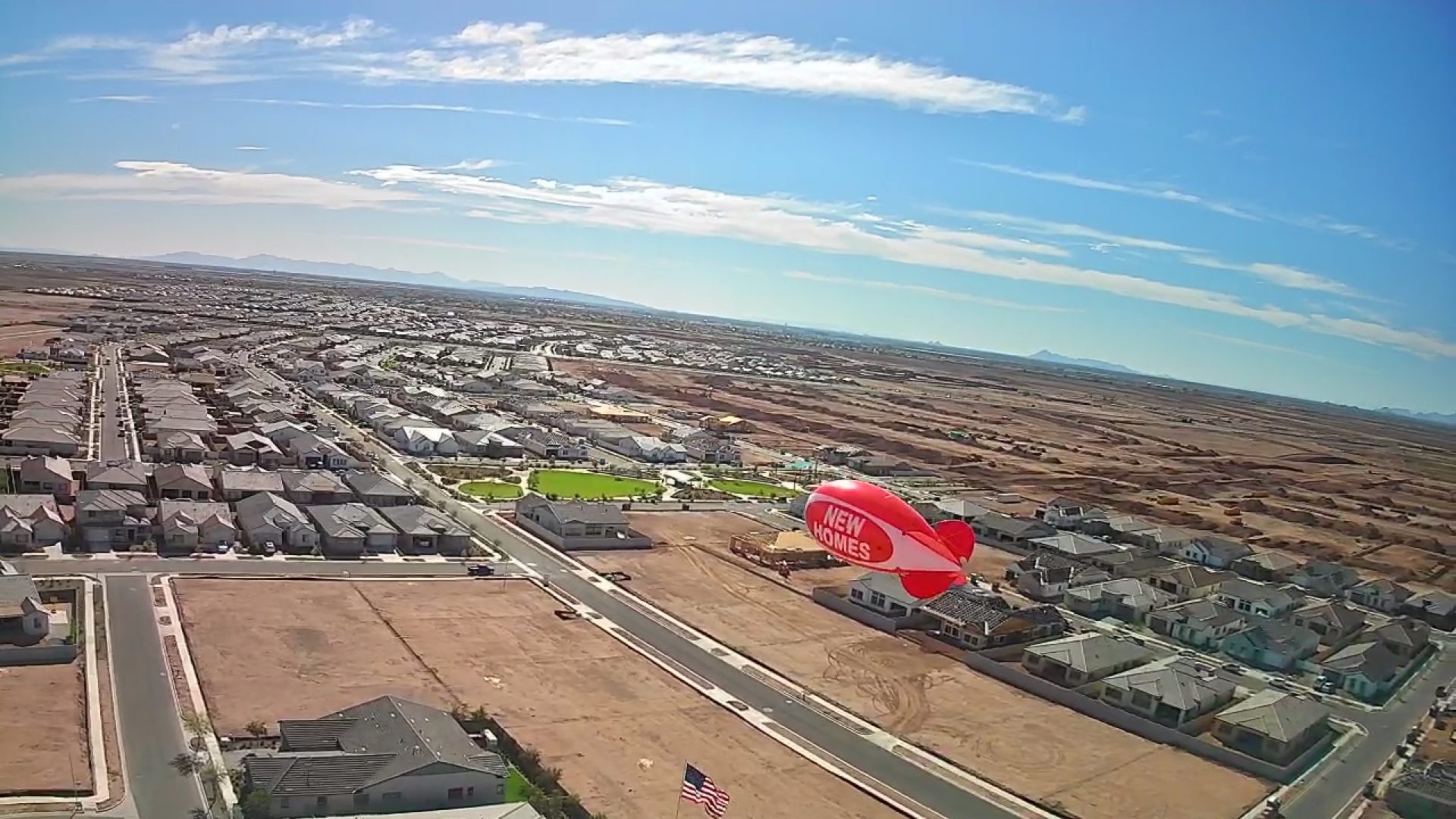
    housing market inventory 2026 showing new homes and for sale signs across American neighborhoods

    The June 2026 Housing Market Snapshot

    The housing market inventory 2026 data tells a story of gradual rebalancing — more supply, softening prices, and a modest uptick in transactions — even as economic headwinds like elevated inflation and uncertain consumer confidence keep the market from fully accelerating. According to the National Association of REALTORS® (NAR), existing home sales rose 3.2% in May 2026, reaching an annualized pace of 4.17 million units, the strongest monthly reading in five months. The median sales price stood at $429,300, with homes averaging just 29 days on market before going under contract.

    At the same time, Churchill Mortgage’s June 2026 market update confirms that listing prices have fallen 2.4% year-over-year — the seventh consecutive monthly decline and the sharpest drop since 2017. For home builders and real estate professionals, this combination of rising sales volume and softening prices creates both opportunity and urgency: buyers are moving, but they have more choices and more leverage than at any point in recent years.

    Inflation remains a complicating factor. The Consumer Price Index climbed 4.2% year-over-year through May, driven largely by a 3.9% spike in energy costs. Mortgage rates remain elevated as a result, and the Federal Reserve is weighing another potential rate hike. Despite this, mortgage application volume surged 10.8% week-over-week in early June — the largest single-week gain since February — signaling that buyers are actively watching for windows of opportunity.

    Supply-side dynamics are the most important story in the housing market inventory 2026 landscape. Active listings rose 1.8% nationally in May, while new listings climbed 2.1%, providing incremental relief after years of historically tight supply. Total inventory reached approximately 4.5 months of supply — an improvement from the sub-three-month levels seen during the pandemic surge, but still short of the six-month benchmark economists associate with a balanced market.

    One underreported factor constraining inventory is the aging capital gains tax exemption. Research cited in the June 2026 Churchill Mortgage update suggests that an outdated 1997 tax cap may be discouraging as many as 13.1 million homeowners from listing their properties. With median home values now near $419,000 compared to $129,000 in 1997, many long-time owners face potential tax bills that make selling feel financially punitive. If Congress does not update this threshold, inventory growth may continue at a sluggish pace even as buyer demand rebuilds.

    Also notable: homeowners withdrew $47 billion in home equity during Q1 2026, the highest first-quarter figure in four years. This suggests that many existing owners are tapping their equity rather than selling — another dynamic reducing the volume of resale inventory hitting the open market. For new home builders, this environment is a genuine opening: when resale supply is constrained, buyers turn to new construction.

    housing market inventory 2026 showing new homes and for sale signs across American neighborhoods

    First-Time Buyers Are Back — and Reshaping Demand

    One of the most significant data points in the NAR May 2026 existing-home sales report is the surge in first-time buyer participation. First-time buyers accounted for 35% of all May purchases, the highest share since June 2020. This demographic shift carries meaningful implications for home builders and real estate marketers. First-time buyers are typically more price-sensitive, more heavily influenced by financing conditions, and more likely to be drawn to new subdivisions where they can negotiate incentives and customize finishes.

    The same NAR report notes that 82% of buyers continued to favor locations outside city centers — a trend that has persisted since the pandemic and continues to support demand in suburban and exurban markets where many production builders operate. Inspection contingency waivers dropped to 17% from 25% a year ago, reflecting a buyer pool that is more cautious and less competitive than in prior years. This means sellers — including new home builders — need to work harder to attract and convert prospective buyers.

    With nearly 47% more home sellers than buyers in the market as of May 2026, standing out in a more crowded field requires deliberate marketing investment. Digital campaigns, signage, and community-level visibility all play a role. For builders operating in competitive subdivisions, the challenge is not just reaching buyers online but capturing their attention during physical site visits and weekend drive-throughs — the moments when purchase decisions are often made or reinforced.

    Regional Highlights: Where the Action Is

    While national figures tell a broad story, regional conditions vary considerably. Florida markets — including Jacksonville, Orlando, Tampa, and Port St. Lucie — are seeing measurable affordability improvements as rising resale inventory, pandemic-era seller re-listings, and heavy new construction combine to ease price pressure. These markets are shifting back toward local buyers after years of being dominated by out-of-state investors and relocating households.

    North Carolina faces a projected housing shortage of 764,000 units over the next four years and is pushing statewide affordability legislation including a proposed property tax cap. This supply gap represents a significant pipeline opportunity for regional builders. Meanwhile, markets like Nashville, Miami, and Austin — once pandemic-era hotspots — are experiencing more balanced conditions, with sellers finding less leverage than they had in 2021 and 2022.

    For real estate professionals operating across multiple markets, the June 2026 data reinforces a core truth: no two submarkets behave identically. Builders and brokers who can respond quickly to local shifts — adjusting pricing, incentives, and on-site marketing — will outperform those relying solely on national trends.

    Why Visibility Matters More Than Ever for Real Estate Marketers

    In a market where sellers outnumber buyers by nearly two-to-one and listing prices are declining for the seventh straight month, differentiation is everything. Home builders and real estate professionals who rely exclusively on digital marketing — online listings, paid search, email campaigns — are competing for attention in an increasingly crowded and expensive digital environment. Physical, location-based marketing offers a high-visibility complement that digital channels cannot replicate.

    This is where giant helium advertising balloons have proven their value across decades of new-home marketing. A large helium balloon anchored above a model home entrance, a grand opening event, or a community release weekend creates a visual landmark that draws traffic from arterial roads, highways, and surrounding neighborhoods. In markets where competing subdivisions may be within a few miles of each other, aerial visibility can be the deciding factor in which development a weekend buyer visits first.

    The same principle applies to cold-air advertising blimps and custom-shaped promotional inflatables. These assets are deployable on short notice, reusable across multiple events, and immediately attention-grabbing at the property level. For home builders navigating a more competitive, buyer-favoring market in 2026, outdoor marketing investments that generate foot traffic to model homes remain among the highest-ROI tools available.

    What This Means for Your Marketing

    The June 2026 housing market data sends a clear message to home builders and real estate marketers: the window for easy sales has narrowed. With nearly half again as many sellers as buyers in the market, and listing prices in their seventh straight month of year-over-year decline, competing on price alone is a race to the bottom. The builders and brokers who win in this environment will be those who invest in top-of-funnel awareness, generate consistent weekend traffic to model homes and sales centers, and create memorable brand impressions at the property level.

    Outdoor and location-based marketing is experiencing renewed relevance precisely because digital channels are saturated. Buyers who are seriously shopping often make drive-through visits to subdivisions before scheduling formal tours. A visually striking helium advertising balloon visible from a quarter-mile away can be the difference between a buyer turning into your community or continuing down the road. Arizona Balloon Company has supplied home builders across the Southwest with high-visibility aerial marketing assets for grand openings, weekend sales events, and ongoing community branding campaigns.

    As inventory grows and competition intensifies through summer 2026, smart real estate marketers will diversify their channel mix. Pairing digital lead generation with physical, on-site visibility tools creates a two-stage funnel: digital drives awareness and inquiry, while location-based assets drive visits and urgency. Whether you are launching a new phase of a master-planned community or trying to move standing inventory before fall, outdoor marketing investment is one of the most cost-effective tools available in the current market environment.

    Sources

  • Grand Opening Advertising Balloons Fuel the 2026 Retail Boom


    Grand Opening Advertising Balloons Fuel the 2026 Retail Boom

    Grand Opening Advertising Balloons Fuel the 2026 Retail Boom

    By Arizona Balloon Company (arizonaballoon.com) — June 13, 2026

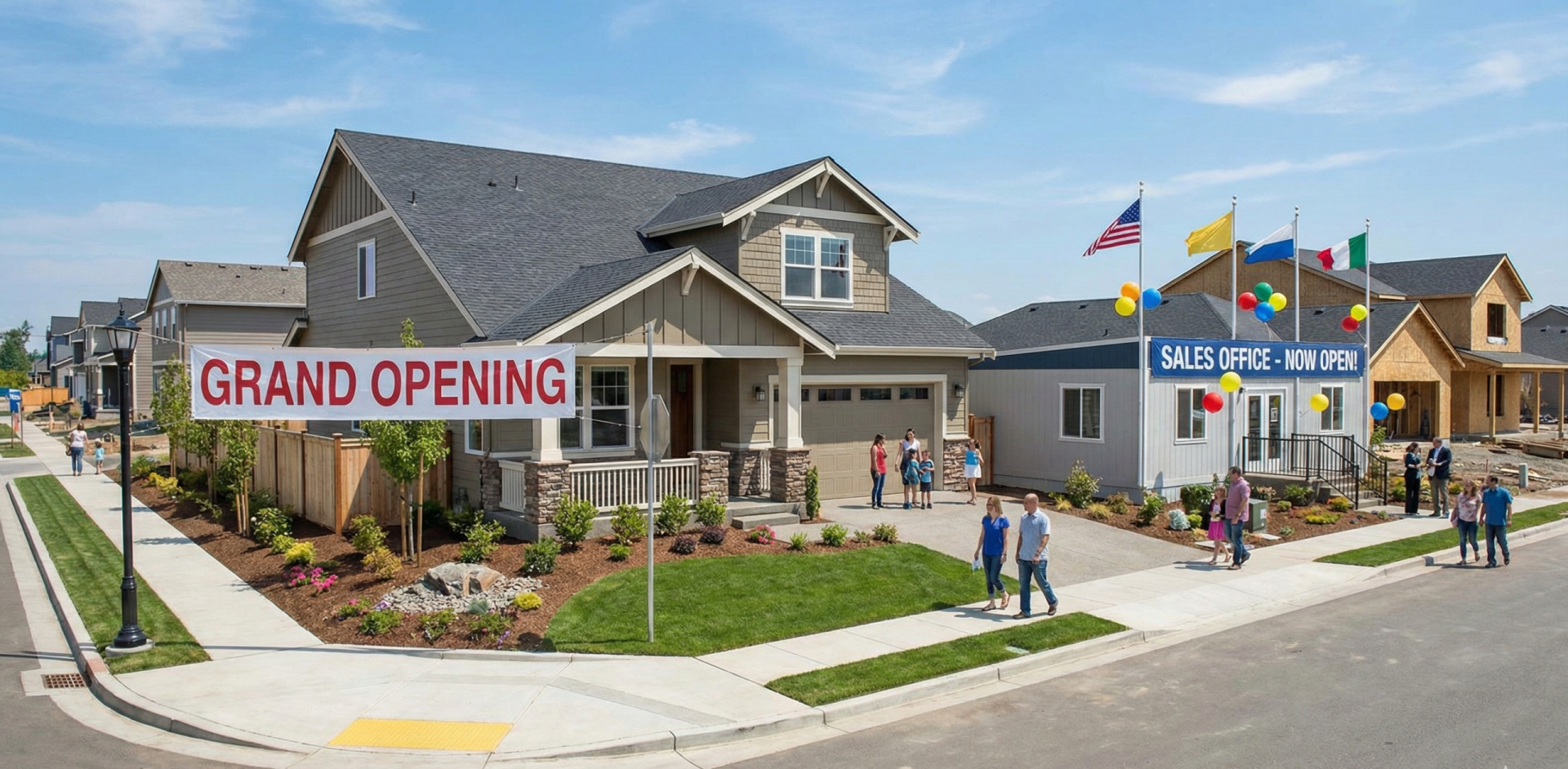
    grand opening advertising balloons at a retail store launch event

    U.S. Retail Expansion in 2026: The Numbers Behind the Boom

    Grand opening advertising balloons have become a critical tool in one of the busiest retail expansion years in recent memory. According to industry reports, U.S. retailers are on track to open approximately 5,500 new locations in 2026, driven by aggressive growth strategies from national chains, specialty retailers, and regional franchises alike. Brands across footwear, grocery, wholesale, and home goods sectors have publicly committed to multi-location rollouts, with names like Barnes & Noble, Nordstrom Rack, Costco, BJ’s Wholesale Club, and Academy Sports & Outdoors all announcing significant store counts for the year.

    This level of physical retail expansion has not been seen at scale for several years. After a period marked by closures and consolidation, the momentum has shifted decisively toward brick-and-mortar growth. For marketing managers and business owners, that means the competitive pressure to stand out at a grand opening has never been higher. When thousands of new stores are launching simultaneously across the country, simply opening the doors is not enough — businesses need tools that cut through the noise at street level.

    Retailers entering new markets are discovering that local awareness, not digital impressions, drives foot traffic on opening day. The most effective strategies combine pre-opening buzz with a high-impact physical presence on launch day and continued roadside visibility in the weeks that follow. Outdoor marketing solutions that work at the location itself have taken on renewed importance in this environment, and helium advertising balloons and custom marketing blimps are among the most cost-effective ways to own the visual space around a new retail location.

    The Outdoor Visibility Challenge for New Store Openings

    Opening a store in 2026 means entering a landscape where digital ads are saturating consumer attention. Marketing experts note that while digital targeting can reach people on their phones, outdoor advertising is what physically pulls them off the road and through the front door. New locations face a specific challenge: even customers who might want to visit do not yet know exactly where the store is, what it looks like, or when it opened. Local brand recognition must be built fast, often within the first two to four weeks of operation.

    Research consistently shows that a high percentage of consumer purchases — particularly for automotive, home goods, and food and beverage — are influenced by roadside exposure. A business that is invisible from the street relies entirely on other channels to generate traffic, which drives up customer acquisition costs. Grand opening marketing professionals increasingly recommend a three-phase approach: pre-opening awareness using teaser campaigns in the surrounding area, a high-impact opening day presence with maximum visual footprint, and sustained post-opening visibility to convert passing traffic into repeat customers.

    The challenge compounds for businesses opening in strip centers, mixed-use developments, or areas with heavy signage competition. In those environments, standard static signage can disappear into the visual landscape. Elevated, motion-attracting, and oversized displays give new locations a presence that registers at speed — from a car traveling 40 miles per hour, a large inflatable visible above rooftop lines is often the first clear signal that something new and worth investigating has arrived.

    grand opening advertising balloons at a retail store launch event

    Promotional Inflatables Market Is Growing to Meet Demand

    The broader promotional inflatables industry is expanding alongside the retail boom, reflecting rising demand for branded outdoor advertising tools. The global promotional inflatables market was valued at approximately $1.2 billion in 2026 and is projected to grow to nearly $1.87 billion by 2035, a compound annual growth rate of roughly 5.7 percent. In the United States, which accounts for more than a quarter of global market share, the adoption of promotional inflatables is being driven by demand across retail, automotive, healthcare, trade shows, and entertainment verticals.

    Market analysts point to several factors accelerating this growth. Lightweight materials and customizable designs have made inflatables more cost-effective to produce and redeploy. Reusable construction extends the return on investment across multiple campaigns and locations. The rise of experiential marketing — where consumers increasingly expect tangible, memorable brand interactions rather than digital-only messaging — has made large-format physical displays more valuable at exactly the moment when brands are opening new physical spaces.

    Manufacturers are also investing in more durable materials and longer-lasting helium retention. Premium polyurethane construction, used in domestically manufactured products, can require as little as one-sixth the helium of standard imported alternatives, reducing ongoing operating costs and extending the usable life of the inflatable across repeated deployments. These material improvements are making advertising inflatables a more attractive line item in grand opening marketing budgets that are already stretched across multiple channels.

    How Grand Opening Advertising Balloons and Blimps Deliver Results

    Advertising balloons and marketing blimps operate on a simple principle: size and elevation create attention at a distance. A helium blimp flying 50 to 150 feet above a business location is visible from multiple blocks in every direction, functioning as a passive, continuous advertisement for as long as it is airborne. Unlike a digital ad that disappears when the campaign budget runs out, a properly tethered blimp works around the clock without recurring media costs.

    For grand openings specifically, the visual signal of a large inflatable communicates to passing drivers and pedestrians that something notable is happening at that location today. It bridges the gap between consumers who have seen pre-opening advertising and those who are encountering the business for the first time from the road. Promotional blimps can be customized with full-color branding, logos, phone numbers, and messaging, delivering the equivalent of a large-format outdoor billboard at a fraction of the cost and with the added benefit of motion and altitude.

    Retail operators report that combining a grand opening advertising balloon campaign with social media documentation — photographing the inflatable display and sharing it across local channels — multiplies the visibility effect by giving the physical outdoor presence a digital reach. A large, striking inflatable is inherently photogenic and shareable, turning a single physical deployment into organic content across Instagram, Facebook, and local community groups. Custom advertising blimps from Arizona Balloon Company are designed with this multi-channel strategy in mind, offering bold graphic real estate that photographs well from both street level and aerial perspectives.

    Which Industries Are Leaning Into Aerial Marketing in 2026

    The 2026 retail expansion is concentrated in several sectors that are already among the strongest users of promotional inflatables. Auto dealerships have long relied on helium balloons and roof-mounted inflatables to draw weekend traffic to lot events and new-model launches. As dealerships open new locations or refresh existing ones to support growing EV inventory, outdoor advertising is central to their marketing mix. Home builders launching new communities face a similar challenge: attracting buyers to model homes in areas that may not yet appear prominently in GPS or local search results, making a highly visible aerial marker essential.

    Trade show exhibitors continue to use custom inflatables as booth identifiers and crowd-drawing tools, particularly in large convention halls where standing out from neighboring booths requires a display that reaches above standard booth heights. General retailers, fitness brands, food and beverage chains, and service businesses are all represented in the 2026 expansion wave, and each category benefits from the same core advantage: a helium-inflated display that makes a new location impossible to miss from the road.

    The promotional inflatables industry has historically tracked closely with broader marketing spend on experiential and event-based channels. As 2026 brings a surge in physical store openings, demand for grand opening advertising solutions is expected to remain elevated through the second half of the year and into 2027, as the next round of planned expansions moves from announcement to execution.

    What This Means for Your Marketing

    If your business is opening a new location, launching a community, exhibiting at a trade show, or running a grand sale event in 2026, the competitive environment demands a physical marketing presence that registers at street level. Digital campaigns build awareness, but outdoor visibility converts that awareness into foot traffic on the day it matters most. The businesses that win grand openings in a year with 5,500 competing launches are the ones that own the visual space around their location from the day before opening through the first full month of operation.

    Outdoor and location-based marketing has always delivered a cost-per-impression advantage over broadcast and paid digital channels. In the inflatable products industry, a single well-placed helium blimp or rooftop advertising balloon can generate thousands of daily impressions from vehicle traffic alone, with no recurring media fee after the initial investment. For businesses managing tight grand opening budgets, that efficiency matters. The key is planning early: custom inflatables typically require three to five weeks from order to delivery, and demand during peak retail opening seasons can extend lead times further.

    Arizona Balloon Company has supplied helium advertising balloons and custom marketing blimps to home builders, auto dealers, retailers, trade show exhibitors, and balloon companies nationwide for more than 45 years. Whether you need a single blimp for a one-day grand opening or a multi-unit rental fleet for a multi-location rollout, planning your outdoor advertising alongside your digital and print campaigns gives your business the complete market presence that turns a launch into a sustained traffic driver.

    Sources


  • Real Estate Market Conditions: What Home Builders Need to Know


    Real Estate Market Conditions: What Home Builders Need to Know

    Real Estate Market Conditions: What Home Builders Need to Know

    By Arizona Balloon Company (arizonaballoon.com) — June 12, 2026

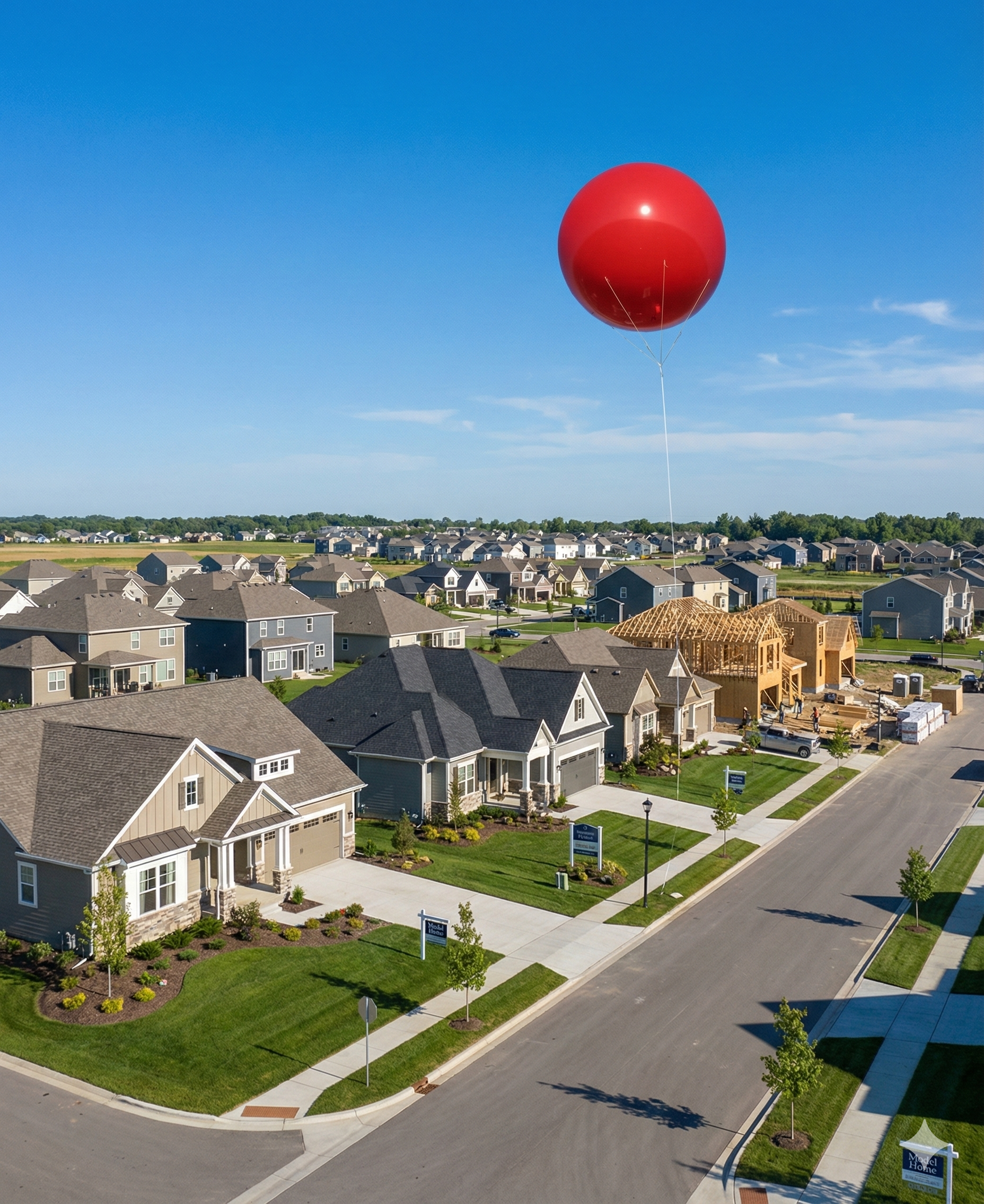
    Real estate market conditions in the United States, June 2026

    May 2026 Existing-Home Sales at a Glance

    The latest U.S. real estate market conditions data from the National Association of Realtors (NAR) shows the market continuing to navigate choppy waters heading into summer. May 2026 saw 4.17 million existing-home sales at a seasonally adjusted annual rate, with a national median sales price of $429,300 and 4.5 months of total housing inventory on the market. That inventory reading edges the country closer to a balanced market — historically defined as five to six months of supply — a significant departure from the ultra-tight conditions that defined 2021 through 2023.

    For home builders, real estate agents, and marketing decision-makers, these numbers carry a clear message: competition for buyer attention is intensifying. More homes are available, but sales volume has not accelerated to match. The result is a market where presentation, visibility, and location-based marketing matter more than they have in years.

    Rising Inventory and the Delisting Surge

    One of the most striking data points to emerge this week comes from Redfin’s comprehensive market analysis: in April 2026, 5.8 percent of all U.S. home listings were pulled from the market — the highest delisting share since March 2020, when pandemic shutdowns froze transactions nationwide. In some markets, that rate is even higher. Houston, for example, recorded a delisting rate of 6.7 percent year-over-year, up a full percentage point from the prior year.

    At the same time, relisting activity is also climbing. Roughly 2.5 percent of homes on the market in April were relistings — properties that had been withdrawn over the prior twelve months and are now returning, often with adjusted pricing. Together, these trends paint a picture of a seller population recalibrating expectations to meet a more cautious and selective buyer pool.

    Regional markets confirm the same story. In Southern California’s South Bay, inventory climbed from 2.1 months of supply in January 2026 to 3.3 months as of early June. Price reductions have become more common across most price tiers, and luxury inventory continues to expand. Buyers have more negotiating leverage than they have held in years.

    Real estate market conditions in the United States, June 2026

    Mortgage Rates Keep Buyers on the Sidelines

    Affordability remains the market’s defining headwind. As of June 11, 2026, the 30-year fixed mortgage rate sits above 6.5 percent, and major forecasting organizations including Fannie Mae and the Mortgage Bankers Association project rates will remain in the mid-to-high 6 percent range through the end of 2026. The 10-year Treasury yield, a key benchmark for mortgage pricing, is hovering around 4.5 percent, elevated in part by the scale of federal borrowing.

    For prospective buyers who purchased or refinanced when rates were below 3 percent, the financial disincentive to move remains powerful. This so-called “lock-in effect” has begun to loosen modestly — as NAR economists have noted, life events such as job relocations, divorces, and family expansions are pushing more homeowners to list regardless of rate environment — but the effect continues to suppress transaction velocity relative to pre-pandemic norms.

    What This Means for Home Builders and New Construction

    New construction holds a structural advantage in this environment that is easy to overlook. Unlike existing sellers who must compete against rising resale inventory and persistent price-reduction pressure, home builders can offer rate buydowns, customization incentives, and flexible closing timelines. These tools have allowed national and regional builders to maintain relative sales momentum even as the broader market softens.

    However, the competitive pressure is no less real. With more resale inventory returning to market and buyers exercising greater patience and selectivity, new home communities must work harder to generate foot traffic and on-site engagement. The builders who capture attention at the community level — at the subdivision entrance, along the roadside, at model home sites — are the ones converting curious drive-by visitors into qualified leads.

    CBRE’s 2026 U.S. Real Estate Market Outlook projects that commercial real estate investment will increase by 16 percent this year to approximately $562 billion, with asset selection and management emerging as key differentiators for returns. The same logic applies to residential development: in a market where not all assets perform equally, standing out at the local level is a strategic imperative, not an optional extra.

    How Advertising Balloons Help Properties Stand Out in a Crowded Market

    In a market defined by rising inventory, selective buyers, and flattening price appreciation, the properties and communities that generate the highest foot traffic early in a listing cycle are best positioned to close at or near asking price. That is where outdoor, location-based marketing tools deliver measurable return on investment.

    Marketing blimps and tethered advertising blimps have long been a trusted tool for home builders and real estate developers precisely because they perform the job that digital advertising cannot: they make a physical location impossible to miss. A helium blimp tethered above a model home entrance or a new-community grand opening is visible from a quarter mile away or more, drawing drive-by traffic that no search ad or social post can replicate. In a market where buyers are touring multiple communities over multiple weekends, the property that registers visually from the road is the one that earns the walk-through.

    Large helium advertising balloons offer similar impact at a lower price point, making them accessible to smaller builders and independent real estate offices running weekend open house events or model home grand openings. Both formats are reusable, weather-resistant, and can be customized with community branding, directional messaging, or promotional offers — all of which compound the conversion value of a single deployment.

    Auto dealers — another sector heavily attuned to foot traffic and impulse visits — have relied on aerial advertising inflatables for decades, and the underlying principle transfers directly to real estate: when a buyer is undecided between two comparable properties, the one they remember seeing from the highway is the one they schedule a showing for first.

    What This Means for Your Marketing

    The May 2026 housing data is a clear signal that passive marketing strategies are no longer sufficient in most U.S. markets. With 4.5 months of inventory on the market and delisting rates at a six-year high, sellers and builders who rely solely on MLS syndication and social media ads to generate traffic are competing on a crowded digital playing field with diminishing differentiation. Outdoor, location-based visibility is the complement that activates the awareness that digital campaigns cannot independently create.

    For home builders opening new communities, hosting grand openings, or launching model home programs over the summer selling season, this is the moment to invest in physical presence at the property. Helium advertising balloons and aerial marketing blimps placed at community entrances, major intersections near the development, or directly above model homes have a proven track record of generating incremental foot traffic that converts to sales appointments. The visibility is immediate, the setup is straightforward, and the cost per impression is low relative to comparable digital placements.

    As the market continues to rebalance through 2026, marketing decision-makers in real estate and home building would do well to think in terms of total marketing mix: digital to generate awareness, and outdoor inflatables to capture the in-market buyer who is already driving your roads, touring your neighborhood, and looking for a reason to stop.

    Sources


  • Grand Opening Marketing Strategies for 2026’s Retail Boom


    Grand Opening Marketing Strategies for 2026’s Retail Boom

    Grand Opening Marketing Strategies for 2026’s Retail Boom

    By Arizona Balloon Company (arizonaballoon.com) — June 11, 2026

    grand opening marketing with balloons and retail storefront crowd

    U.S. Retail Is Expanding Aggressively in 2026

    Grand opening marketing has never been more urgent or more competitive than it is right now. Across the United States, a wave of new store openings is reshaping suburban corridors, shopping centers, and neighborhood retail strips—and each new location is fighting for the same local customer attention on the same day it unlocks its doors. Industry analysts and retail real estate specialists confirm that 2026 is a year defined by physical store growth, with discount grocers, off-price apparel brands, fitness concepts, and specialty retailers all accelerating their expansion footprints simultaneously.

    Discount retailer Aldi alone has announced plans to open more than 180 new U.S. locations in 2026, part of a broader multi-billion-dollar national expansion strategy. That is just one chain. ICSC’s 2026 outlook data points to continued store growth across off-price, beauty, and discount categories as the dominant drivers of new openings. In communities where retail space remains tight—because shopping center gross leasable area grew only a fraction of the pace of retail sales over the past fifteen years—every new opening competes with an already packed local commercial landscape. Getting noticed on day one is not optional; it is the foundation of long-term location success.

    Retail Strategies, a firm that advises municipalities on commercial development, emphasizes that smaller store footprints and value-driven formats are leading the charge. Brands are opening stores sized precisely to match current labor and construction costs, and those stores need to generate profitable foot traffic faster than ever to justify their economics. That pressure falls squarely on whoever is managing the grand opening campaign.

    The Surge in Experiential In-Person Shopping

    Parallel to the store-opening boom, a powerful shift in consumer behavior is making physical retail more important—not less—as a marketing channel. Research compiled by The Harris Poll and published by Quad found that 76 percent of Americans report connecting more deeply with brands through in-person retail experiences than through digital channels alone. That finding, surfaced in one of the most comprehensive marketing trend analyses of the year, underscores a counterintuitive reality: despite the maturation of e-commerce, shoppers are increasingly hungry for tangible, sensory brand encounters.

    Trend analysts at TrendHunter, reviewing June 2026 retail activity specifically, note that experiential retail continues to accelerate momentum, with sensory summer shop activations and resort-themed retail pop-ups transforming ordinary store visits into destination events. Retailers that invest in interactive, personalized touchpoints on opening day are generating measurable lifts in both initial purchases and long-term loyalty. For brands opening new locations this summer, the grand opening is no longer just a ribbon-cutting ceremony—it is the first act of an immersive brand experience that sets the tone for everything that follows.

    The experiential retail market is projected to grow from $114.6 billion in 2024 to more than $543 billion by 2035, according to market analysis from Accio Research. That trajectory signals that retailers who master the blend of physical spectacle and in-person engagement will hold a durable competitive advantage. For businesses planning new locations, this creates both an opportunity and a challenge: how do you make your opening day feel like an event worth attending?

    grand opening marketing with balloons and retail storefront crowd

    Why Advertising Balloons and Blimps Dominate Grand Opening Visibility

    In a crowded market where dozens of new stores may open in the same metro area in a single month, roadside visibility is often the single most underinvested element of a grand opening marketing plan. Digital ads reach devices, but they do not stop a driver on a busy commercial corridor and announce that something new and exciting has arrived. That is precisely what custom advertising blimps and marketing inflatables do, and why they remain one of the most effective tools in the grand opening marketer’s toolkit.

    Helium-filled advertising balloons and rooftop blimps are visible from hundreds of feet away and can be seen from multiple directions simultaneously. Unlike a banner or a ground-level sign, an aerial inflatable draws the eye upward, creating a beacon effect that works on passing traffic, pedestrians, and neighboring business customers alike. For retailers opening in a strip mall, shopping center, or standalone location, a large branded blimp positioned above the building during opening weekend communicates one message instantly and unmistakably: something is happening here, and you should stop.

    The effectiveness of outdoor aerial marketing compounds when paired with the experiential strategies dominating retail in 2026. A store that has invested in interactive in-store activations, sensory displays, and opening-day promotions needs to first attract the crowd that will experience all of those things. Advertising inflatables and marketing blimps serve as the outdoor call-to-action that turns a passing consumer into a curious visitor. They are the visual anchor that makes a grand opening visible from the road before a shopper ever sees a social media post or a digital ad.

    Outdoor Visibility Is the Missing Link in Most Grand Opening Plans

    Marketing decision-makers planning new store openings frequently allocate significant budgets to digital advertising, social media campaigns, and in-store event production. These are valuable investments. But a consistent gap in grand opening strategies is the failure to invest equally in the physical, location-based visibility that converts local drive-by traffic into first-day customers. A well-executed digital campaign may generate awareness among people who are already thinking about your brand. Outdoor aerial marketing reaches the people who were not thinking about you at all—until they looked up and saw your name floating above your parking lot.

    Retail space constraints, noted by analysts at Retail Strategies, mean that new stores are increasingly opening in dense commercial corridors where multiple competing businesses are already established. In that environment, passive visibility—being clearly identifiable and attention-grabbing from the street—is a prerequisite for foot traffic, not a bonus. Businesses that rely on signage alone are competing with every other sign in the same visual field. Businesses that deploy helium advertising balloons above their roofline create an unmistakable vertical presence that no competitor’s ground-level signage can match.

    This principle applies across the categories driving the 2026 store-opening boom: discount grocers launching in new markets, off-price retailers entering suburban corridors, fitness studios anchoring redeveloped shopping centers, and specialty beauty and wellness brands opening their first locations in new cities. Each of these businesses faces the same challenge: converting an unfamiliar address into a known community destination as quickly as possible. Outdoor aerial marketing accelerates that process by making the location impossible to miss.

    A Three-Phase Grand Opening Marketing Approach That Works

    Marketing professionals who have managed high-traffic grand openings across multiple retail categories consistently recommend a structured, phased approach to location launch campaigns. The first phase focuses on pre-opening awareness, typically beginning two to four weeks before the opening date. This phase uses a combination of digital advertising, local media outreach, community partnerships, and early outdoor visibility elements—including pre-positioned advertising inflatables—to build anticipation and drive early social sharing in the surrounding trade area.

    The second phase is opening day and opening weekend, where the investment in high-impact, on-site visual marketing pays off most directly. This is when aerial advertising blimps and large-format helium balloons perform at their highest value, creating the visual spectacle that turns a single day into a community event. Ribbon-cutting ceremonies, in-store activations, opening-day promotions, and outdoor crowd-drawing elements all work together in this phase to create the first impression that shapes long-term customer perception of the location.

    The third phase, often overlooked by businesses focused entirely on the opening day, is sustained post-opening visibility. Research on retail location performance consistently shows that first-month foot traffic patterns establish the behavioral baseline that determines whether a new store achieves sustained profitability. Maintaining elevated outdoor visibility—through rotating advertising balloon and blimp deployments, continued digital campaigns, and community engagement—during the first four to six weeks after opening significantly improves long-term location performance. Businesses that treat the opening as a single event rather than a campaign consistently underperform compared to those that treat it as the beginning of an extended awareness initiative.

    What This Means for Your Marketing

    If you are planning a store opening, retail event, or location launch in 2026, the competitive environment demands a marketing strategy that covers every channel—including the one directly above your building. The data is clear: in-person retail is surging, consumers are seeking physical brand experiences, and dozens of new stores are opening in markets across the United States every week. Standing out in that environment requires more than a social media announcement and a banner above the door.

    Outdoor, location-based marketing tools like helium advertising balloons and aerial marketing blimps from Arizona Balloon Company give retailers a proven, cost-effective way to create street-level and sky-level visibility that digital campaigns simply cannot replicate. Whether you are launching a single location or managing a multi-market rollout, an aerial inflatable tethered above your grand opening sends an unambiguous signal to everyone within sight: this business is open, it is here, and it is ready for customers. That signal is worth more on opening day than almost any other marketing asset you can deploy.

    Arizona Balloon Company provides custom-branded advertising balloons, rooftop blimps, and large-format marketing inflatables sized for single-day grand openings, extended promotional campaigns, and multi-location rollouts. With more than 45 years of experience and nationwide sales, rental, and service support, the company works with retailers, home builders, auto dealers, and event marketers across every category driving the 2026 store-opening boom. Contact the team to discuss the right aerial marketing solution for your next grand opening campaign.

    Sources

  • Trade Show Booth Visibility Trends 2026: What Exhibitors Need to Know


    Trade Show Booth Visibility Trends 2026: What Exhibitors Need to Know

    Trade Show Booth Visibility in 2026: The Trends Every Exhibitor Needs to Know

    By Arizona Balloon Company (arizonaballoon.com) — June 10, 2026

    trade show booth visibility at a large exhibition hall

    Trade Show Attendance Has Rebounded—But the Stakes Are Higher

    Achieving strong trade show booth visibility has never been more competitive than it is in 2026. After years of disruption, major U.S. trade shows are operating close to pre-pandemic attendance levels. Events such as CES in Las Vegas, HIMSS in healthcare IT, and PACK EXPO in manufacturing have all reported near-full recoveries, and exhibitor investment has followed. But the return of crowds has not made standing out easier—if anything, the noise level on the show floor has intensified.

    Industry analysts tracking the Center for Exhibition Industry Research (CEIR) Index note that while attendance is now only about 3.7 percent below 2019 levels, exhibitor revenue gaps have been slower to close. Companies are bringing leaner teams to shows, spending more deliberately, and demanding clearer returns on every marketing dollar. In that environment, getting noticed quickly—before an attendee walks past—is no longer optional. It is the whole game.

    The United States hosts roughly 13,000 trade shows annually, according to industry estimates, making it the most active exhibition market in the world. That volume gives exhibitors constant opportunity, but it also means that a forgettable booth presence is quietly expensive. The brands gaining ground in 2026 are those that treat a trade show not as a three-day event but as a multi-month marketing campaign anchored by a standout physical presence.

    Exhibit marketing in 2026 is moving away from passive, product-on-a-table displays and toward experiences that pull attendees in and hold their attention. The top-performing booths this year combine multisensory elements—directional audio, branded scent, and motion-triggered digital content—with intentional spatial design that creates calm contrast amid the surrounding chaos. Attendees who feel comfortable linger longer, and longer dwell time directly improves lead quality.

    Dynamic signage has become a central investment. Flexible LED tiles and lightweight screen panels now allow booth walls to function as moving canvases, with messaging that can shift based on time of day or audience flow. Yet even the best digital display has a hard ceiling: it only reaches the people who are already standing in front of it. For exhibitors competing in large convention halls where one brand’s booth looks like the next, the most critical design challenge is attracting foot traffic before a prospect ever gets close enough to see a screen. That is where height and visibility above the crowd line become strategic assets, not aesthetic choices.

    Branding experts consistently emphasize that attendees should be able to understand who an exhibitor is and what they offer within seconds of noticing the booth—ideally from across the hall. Visual consistency across signage, colors, and messaging plays a role, but so does the physical elevation of brand elements. The exhibitors who claim space overhead, rather than only at eye level, are using one of the most direct ways to cut through a visually saturated environment. Learn more about high-visibility solutions at our advertising blimps page and explore how aerial branding works for trade show and event environments.

    trade show booth visibility at a large exhibition hall

    The Height Advantage: Why Aerial Signage Cuts Through the Noise

    One of the clearest insights from 2026 booth design research is that height functions as a signal. When a brand element rises above the crowd line—whether it is a multi-story LED tower, an overhead banner, or a floating inflatable—it communicates presence and confidence before a single conversation starts. The eye naturally tracks upward in a crowded environment, making elevated branding one of the few forms of exhibit marketing that works at a distance and at close range simultaneously.

    For outdoor trade shows, festival-adjacent events, open-lot expos, and convention center entrances, helium advertising balloons and tethered marketing blimps provide exactly this kind of above-the-crowd brand presence. A custom-printed balloon bearing a company’s logo can be seen from hundreds of feet away—drawing traffic toward the exhibit location before attendees even consult a venue map. Unlike digital installations that require proximity to deliver their message, aerial inflatables work continuously at maximum range from the moment they are inflated.

    The practical advantages align well with the cost-consciousness that defines 2026 exhibit spending. Helium advertising balloons require no power source, no technical staff to operate, and no complex setup logistics. They are reusable across multiple shows, consistent with the sustainability and modularity trends reshaping the exhibit industry this year. For a regional business or mid-size exhibitor competing against larger booths, aerial signage is one of the highest-visibility investments available at a comparatively modest price point.

    Personalization and Experience Replace Passive Displays

    The B2B buyer attending trade shows in 2026 has been shaped by consumer platforms that deliver hyper-personalized experiences on demand. Generic product demos no longer satisfy attendees who arrive with specific goals and limited time. Research consistently shows that when an attendee’s event experience aligns with their objectives, they are dramatically more likely to return and more likely to convert into a qualified lead after the show.

    For exhibitors, this means the pre-show, on-site, and post-show phases need to function as a unified campaign rather than three separate activities. Artificial intelligence has moved from novelty to mainstream workflow in event marketing: AI adoption among event planners jumped to roughly 50 percent in 2025, and 2026 is the year these tools are becoming standard practice for lead scoring, attendee matching, and personalized follow-up. Exhibitors who map their full conference marketing funnel from six weeks before to six weeks after the event are consistently outperforming those who treat the show floor as the entire campaign.

    Sustainability and Modularity as Competitive Differentiators

    Sustainability has crossed from aspiration to expectation on the U.S. trade show floor. Modular and reusable booth structures are saving exhibitors an estimated 20 percent on carbon footprint and cost year over year, according to industry tracking. Leading operators are replacing disposable signage with bamboo frames, LED panels, and digital handouts. For many enterprise exhibitors, sustainable booth design is no longer a brand statement—it appears as a baseline requirement in event RFPs.

    Modular systems also answer a practical operational need: exhibitors attending multiple shows per year need booth components that travel well, reconfigure to different footprints, and maintain brand consistency without being rebuilt from scratch each time. The shift away from single-use display materials mirrors a broader industry movement toward strategic, long-term exhibit investment rather than event-by-event spending. Reusable helium advertising inflatables fit directly into this framework—built to last across dozens of deployments, lightweight to ship, and immediately recognizable as a brand asset from show to show.

    What This Means for Your Marketing

    The defining challenge of trade show marketing in 2026 is not budget—industry planners report that budgets are actually growing, with nearly 60 percent of respondents preferring in-person-only events over virtual or hybrid formats. The challenge is differentiation. With attendance near pre-pandemic levels and exhibitor competition intensifying, the businesses that win on the floor are those that make themselves impossible to miss before an attendee is close enough to read a sign or watch a demo. Outdoor and location-based visibility tools are not supplementary to a trade show strategy—they are the top of the funnel.

    For marketing decision-makers in industries like home building, automotive, and product manufacturing, trade shows remain one of the highest-ROI venues for face-to-face engagement with qualified buyers. Maximizing that ROI starts with driving traffic to the booth, and traffic follows attention. Helium advertising balloons and tethered aerial marketing blimps provide the kind of above-the-crowd visibility that no banner stand or digital display can replicate at range. A custom-branded inflatable floating 20 to 30 feet above a convention entrance or outdoor expo lot creates a visual landmark that attendees navigate toward—often before the show officially opens.

    Whether you exhibit at regional consumer shows, national industry conventions, or outdoor seasonal expos, aerial signage solutions deserve a place in your pre-show and on-site marketing plan. The exhibitors pulling ahead in 2026 are combining immersive booth experiences with maximum approach visibility. Investing in both dimensions—what people see up close and what draws them from a distance—is the complete strategy that the current trade show landscape rewards.

    Sources


  • U.S. Outdoor Advertising Revenue Growth Hits Record $2.12 Billion in Q1 2026


    U.S. Outdoor Advertising Revenue Growth Hits Record $2.12 Billion in Q1 2026


    U.S. Outdoor Advertising Revenue Growth Hits All-Time Record of $2.12 Billion in Q1 2026

    By Arizona Balloon Company (arizonaballoon.com) — June 9, 2026

    outdoor advertising revenue growth billboard and experiential marketing display

    A Record Quarter for Outdoor Advertising Revenue Growth

    Outdoor advertising revenue growth in the United States reached a historic milestone in the first quarter of 2026, with the Out of Home Advertising Association of America (OAAA) reporting an all-time Q1 high of $2.12 billion in total industry revenue. The figure represents a 7.1 percent increase compared to the same period in 2025 and extends the medium’s unbroken growth streak to 20 consecutive quarters. For marketing managers, business owners, and brand strategists, the data signals one undeniable trend: location-based, real-world advertising is not just surviving in a digital era — it is accelerating.

    The strong Q1 performance follows a record-setting 2025, during which the OOH industry generated $9.46 billion in annual revenue. The latest figures build on that foundation and suggest 2026 is on track to surpass it. For businesses that invest in physical, place-based visibility — from home builders and auto dealers to trade show exhibitors and retail chains — the timing is favorable. Consumer attention is demonstrably shifting back toward the physical environment, and advertisers across nearly every category are responding with increased outdoor budgets.

    For businesses looking to capitalize on this momentum with high-impact physical media, custom advertising balloons from Arizona Balloon Company offer a proven, attention-commanding format that fits seamlessly into an outdoor advertising strategy.

    What Is Driving Outdoor Advertising Revenue Growth in 2026

    Digital Out-of-Home (DOOH) formats are the primary engine behind the industry’s expansion, rising 12.9 percent year-over-year and accounting for 36 percent of total OOH revenue in Q1 2026. These programmatic, screen-based placements allow advertisers to update creative in real time, target audiences by time of day or weather condition, and measure campaign performance with greater precision than traditional static formats. The rapid adoption of DOOH by major national brands has elevated the perceived legitimacy of the broader OOH category, creating a rising tide effect that benefits all outdoor formats.

    Among specific OOH channel types, Transit advertising posted the highest growth in Q1 2026 at 18 percent over the prior year period. Street Furniture placements followed closely with an 11.5 percent increase. Billboard formats grew 4.8 percent, while Place-Based media expanded 3.3 percent. Across all major format categories, digital inventory posted gains — with double-digit growth across nearly every digital OOH segment. Printed OOH, sometimes described as a declining medium, still managed a 4.1 percent increase, underscoring that physical presence continues to deliver measurable value for advertisers.

    outdoor advertising revenue growth billboard and experiential marketing display

    Traditional Formats Hold Strong Alongside Digital Innovation

    A common misconception in marketing circles holds that traditional, non-digital outdoor formats are being displaced entirely by screens and programmatic inventory. The Q1 2026 OAAA data challenges that view. Printed OOH grew by 4.1 percent, and all major format categories reported positive results. The evidence suggests that physical, analog outdoor media continues to play a valuable and complementary role in the modern media mix, particularly for businesses that need to establish a visible, trusted presence in a specific geography.

    Physical outdoor formats carry a brand legitimacy that digital screens cannot fully replicate. A large-format presence in a high-traffic area signals investment, commitment, and scale — qualities that resonate especially with consumers making significant purchasing decisions, such as buying a home, selecting a contractor, or choosing an auto dealership. The OAAA data reinforces what experienced local and regional marketers have long understood: being visible in the real world builds the kind of brand trust that accelerates conversion downstream, whether online or in person.

    New Brands Entering the OOH Space in Q1 2026

    One of the more telling indicators from the Q1 2026 OAAA report is the wave of brands that made their first-ever appearance in OOH spending during the quarter. Eight brands were identified as new to Q1 OOH compared with the same period in 2025, including artificial intelligence companies Genspark, OpenAI, and Lambda, as well as established names such as Charter Communications, Citi, eBay, and Boehringer Ingelheim. The entry of AI-sector brands into physical outdoor media is particularly instructive: companies whose entire product exists in the digital world are now turning to real-world, location-based advertising to build awareness and credibility with a general consumer audience.

    This pattern reflects a broader understanding among sophisticated marketing teams that digital-only strategies have ceiling effects. Display advertising faces growing challenges from ad blockers, banner blindness, and platform saturation. OOH, by contrast, is non-skippable, non-blockable, and reaches consumers precisely when they are moving through the world and making decisions. The influx of new advertisers — particularly high-spending technology brands — drives up the overall perceived value of the OOH category and validates the investment for businesses of all sizes that have relied on outdoor formats for years.

    How Helium Advertising Balloons and Marketing Blimps Fit the Outdoor Surge

    The record outdoor advertising numbers released by the OAAA reflect demand for visibility in the physical world — a demand that helium advertising balloons and marketing blimps have served for decades. While the industry conversation often centers on digital screens and programmatic technology, the fundamental principle driving OOH growth is unchanged: brands need to be seen, remembered, and associated with specific locations. Inflatable aerial advertising achieves all three objectives at a fraction of the cost of a digital billboard campaign.

    For home builders, auto dealers, trade show exhibitors, and general businesses, a giant advertising blimp or a cluster of custom-shaped helium balloons creates an instant visual landmark. It draws attention from passing traffic, anchors a brand to a physical location, and communicates the message that something significant is happening at that address — a grand opening, a sale event, a model home tour, or a trade show presence. These are precisely the use cases that the broader OOH surge validates. Outdoor advertising works because people are physically present in the world, and aerial formats cut through ground-level visual clutter in ways that static signage cannot.

    Arizona Balloon Company’s aerial marketing blimps are manufactured, rented, and serviced to deliver this kind of high-impact visibility for businesses across every sector currently driving OOH growth. As the industry continues its record-setting trajectory, physical aerial formats represent a cost-effective and highly differentiated entry point into the outdoor advertising mix.

    What This Means for Your Marketing

    The OAAA’s Q1 2026 data is more than an industry benchmark — it is a strategic signal for marketing decision-makers. The 20 consecutive quarters of growth demonstrate that the consumer shift toward digital consumption has not diminished the effectiveness of outdoor and location-based media. If anything, outdoor advertising is proving to be a critical counterbalance in an era of digital oversaturation. For business owners planning their 2026 campaigns, the data supports a stronger allocation toward real-world visibility, particularly in the high-traffic locations where their target customers are already present.

    Experiential and location-based advertising formats are especially well-positioned for businesses with a strong geographic component to their sales process — home builders marketing model homes, auto dealers driving lot traffic, and trade show exhibitors competing for attention on a crowded show floor. The most effective outdoor strategies combine multiple physical touchpoints: signage, branded environments, and aerial elements that establish a visible identity across a wide radius. Helium advertising balloons from Arizona Balloon Company can serve as the anchor of that aerial layer, providing the kind of unmistakable, high-altitude visibility that no ground-level format can replicate.

    The record OOH revenue figures from Q1 2026 should encourage marketing managers to resist the temptation to shift all investment into digital channels. The brands winning in today’s advertising environment are those deploying integrated strategies that combine the targeting precision of digital with the undeniable physical impact of outdoor. An aerial marketing blimp above a grand opening event, a balloon arch at a trade show booth, or a giant custom shape floating above a home builder’s community — these are proven, measurable tools that belong in any serious outdoor advertising plan. The data supports the investment. The results speak for themselves.

    Sources


  • Helium Shortage 2026: What It Means for Your Marketing


    Helium Shortage 2026: What It Means for Your Marketing

    Helium Shortage 2026: What It Means for Your Marketing

    By Arizona Balloon Company (arizonaballoon.com) — June 8, 2026

    Helium shortage 2026 impact on advertising balloons and marketing blimps

    What Triggered the 2026 Helium Shortage

    The helium shortage 2026 is being called structurally different from any previous supply disruption — and the numbers back that up. In March 2026, missile and drone strikes destroyed key production infrastructure at Qatar’s Ras Laffan facility, the largest liquefied natural gas complex in the world. Because helium is extracted as a byproduct of natural gas processing, when Qatar’s LNG operations halted, helium output ceased automatically. The result was the removal of roughly one-third of global helium supply from the market in a matter of days.

    Qatar is the world’s second-largest helium producer after the United States. Russia, the third-largest producer, has faced ongoing export constraints due to sanctions stemming from the conflict in Ukraine. With two of the three dominant global suppliers effectively sidelined, the market tightened faster than at any point in recent memory. Industry observers are calling this the fifth helium shortage in twenty years — and the most severe.

    Adding further pressure, the U.S. Federal Helium Reserve in Amarillo, Texas — historically a strategic buffer for domestic supply — has been fully privatized, eliminating the government backstop that once moderated price spikes. Learn more about how Arizona Balloon Company navigates helium sourcing to keep our clients’ campaigns running.

    How U.S. Helium Prices and Supply Are Being Affected

    The domestic market impact has been swift. Airgas, one of the largest industrial gas distributors in the United States, declared force majeure on helium shipments effective March 17, 2026. The company has indicated it can supply only up to 50 percent of normal monthly allocations to some customers and has imposed a surcharge of $13.50 per hundred cubic feet above contracted prices. Multiple other distributors have followed with similar rationing measures and surcharge policies.

    Prior to the Ras Laffan disruption, North American helium prices had already been climbing. According to market data, prices in North America reached $68.99 per thousand cubic feet in March 2026, representing an 8.7 percent increase from December 2025 through March 2026. The broader U.S. bulk price index averaged approximately $96,440 per metric ton over the first quarter of 2026. Spot pricing has diverged sharply from contracted rates since the Qatar incident, with limited prompt cargo availability from the Middle East pushing buyers into U.S. domestic sources — which are themselves committed to long-term contracts with healthcare and semiconductor customers.

    Helium shortage 2026 impact on advertising balloons and marketing blimps

    Why Recovery Will Take Years, Not Weeks

    Even optimistic scenarios for the Strait of Hormuz reopening do not translate into a quick helium recovery. The south production site at Ras Laffan sustained the direct strikes and is not expected to restart before the end of summer 2026 at the earliest, with its capacity reduced from 36 million tonnes per annum to 24 million tonnes per annum — a deficit that industry analysts say will not be recovered for years. Qatar’s CEO of QatarEnergy, Saad al-Kaabi, confirmed in a March 19, 2026 statement that the damage to key production trains will take substantial time to repair.

    New domestic production projects in the United States — including ventures in Minnesota, Montana, Colorado, and New Mexico — are gradually adding capacity, but meaningful volume relief from these projects is estimated to be 12 to 24 months away. The U.S. Geological Survey’s Mineral Commodity Summaries 2026 pegged the base price for Grade-A helium at approximately $12 per cubic meter in 2025, with producers adding surcharges on top of that. Industry forecasters are projecting prices to remain elevated for up to three years.

    Who Gets Helium First: The Allocation Hierarchy

    During a shortage of this magnitude, distributors do not allocate supplies equally. Medical applications — MRI machines, NMR systems — are consistently prioritized at the top of the supply chain. Defense and aerospace applications rank immediately below. Semiconductor fabrication, which accounts for a significant share of global helium demand, falls next in the priority queue.

    Lower-volume and more substitutable applications, including welding, leak detection in non-critical systems, and promotional or advertising balloon uses, face the sharpest proportional cuts in constrained supply environments. This does not mean helium for advertising applications disappears entirely, but it does mean businesses that rely on helium for marketing should anticipate higher costs, potential lead-time extensions, and supply variability for the foreseeable future. The Department of Defense has established a target of maintaining a six-month strategic helium reserve, up significantly from the 83-day reserve that existed before the current crisis — a policy that further tightens civilian market availability.

    What This Means for Helium Advertising Balloons and Marketing Blimps

    For businesses that use helium advertising balloons or aerial marketing blimps as core components of their outdoor visibility strategy, the 2026 helium shortage introduces both operational challenges and strategic opportunities. On the cost side, clients should plan for helium surcharges to be incorporated into event and campaign budgets through at least 2027. Balloon companies and event marketers are also advised to work with experienced suppliers who maintain reliable supply relationships and can prioritize continuity for long-standing accounts.

    On the opportunity side, scarcity tends to sharpen competitive differentiation. When everyone in a market is pulling back on helium-dependent displays due to cost pressure, the businesses that maintain a visible aerial presence — a giant blimp above a grand opening, a tethered cold-air inflatable over a new-home community — stand out more prominently than ever. Many large-format advertising inflatables can be configured as cold-air units that require no helium at all, delivering the same high-visibility impact at ground level or tethered flight without any dependency on the spot helium market. This is a meaningful operational hedge that smart marketing managers are actively evaluating right now.

    For home builders, auto dealers, and trade show exhibitors who depend on event marketing, the shortage also creates an argument for locking in rental agreements and advance supply commitments earlier in the planning cycle rather than making last-minute procurement decisions. Suppliers with established helium contracts and storage infrastructure are better positioned to honor commitments than those buying on the open spot market.

    What This Means for Your Marketing

    The 2026 helium shortage is a supply-chain story, but it is equally a marketing strategy story. Outdoor, location-based advertising has always delivered one of the strongest cost-per-impression ratios available to businesses in competitive local markets. A towering inflatable above a model home community or a giant blimp tethered above a dealership lot generates awareness from distances and angles that no ground-level signage or digital ad can replicate. The question the current environment forces is not whether aerial marketing still works — it clearly does — but how to sustain it efficiently given evolving helium supply conditions.

    The most effective response is to diversify the inflatable mix. Cold-air advertising inflatables, which use a blower rather than compressed helium for inflation, deliver comparable visual impact for grand openings, seasonal promotions, and permanent location markers without any exposure to helium pricing volatility. For campaigns where helium lift is genuinely required — tethered blimps, high-altitude visibility events, or specific creative formats — working with a supplier who manages supply logistics professionally becomes more important than ever.

    Arizona Balloon Company specializes in helping home builders, auto dealers, trade show exhibitors, and businesses across industries deploy helium advertising balloons and aerial marketing blimps with reliable supply, professional service, and strategic guidance. Whether you are planning a single grand opening or a sustained outdoor marketing campaign, now is the right time to discuss your options before helium allocations tighten further heading into the fall event season.

    Sources


  • Auto Dealer Sales Strategy: What May 2026’s Market Shift Means


    Auto Dealer Sales Strategy: What May 2026’s Market Shift Means


    Auto Dealer Sales Strategy: What May 2026’s Market Shift Means

    By Arizona Balloon Company (arizonaballoon.com) — June 6, 2026

    Auto dealer sales strategy with vehicles on a dealership lot

    May 2026 Sales Results: A Modest Recovery

    Refining your auto dealer sales strategy has never been more urgent than right now, as the U.S. automotive retail market sends mixed signals heading into the summer. According to data published June 3, 2026, U.S. light-vehicle sales rose a modest 0.6% in May to approximately 1.48 million units — marking the first monthly year-over-year gain in 2026. The seasonally adjusted annual rate (SAAR) came in at 16.2 million vehicles, slightly ahead of analyst expectations. On paper, that sounds like a win. In practice, it requires a closer look before dealers start celebrating.

    Year-to-date sales through May remain down roughly 5% compared to the same period in 2025. A significant portion of May’s improvement was driven by fleet deliveries to rental car companies and commercial buyers, rather than retail consumers walking onto dealership lots. That distinction matters enormously for dealers whose revenue depends on retail foot traffic and financing margins.

    Among the brands reporting monthly sales, the results were sharply divided. Toyota remained the volume leader at 207,393 units, while Honda posted a strong 10.5% gain on record CR-V demand. Mazda surged 35% year-over-year — one of the biggest monthly gains in the industry. Meanwhile, Ford fell 14%, with F-Series deliveries dropping 13% due to ongoing supply disruptions tied to an aluminum supplier. Lincoln also declined 20.5%. The winners and losers in May tell a story not just about product mix, but about how well each brand is meeting consumers where they are financially.

    The Affordability Squeeze Dealers Can’t Ignore

    The structural challenges facing retail auto sales in 2026 are well documented, and May’s data reinforces them. The average transaction price held essentially flat at just over $46,000, and the average monthly payment now sits around $810. Interest rates remain in the mid-6% range, making financing a significant barrier for many buyers. Perhaps the most striking figure: nearly one in three trade-ins currently carries negative equity, meaning buyers owe more on their current vehicle than it is worth. That reality makes moving into a new vehicle a materially harder decision than it was two or three years ago.

    To combat softening retail demand, automakers have significantly escalated incentive spending, which climbed more than 20% from a year ago to an average of nearly $3,300 per vehicle. Electric vehicles remain the most heavily discounted segment, with incentives averaging more than $10,000 per unit following the expiration of the federal EV tax credit. Leasing is also rebounding, with more than 22% of new-vehicle transactions in May structured as leases — a reflection of consumers seeking lower monthly payments over vehicle ownership.

    For dealership operators and marketing managers, this environment creates a clear imperative: reaching budget-conscious, comparison-shopping consumers before competitors do. Dealers who rely solely on digital advertising and inbound web traffic risk invisibility at the local level, where many purchase decisions are ultimately triggered. Connecting with the high-visibility advertising balloons available from Arizona Balloon Company can give your lot the local presence that digital ads simply cannot replicate.

    Auto dealer sales strategy with vehicles on a dealership lot

    The Hybrid Surge Is Reshaping the Showroom Floor

    If there is a clear winner in May 2026, it is the hybrid vehicle segment. Toyota reported that electrified vehicles accounted for 57% of its May sales, with hybrids doing most of the heavy lifting. Honda posted record hybrid sales. Hyundai and Kia saw hybrid deliveries jump 90% and 179%, respectively, compared to a year earlier. Subaru also reported growing hybrid demand alongside improving EV numbers. The consumer message could not be clearer: buyers want better fuel economy and reduced operating costs, but many are not yet ready to commit fully to battery-electric vehicles.

    For dealerships carrying Toyota, Honda, Hyundai, or Kia franchises, this trend represents a genuine sales opportunity in an otherwise difficult market. The challenge is that competitors with the same inventory are chasing the same buyer pool. Promoting hybrid inventory prominently — both online and on the lot — becomes a differentiator. Dealers who can physically signal to passing traffic that they stock in-demand hybrid models have an advantage, particularly in high-traffic corridors where drive-by awareness directly influences weekend lot visits.

    Inventory Is Back — Now the Competition Heats Up

    One of the more consequential shifts in the 2026 market is the normalization of inventory. Total dealer inventory is sitting near 2.9 million vehicles nationally — a dramatic contrast to the shortage conditions that characterized 2021 through early 2023. For consumers, that means more choices and better negotiating leverage. For dealers, it means the era of selling vehicles at or above MSRP without meaningful effort is over. Competition for every retail sale has intensified across nearly every segment and price point.

    Not every brand is in the same position. Toyota, Honda, Kia, Lexus, and Audi continue to operate with tighter-than-average supplies, which preserves some margin protection. Brands including Ram, Jeep, Dodge, Chrysler, and Mitsubishi are sitting on considerably more inventory, which increases the urgency to move units through aggressive marketing and promotions. Dealers carrying overstocked nameplates face the most pressure to drive foot traffic and create buying urgency before carrying costs accumulate.

    Whether inventory is tight or plentiful, the competitive pressure in 2026 makes local market visibility a premium asset. Learn more about outdoor advertising solutions at arizonaballoon.com to see how aerial marketing products can help your dealership stand out along the roadways where your customers drive every day.

    Why Outdoor Visibility Is Critical for Auto Dealer Sales Strategy Right Now

    In a market defined by affordability concerns, rising incentives, and fierce competition for a selective buyer pool, an effective auto dealer sales strategy must go beyond digital channels. Lot traffic remains a leading indicator of retail sales conversion, and lot traffic is driven by physical visibility. A dealership that is easy to see, easy to find, and signals activity and promotions from a distance will consistently outperform a competitor that looks quiet or indistinct from the road.

    This is precisely where giant advertising blimps for car dealerships deliver outsized returns. Helium-filled advertising blimps and large-format inflatable balloons are visible from hundreds to thousands of feet away — far beyond what any sign, banner, or flag can achieve. They communicate scale, energy, and event activity at a glance, which is exactly the message a dealership wants to send during a sales event, new model launch, or end-of-month clearance push. In a summer selling season where every retail unit counts, the dealers who draw the most eyes to their lot are the ones most likely to convert drive-by awareness into showroom visits.

    Arizona Balloon Company supplies, rents, and services helium advertising balloons and marketing blimps specifically for dealerships, with products scaled for everything from weekend promotions to extended campaign deployments. Our team understands the automotive retail calendar and can help you match the right aerial product to your sales objectives.

    What This Means for Your Marketing

    May 2026’s auto sales data confirms that the market has stabilized but has not rebounded to the frictionless selling environment of recent years. Consumers are taking longer to make purchase decisions, are more price-sensitive than at any point since 2019, and are being pursued by every dealership in their market through overlapping digital channels. In this environment, the dealers who win will be those who combine smart digital targeting with high-impact physical presence — particularly along the high-traffic routes where their target buyers already travel.

    Outdoor and location-based marketing plays a defining role in that equation. A well-placed helium advertising balloon above your lot during a weekend hybrid promotion or a summer clearance event creates immediate local awareness that no online ad can replicate. It signals to the consumer who drives past your dealership three times a week that something is happening, that now is the time to stop in, and that your inventory is worth looking at. That kind of ambient, repeated impression is especially valuable when buyers are in a longer consideration phase and need multiple touchpoints before acting.

    As the summer selling season accelerates, dealerships that invest in both digital precision and physical visibility will be best positioned to capture the retail buyers who are genuinely in the market. Whether you are launching a new hybrid lineup, clearing aged inventory before Q3, or simply trying to maintain lot traffic against a crowded competitive set, aerial marketing blimps from Arizona Balloon Company are a proven, cost-effective tool for generating the local awareness that converts into showroom visits and signed deals.

    Sources


  • Spring 2026 Fell Short: Rethink Your Homebuilder Marketing Strategy Now


    Spring 2026 Fell Short: Rethink Your Homebuilder Marketing Strategy Now

    Spring 2026 Fell Short: Rethink Your Homebuilder Marketing Strategy Now

    By Arizona Balloon Company (arizonaballoon.com) — June 5, 2026

    homebuilder marketing strategy for new home construction communities

    Spring Selling Season Falls Short for Most Builders

    A well-crafted homebuilder marketing strategy has never been more critical than it is right now. According to Zonda’s April 2026 New Home Market Update, published May 21, 2026, a striking 70% of homebuilders across the United States reported that the market performed below their expectations during April — historically one of the strongest months of the spring selling season. The findings serve as a clear signal to marketing and sales leaders in new home construction: the old playbook is no longer enough.

    The spring selling season is typically when builders move the highest volume of contracts. New communities launch. Model homes draw weekend traffic. Incentive campaigns hit their stride. But 2026 has delivered a more complicated picture, one shaped by macroeconomic headwinds that are dampening buyer confidence even among households that are genuinely ready and able to buy. For community marketing managers and new home sales directors, that means the pressure to perform — and to stand out — is intensifying.

    What the Zonda April 2026 Data Actually Shows

    Zonda, which tracks approximately 85% of the production new home market nationwide, reported that on a seasonally adjusted annualized rate, 720,924 new homes were sold in April 2026. While that figure represents a 2.6% gain from March and is technically flat compared to a year ago, it masks a more difficult reality at the community level: builders expected considerably more.

    Ali Wolf, chief economist for Zonda and NewHomeSource, attributed the underperformance to a convergence of pressures. Higher-than-expected mortgage rates, rising gas prices, broad economic uncertainty, and what Wolf specifically identified as “incentive fatigue” all combined to keep sales from gaining meaningful momentum. “Builders expected more out of this year’s spring selling season, but macroeconomic headwinds got in the way,” Wolf said.

    Community counts are up roughly 11% compared to last year, meaning more neighborhoods than ever are competing for a cautious pool of active buyers. That supply-side growth, absent a corresponding surge in demand, creates a competitive environment where differentiation — both in product and in marketing — becomes the determining factor in who closes contracts and who sits on inventory.

    homebuilder marketing strategy for new home construction communities

    Two Types of Buyers: Who Is Still in the Market

    One of the more actionable insights from Zonda’s April report is the distinction the firm draws between two buyer segments currently active in the new home market. The first are need-based buyers: households compelled to move by life events such as a growing family, a job relocation, retirement, marriage, or divorce. These buyers remain active regardless of broader economic sentiment because their timelines are not fully discretionary.

    The second group are discretionary buyers, households who want to move but do not have to. This segment is far more sensitive to mortgage rate swings, media coverage of economic uncertainty, and general consumer confidence. When this group hesitates — as it has done repeatedly in 2025 and into 2026 — overall sales volumes soften even as builder communities remain open and staffed.

    For marketing decision-makers, this bifurcation carries a practical implication: the message that converts a need-based buyer is different from the one that motivates a discretionary buyer to act now. Need-based buyers respond to urgency, process clarity, and availability. Discretionary buyers need to be convinced that now is the right time and that this community is the right place — and they often need a visible, memorable reason to stop and visit before they ever fill out a contact form.

    Incentive Fatigue Is Real — What Builders Are Doing Instead

    Perhaps the most striking term in Zonda’s April 2026 summary is “incentive fatigue.” For the past two years, builders have leaned heavily on rate buydowns, closing cost assistance, and design upgrade packages to move inventory. Those tools still work, but their incremental impact is diminishing as buyers have come to expect them as baseline offerings rather than meaningful differentiators.

    Marc Friedman, senior vice president of sales for Kolter Homes, captured the shifting dynamic succinctly: “The market is turning back into a real market coming off peak levels.” That normalization means builders who relied on incentives alone to drive traffic now need to rebuild the front end of their marketing funnel — generating awareness, traffic, and community visits — with greater creativity and more presence at the point of sale.

    Brandon Jones, CEO of Davidson Homes, noted that consumer sentiment remains unstable and that stability, more than any single promotional offer, is what buyers are seeking. That observation points toward marketing strategies that create a consistent, visible, and trustworthy presence at and around new home communities — not just in digital channels where noise is overwhelming, but in the physical geography where homes are actually being built and sold.

    How On-Site Visibility Tools Fit Into a Homebuilder Marketing Strategy

    When digital channels are saturated and incentive-driven advertising is losing its edge, location-based marketing becomes proportionally more valuable. Buyers who are actively shopping for a new home still drive through communities, scout neighborhoods on weekends, and make split-second decisions about which sales offices to stop at based on what catches their eye from the road.

    This is exactly the environment where helium advertising balloons for new home communities deliver measurable, cost-effective returns. A large helium balloon or aerial marketing inflatable positioned above a model home or community entrance is visible from a significant distance and at multiple traffic angles — capturing the attention of drivers who may not have been actively looking for a new home community but are in the geographic vicinity. Unlike a digital ad that disappears when a browser tab closes, a balloon or blimp maintains continuous on-site presence for hours or days at a time.

    For homebuilders specifically, grand opening events, weekend sales events, and model home debut weekends represent natural deployment windows for large marketing blimps and cold-air advertising inflatables. At a time when 70% of builders say traffic fell short of expectations during spring 2026, tools that increase physical community visibility and spontaneous drive-by traffic deserve serious consideration as part of a broader multi-channel approach.

    What This Means for Your Marketing

    The April 2026 data from Zonda makes a compelling case that homebuilder marketing strategy can no longer depend on a single lever. Digital advertising, social media content, and incentive packages all remain important, but they operate in a crowded, high-noise environment where buyer hesitation means fewer active shoppers are entering the funnel at all. In that context, the builders who win contracts in the second half of 2026 will be the ones who create presence, visibility, and memorable brand moments at every stage of the buyer journey — from the freeway to the front door.

    Location-based and outdoor marketing tools play an essential role in that multi-channel mix. Driving traffic to a model home or sales center requires getting the attention of buyers before they have committed to any particular community. Helium advertising balloons and aerial marketing blimps from Arizona Balloon Company are specifically designed for this purpose: commanding roadside and aerial visibility that no billboard or yard sign can replicate, and doing so at a price point that scales from a single grand opening event to an ongoing seasonal presence across multiple communities.

    As the market normalizes and buyer confidence gradually rebuilds, the homebuilders who maintain aggressive, visible community-level marketing now will be best positioned to capture pent-up demand when it releases. Whether your communities are in high-growth Midwest metros like Columbus and Indianapolis or in competitive Sunbelt markets navigating a cooldown, combining digital strategy with powerful on-site physical presence is the marketing approach the current environment demands.

    Sources

  • Green Sustainable Marketing: What 2026 Greenwashing Rules Mean for You


    Green Sustainable Marketing: What 2026 Greenwashing Rules Mean for You

    Green Sustainable Marketing: What 2026 Greenwashing Rules Mean for You

    By Arizona Balloon Company (arizonaballoon.com) — June 4, 2026

    Green sustainable marketing outdoor advertising campaign with eco-friendly branding

    What Is Changing in Green Sustainable Marketing Compliance

    For marketing managers and business owners investing in green sustainable marketing, 2026 is a pivotal year. A tightening compliance environment on both sides of the U.S.–Canada border is forcing brands to treat environmental claims with the same legal rigor they apply to product performance statements. A compliance guide published by Fairware on May 25, 2026 summarizes the landscape clearly: regulators are paying closer attention to whether eco-claims are specific, supportable, and unlikely to leave a misleading overall impression on consumers.

    The shift is not driven by a single landmark ruling. In the United States, the Federal Trade Commission’s existing Green Guides remain the primary federal framework for environmental marketing claims. What has changed is the enforcement posture. Legal teams, procurement departments, and brand strategists must now work in tighter alignment to verify that any public sustainability messaging is accurate and defensible before campaigns launch. Businesses that approach outdoor marketing proactively—including those that use helium advertising balloons for high-visibility location-based promotions—stand to gain a credibility edge by leading with transparent, verifiable messaging.

    In Canada, the shift is more concrete. Amendments to the Competition Act that became law on June 20, 2024, now require that environmental benefit claims be backed by adequate and proper testing, and business-level claims must follow an internationally recognized methodology. While that law applies north of the border, North American marketers running cross-market campaigns should treat it as a preview of where U.S. enforcement is heading.

    The FTC Green Guides and What They Actually Require

    A widespread misconception circulating in marketing circles is that the FTC issued a new Green Guides ruling in 2026. According to Fairware’s compliance analysis, no finalized new ruling is in force. The current Green Guides, which have been the key U.S. guidance for environmental marketing claims for decades, remain the operative standard. The FTC’s baseline requirement is that advertising must be truthful, not misleading, and properly substantiated.

    What has shifted, in practical terms, is the cultural expectation inside organizations. Sustainability language that once sat comfortably inside brand storytelling now belongs in the same category as product performance claims: it needs internal evidence, cross-functional alignment, and pre-launch review. Marketing managers who treat green claims as brand narrative rather than verifiable fact are increasingly exposed to regulatory scrutiny, consumer skepticism, and reputational risk.

    For businesses promoting new home communities, auto dealerships, trade shows, or retail locations, this regulatory context makes outdoor marketing strategy more important than ever. Physical, location-specific advertising—such as the custom advertising blimps available through Arizona Balloon Company—delivers brand presence without the digital paper trail that regulators increasingly scrutinize for misleading environmental claims made in online copy.

    Green sustainable marketing outdoor advertising campaign with eco-friendly branding

    Which Eco-Marketing Terms Carry the Highest Legal Risk

    The compliance guide identifies the highest-risk marketing terms as the broadest ones: “green,” “eco-friendly,” “sustainable,” and “carbon neutral.” The danger, regulators note, is not usually that these claims are entirely false, but that the overall impression they create is too broad for the narrow evidence a brand can actually provide. Calling a product line “eco-friendly” when only one component has been tested against an environmental standard, for example, may meet the letter of brand intent while failing regulatory scrutiny.

    This has created a genuine tension for marketing teams. Consumers still type terms like “green” and “eco-friendly” into search engines and AI tools when looking for responsible brands, meaning that abandoning these terms entirely would hurt discoverability. The practical solution, according to sustainability compliance experts, is to pair broad terms with specific, documented substantiation—stating exactly what is green, how it was measured, and what the limitation of the claim is. Honesty about progress builds more consumer loyalty than vague aspirational language.

    The Consumer Trust Gap: Why Vague Claims Are Backfiring

    The compliance pressure from regulators reflects a deeper problem that is already visible in consumer data. According to research cited by Shopify’s green marketing analysis, only one in five consumers currently believes brands’ claims about their environmental efforts. That trust deficit is the product of years of overpromising and underdelivering across industries. A 2024 PwC Voice of the Consumer survey found that shoppers are willing to pay a nearly 10 percent premium for sustainably sourced goods—but that premium is contingent on trust.

    Around 82 percent of American consumers consider sustainability factors before purchasing, according to green marketing market data published in April 2026 by Business Research Insights. Yet that same consumer base is increasingly skeptical of vague branding. Brands with strong, substantiated sustainability narratives are documented to grow at more than twice the rate of average competitors—but the key word is substantiated. Businesses that make specific, honest claims supported by documentation are outperforming those that rely on aesthetic eco-signaling alone.

    The takeaway for marketing decision-makers is that authenticity is now a competitive advantage, not just a compliance requirement. Businesses willing to document their actual environmental practices—however incremental—and communicate them clearly are better positioned to capture the growing segment of values-driven buyers than those relying on broad green labels.

    How Aerial Advertising Supports Authentic Green Sustainable Marketing

    For businesses operating in the green and sustainable marketing space, aerial and outdoor advertising formats offer a practical branding advantage that is worth understanding. Helium advertising balloons and custom marketing blimps are reusable, long-lasting physical assets. Unlike single-use printed banners, disposable promotional materials, or energy-intensive digital display campaigns, a well-maintained advertising balloon can serve a brand across dozens of events and locations over multiple seasons. That longevity reduces per-impression material waste significantly.

    For home builders promoting green-certified communities, auto dealers featuring electric or hybrid vehicle lines, or trade show exhibitors showcasing sustainability solutions, a giant aerial balloon or blimp creates immediate, unmistakable brand presence at the physical location where the sale is happening. This matters in the context of 2026’s compliance environment because the message delivered by a physical aerial display is inherently local, transparent, and tied to a specific offering—a sharp contrast to the broad digital claims that regulators are scrutinizing most closely.

    Outdoor advertising formats are also increasingly aligned with consumer values. Research from industry analysts confirms that sustainability is becoming a defining factor in out-of-home advertising strategies, with brands adopting reusable materials and formats that reduce environmental footprint without sacrificing visibility. A custom helium blimp or advertising balloon from Arizona Balloon Company represents the kind of durable, location-based marketing investment that holds up well under both consumer scrutiny and environmental accounting.

    What This Means for Your Marketing

    The 2026 greenwashing compliance story is ultimately a story about credibility. Marketing managers who relied on vague sustainability language to differentiate their brands now face a choice: invest in documenting and substantiating their environmental claims, or risk regulatory exposure and declining consumer trust. The businesses that will benefit most from the current environment are those that have always led with transparency—communicating honestly about what they do, where they do it, and why it matters to the customer standing in front of them.

    Location-based, physical advertising is well suited to this moment. When a prospective home buyer drives past a new community and sees a giant branded helium advertising balloon marking the sales office, the message is direct, visible, and tied to a real place and a real product. There is no algorithmic mediation, no digital ad copy for regulators to scrutinize, and no vague eco-claim floating across a social feed. The brand shows up exactly where the customer is, delivering a message that is as transparent as the open sky above it.

    For businesses in home building, automotive, trade shows, or any sector where green credentials are part of the brand story, the smartest next move is to pair credible sustainability documentation with high-impact outdoor advertising that gets customers to the location. Whether you are marking a grand opening, promoting a green-certified development, or standing out at an outdoor event, aerial marketing blimps and helium advertising balloons from Arizona Balloon Company deliver the ground-level visibility that no digital campaign can replicate. Contact Arizona Balloon Company to discuss rental, purchase, and custom branding options for your next campaign.

    Sources