Helium Supply Shortage 2026: What It Means for U.S. Businesses Using Advertising Balloons
By Arizona Balloon Company — arizonaballoon.com — April 30, 2026

What Triggered the 2026 Helium Supply Shortage
A worsening helium supply shortage is sending shockwaves through industrial gas markets across the United States, and the disruption is now broad enough to affect businesses of every size — including those that rely on helium advertising balloons and aerial marketing tools for outdoor promotion. The immediate cause traces back to the Middle East: Iran’s drone strikes on Qatar’s Ras Laffan industrial port in early March 2026 forced QatarEnergy to declare force majeure and halt liquefied natural gas output, automatically cutting helium production along with it. Because helium is extracted as a byproduct of natural gas processing, when the primary facility goes offline, so does the helium stream.
Qatar produced roughly 63 million cubic meters of helium in 2025 — close to one-third of the global supply of approximately 190 million cubic meters. The Ras Laffan facility is the world’s largest single LNG liquefaction complex, and its disruption eliminated a critical node in a supply chain that was already operating under strain. According to research from The Oregon Group published in April 2026, this marks what analysts believe could be the fifth major global helium supply disruption since 2006, this time driven by military conflict rather than equipment failure.
The cascading effect was rapid. With no secondary logistics routes for helium from Qatar through the Persian Gulf — and the Strait of Hormuz facing potential restriction — global spot prices surged. Fitch Ratings issued warnings that spot helium prices could spike between 50% and 200% in severe shortage scenarios, while longer-term contract prices could rise 20% to 40% upon renegotiation.
U.S. Helium Prices Are on the Rise
North American helium prices were already trending upward before the Qatar disruption. According to IMARC Group data, prices in North America reached $68.99 per thousand cubic meters in March 2026 — an 8.7% increase from December 2025 levels. The U.S. Geological Survey’s Mineral Commodity Summaries 2026 places the base price for Grade-A helium at approximately $12 per cubic meter (or $330 per thousand cubic feet) in 2025, with suppliers posting additional surcharges on top of that base figure.
The ongoing closure of the Federal Helium Reserve in Amarillo, Texas — a strategic stockpile that for decades helped buffer U.S. markets against supply swings — has left the domestic market more exposed to global volatility. New domestic projects from companies such as Pulsar Helium (Minnesota), Helix Exploration (Montana), Blue Star Helium (Colorado), and New Era Helium (New Mexico) are gradually adding supply, but analysts note that meaningful volume relief from these new sources is still 12 to 24 months away.
Airgas, one of the largest U.S. industrial gas distributors, had already restricted deliveries to multiple hospital systems by up to 50% by late March 2026, according to reporting cited by management consulting firm Santiago & Company. This rationing behavior signals that even domestic buyers are beginning to feel the squeeze.

Allocation Hierarchy: Who Gets Helium First in a Shortage
Understanding how helium is allocated during a shortage matters for any business that depends on it. When supply tightens severely, distributors follow a predictable priority order. Medical applications — particularly MRI machines, which consume the largest single share of global helium — receive the highest protection. Defense and aerospace come next. Semiconductor fabrication follows, though chipmakers account for 20 to 25% of global annual helium consumption and are growing rapidly due to AI infrastructure buildout.
At the lower end of the priority ladder sit uses that are considered more discretionary or where substitutes exist. Welding, leak detection in non-critical applications, and party balloons typically face the sharpest cuts first during a severe shortage. Marketing-grade balloon helium falls into a similar tier. This does not mean commercial-grade helium for large inflatable advertising products disappears overnight — industrial balloon helium and party-grade helium occupy somewhat different supply streams — but it does mean that prices for all grades are pulled upward when overall supply contracts.
Businesses and marketing managers planning campaigns that rely on helium-filled inflatables should factor current market conditions into their timelines and budgets, and work with experienced vendors who have established supplier relationships and can navigate allocation challenges on their behalf.
The U.S. as a Strategic Helium Supplier
The crisis carries a silver lining for the United States. The country remains the world’s largest helium producer, with ExxonMobil’s LaBarge/Shute Creek facility in Wyoming alone accounting for roughly 20% of global supply. As Qatar’s share of the global market shrinks due to conflict-related disruptions, and as Russia continues to face sanctions that restrict its helium exports, U.S. producers are emerging as the preferred alternative for buyers across Asia and Europe.
South Korea, which sourced nearly 65% of its helium from Qatar in 2025, is now reportedly paying spot premiums to access U.S.-origin supply. Northeast Asia spot prices reached $152.70 per thousand cubic feet in March 2026, a 21.5% premium over December levels and the steepest regional price increase globally. This demand surge toward U.S. helium could paradoxically tighten domestic availability further as more American-origin gas gets redirected to export contracts.
The U.S. Department of Defense has set a target of maintaining a six-month strategic helium reserve in response to the crisis. Meanwhile, 22 countries now require special export licenses for helium, citing national security concerns. These policy shifts reflect just how critical helium has become as a geopolitical commodity, well beyond its reputation as a gas for party balloons and parade floats.
How the Helium Supply Shortage Affects Advertising Balloons and Marketing Blimps
For marketing managers and business owners, the practical question is straightforward: will the helium supply shortage affect the cost or availability of helium advertising balloons and marketing blimps? The answer is yes — but the impact is manageable with the right partner and the right approach.
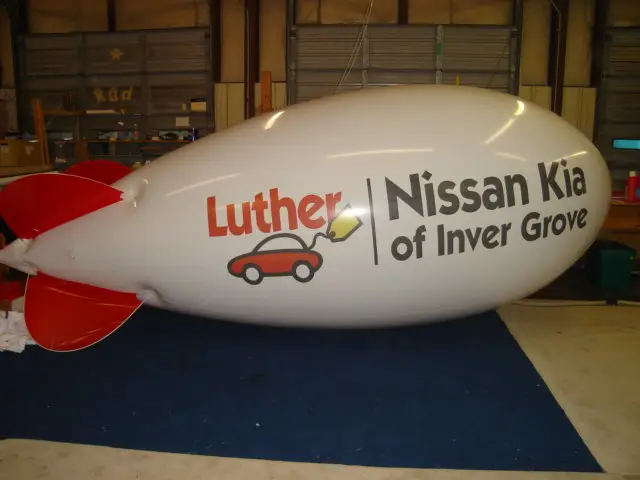
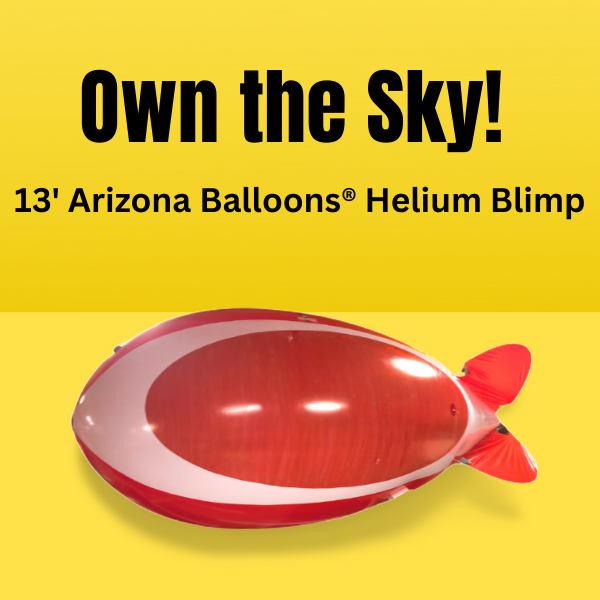
Large-format helium advertising balloons used in commercial and real estate marketing — such as the cold-air and helium blimps deployed above new home communities, car dealerships, and retail grand openings — require industrial-grade helium. While industrial helium commands a lower purity specification than the ultra-high-purity grades used in semiconductor manufacturing, all helium grades share the same upstream supply chain. When that chain constricts, every grade is affected to some degree.
The most direct effect on marketing campaigns is cost escalation. As helium prices rise in North American spot markets, vendors who do not have long-term supply agreements may pass those costs on to customers. This makes it more important than ever to work with an established aerial marketing vendor that has contracted supply relationships in place rather than purchasing helium on an ad hoc basis. For businesses that own their own blimps or large inflatables, now may be a good time to assess your current helium inventory, check your vendor’s supply situation, and consider locking in pricing where possible.
It is also worth noting that cold-air inflatables — large tethered balloons filled with ambient air rather than helium — are entirely unaffected by helium pricing and availability. For many ground-level and rooftop marketing applications, advertising blimps and cold-air inflatables provide the same visual impact and brand visibility as helium-filled units, without any dependency on the helium supply chain. Experienced balloon marketing companies typically offer both options, allowing clients to choose the right tool for each campaign based on site conditions, height requirements, and budget.
What This Means for Your Marketing
Supply disruptions in commodity markets rarely stay contained to the industries directly affected. When helium prices climb and availability tightens, the natural response for some businesses is to scale back outdoor and aerial marketing. That instinct can actually create a competitive opportunity for businesses that stay the course. If your competitors pull back on high-visibility marketing tools like giant inflatables, rooftop blimps, and aerial signage during a supply crunch, your continued presence becomes more noticeable by comparison. Outdoor, location-based marketing works on the principle of standing out — and a moment when others retreat is a moment to be seen.
For home builders, auto dealers, trade show exhibitors, and retail businesses, the visual power of helium advertising balloons and aerial marketing blimps remains one of the most cost-effective ways to generate drive-by traffic and foot traffic. Even in a higher-cost helium environment, the return on investment from a well-deployed inflatable over a new subdivision, a dealership grand opening, or a trade show floor is substantial compared with digital or print alternatives that compete for attention in increasingly saturated channels.
The most practical step for marketing decision-makers right now is to plan campaigns in advance, communicate early with your aerial marketing vendor about timelines, and ask specifically about helium supply commitments. Companies with established distributor relationships and flexible product offerings — including cold-air alternatives — will be best positioned to keep your campaigns on schedule regardless of how the global helium market evolves over the coming months.
Sources
- The Oregon Group / TheNewswire: “Helium Shortage Threatens Semiconductor Supply Chain, Positions U.S. as Strategic Supplier” (April 6, 2026)
- The Oregon Group: “Helium Crisis Puts US in Control of Semiconductor Supply Chain” (April 2026)
- Smith: “Helium Shortage Update: April 9, 2026”
- Santiago & Company: “The Real Helium Crisis Begins After the Ceasefire” (April 2026)
- Unteachable: “Helium Shortage 2026: The Crisis Explained”
- The Weather Network: “Will the Global Helium Shortage Affect Weather Forecasts?” (April 2, 2026)
- U.S. Geological Survey: Mineral Commodity Summaries 2026 — Helium and Rare Gases
- IMARC Group: Helium Price Index, Chart, Trend & Forecast 2026
- Expert Market Research: Helium Price Trend 2026 | Forecast, Chart & Index (March 28, 2026)