Small Business Advertising Trends 2026: Why Outdoor Visibility Still Wins
By Arizona Balloon Company (arizonaballoon.com) | April 22, 2026
Small Business Advertising Trends Show Budgets Are Rising in 2026
The latest research on small business advertising trends confirms what many marketing managers already feel: competition for customer attention is intensifying, and businesses are responding by opening their wallets wider. According to a major survey of 1,500 small business owners across the United States and other English-speaking markets, conducted by Constant Contact and reported by Marketing Profs in February 2026, a substantial majority of small business advertising trends owners’ expect both their marketing budgets and the time they devote to marketing to increase this year. Specifically, 68 percent of respondents anticipated higher marketing spending, and 74 percent expected to invest more hours into their marketing programs.
The same survey found that inflation and rising costs are the top concern heading into the year, yet business owners are pressing forward with investment rather than pulling back. The intent signals a fundamental shift in how small and mid-size businesses view marketing: not as a discretionary line item to be trimmed when budgets tighten, but as a core operational expense tied directly to survival and growth.
A separate analysis from LocaliQ, drawing on responses from more than 300 small business owners in the United States, reinforced this trend. More than half of those surveyed — 53 percent — plan to put more money into video marketing and advertising, while 47 percent plan to increase investment in both search advertising and social media advertising in 2026. At the same time, 24 percent said they planned to reduce investment in traditional media, up from 16 percent the prior year, signaling a continued pivot toward measurable digital channels.
Digital Channels Dominate — But Come With Rising Costs
The surge in digital spending is not without friction. According to the local advertising cost analysis published by Adwave in February 2026, Google Ads costs have continued rising approximately five to ten percent annually as more businesses compete for the same high-intent search queries. The result is a tightening cost-per-lead environment, particularly for local service businesses. Home services and trades providers, for example, routinely encounter cost-per-click figures between five and fifteen dollars, making paid search one of the most expensive digital channels for small businesses in competitive markets.
Social media advertising costs have stabilized somewhat compared to previous years, but the platforms themselves are becoming increasingly pay-to-play. The LocaliQ report noted that 66 percent of small businesses expect economic uncertainty to be a significant challenge in 2026, up sharply from 48 percent the year before. That anxiety is pushing many owners toward lower-cost marketing strategies even as their overall budgets grow — a tension that makes high-visibility, low-cost-per-impression formats more attractive than ever.
Entrepreneur contributor and marketing firm co-founder Neil Patel, writing in March 2026, observed that the marketing funnel itself is being restructured. Discovery now happens across AI assistants, social feeds, marketplaces, and video platforms simultaneously. That fragmentation raises the stakes for formats that create undeniable physical presence — the kind that does not depend on an algorithm to deliver it.
Why Local Visibility Has Never Mattered More
One of the clearest findings across multiple 2026 marketing reports is the renewed emphasis on local, community-rooted visibility. VitalStorm’s analysis of top small business marketing trends, published in February 2026, noted that local marketing in 2026 is no longer just about listing a city name on a website. Search engines and social platforms are increasingly favoring businesses that demonstrate genuine community connection, and consumers are making purchasing decisions based on which businesses feel like they belong to their neighborhood.
The Rhode Island Small Business Development Center’s marketing trends guide for 2026, published in March of this year, reinforced this point from a strategic perspective. Growth-oriented small businesses are shifting focus to mapping the entire customer journey and identifying precisely where prospective customers disengage before converting. For businesses with a physical location — a model home community, a car dealership lot, a trade show booth, a retail storefront — this means that driving foot traffic and first impressions at the location level is as important as any digital funnel optimization.
Physical, location-based visibility creates what community-focused marketing analysts describe as referral ecosystems. When people see a business making a bold, visible statement in their community, they talk about it, photograph it, and share it. That word-of-mouth amplification cannot be purchased through a Google Ads campaign. It has to be earned through presence.
The Outdoor Advertising Advantage for Small Business
Amid all the discussion of digital strategy, outdoor advertising continues to deliver some of the most competitive cost-per-impression figures available to small businesses. The Adwave local advertising cost guide places outdoor formats at roughly three to ten dollars per thousand impressions — significantly lower than the fifteen to eighty dollar CPM range associated with streaming television or paid search. For businesses that need sustained visibility in a specific geographic area, outdoor formats offer an efficiency that digital channels struggle to match.
Outdoor advertising also operates without the fragmentation problem that plagues digital channels. A billboard, banner, or aerial display does not compete with an algorithm for placement. It does not require a user to be logged in, on the right platform, or using the right device. It simply occupies space in the physical environment where customers already are, delivering impressions whether or not a prospective buyer is actively searching.
According to the Shopify small business marketing budget guide, in-person awareness campaigns — including event booths, pop-up shops, and roadshows — are recognized as a legitimate category of core marketing investment alongside digital advertising. This recognition reflects a broader understanding that physical presence and digital presence work best as complements, not substitutes.
Where Helium Advertising Balloons and Marketing Blimps Fit In
For the industries most directly affected by the 2026 small business advertising trend toward local visibility — home builders opening new communities, auto dealerships competing for weekend foot traffic, trade show exhibitors vying for booth attention, and general retailers marking grand openings — helium advertising balloons and giant marketing blimps address a specific marketing problem that no digital channel can solve: making a location impossible to overlook.
A giant helium advertising balloon anchored above a model home sales office or a new construction community creates an aerial landmark visible from a mile or more away. In markets where dozens of competing communities may share the same highway corridor, that kind of differentiation is not cosmetic — it is commercial. Shoppers looking for a sales office they have never visited before will reliably navigate to a visible aerial marker before they will scroll through a website for directions.
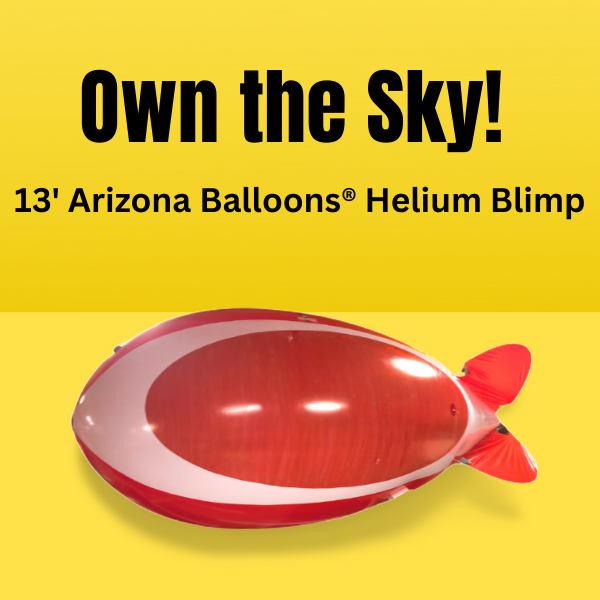
Marketing blimps carry the same principle to an even larger scale. A giant advertising blimp tethered above a trade show, a dealership event, or a grand opening ceremony creates a visual anchor that serves as both a wayfinding tool and a branding statement. The cost-per-impression arithmetic for aerial inflatables compares favorably to digital alternatives, particularly for events where concentrated local reach matters more than broad demographic targeting. And unlike a Google ad, a helium blimp floating above your event does not disappear when the budget runs out — it stays in the air as long as you need it.
The 2026 advertising environment, characterized by rising digital costs, algorithmic fragmentation, and consumer preference for businesses that feel genuinely local, creates favorable conditions for physical, location-based marketing formats. Small businesses that layer aerial visibility into their marketing mix benefit from the combination of digital reach and physical presence — a pairing that the research consistently shows outperforms either channel used in isolation.
What This Means for Your Marketing
The core message of the 2026 small business advertising trend data is straightforward: spending more is not enough. The businesses that are gaining ground are those investing in the right combination of channels — ones that work together to reach prospective customers at different stages of their journey. For businesses that depend on location-based traffic, that combination must include a strategy for physical, on-site visibility. Digital campaigns drive awareness and interest; location-based tactics convert that interest into a visit.
Outdoor advertising formats, including helium advertising balloons and aerial marketing blimps from Arizona Balloon Company, are particularly well suited to the industries where local foot traffic is the primary revenue driver. Home builders, auto dealers, event exhibitors, and retail businesses all operate in environments where the ability to be seen from a distance — before a customer has made a final decision about where to go — directly influences sales outcomes. In a competitive market, the business that can be spotted from a busy road or a trade show floor entrance has a structural advantage that no amount of social media spend can fully replicate.
As digital advertising costs continue to rise and consumer attention becomes more fragmented across platforms, the relative value of high-visibility outdoor formats increases. Marketing managers evaluating their 2026 channel mix should assess not just where their budget is going, but where it is physically showing up. Aerial inflatables, event balloons, and custom marketing blimps offer a proven, cost-effective mechanism for making your location the most visible one in any competitive environment — a principle that has only become more valuable as the digital landscape grows more crowded and expensive.
Sources
- MarketingProfs: More Spend, More Time — Small Business Marketing Trends for 2026 (February 28, 2026)
- LocaliQ: The Big Small Business Marketing Trends Report for 2026 (February 25, 2026)
- VitalStorm: Top 5 Marketing Trends Every Small Business Should Watch in 2026 (February 28, 2026)
- Rhode Island SBDC: Marketing Trends for 2026 — What’s Changing and How Established Businesses Can Expand Their Customer Base (March 12, 2026)
- Adwave: Local Advertising Cost Guide 2026 (February 18, 2026)
- Entrepreneur: These Marketing Trends Are Helping Small Businesses Get Ahead in 2026 (March 13, 2026)
- Shopify: How to Create a Small Business Marketing Budget in 2026