Trade Show Booth Visibility in 2026: The Trends Every Exhibitor Needs to Know
By Arizona Balloon Company (arizonaballoon.com) — June 10, 2026
Trade Show Attendance Has Rebounded—But the Stakes Are Higher
Achieving strong trade show booth visibility has never been more competitive than it is in 2026. After years of disruption, major U.S. trade shows are operating close to pre-pandemic attendance levels. Events such as CES in Las Vegas, HIMSS in healthcare IT, and PACK EXPO in manufacturing have all reported near-full recoveries, and exhibitor investment has followed. But the return of crowds has not made standing out easier—if anything, the noise level on the show floor has intensified.
Industry analysts tracking the Center for Exhibition Industry Research (CEIR) Index note that while attendance is now only about 3.7 percent below 2019 levels, exhibitor revenue gaps have been slower to close. Companies are bringing leaner teams to shows, spending more deliberately, and demanding clearer returns on every marketing dollar. In that environment, getting noticed quickly—before an attendee walks past—is no longer optional. It is the whole game.
The United States hosts roughly 13,000 trade shows annually, according to industry estimates, making it the most active exhibition market in the world. That volume gives exhibitors constant opportunity, but it also means that a forgettable booth presence is quietly expensive. The brands gaining ground in 2026 are those that treat a trade show not as a three-day event but as a multi-month marketing campaign anchored by a standout physical presence.
Booth Design Trends Dominating the 2026 Floor
Exhibit marketing in 2026 is moving away from passive, product-on-a-table displays and toward experiences that pull attendees in and hold their attention. The top-performing booths this year combine multisensory elements—directional audio, branded scent, and motion-triggered digital content—with intentional spatial design that creates calm contrast amid the surrounding chaos. Attendees who feel comfortable linger longer, and longer dwell time directly improves lead quality.
Dynamic signage has become a central investment. Flexible LED tiles and lightweight screen panels now allow booth walls to function as moving canvases, with messaging that can shift based on time of day or audience flow. Yet even the best digital display has a hard ceiling: it only reaches the people who are already standing in front of it. For exhibitors competing in large convention halls where one brand’s booth looks like the next, the most critical design challenge is attracting foot traffic before a prospect ever gets close enough to see a screen. That is where height and visibility above the crowd line become strategic assets, not aesthetic choices.
Branding experts consistently emphasize that attendees should be able to understand who an exhibitor is and what they offer within seconds of noticing the booth—ideally from across the hall. Visual consistency across signage, colors, and messaging plays a role, but so does the physical elevation of brand elements. The exhibitors who claim space overhead, rather than only at eye level, are using one of the most direct ways to cut through a visually saturated environment. Learn more about high-visibility solutions at our advertising blimps page and explore how aerial branding works for trade show and event environments.

The Height Advantage: Why Aerial Signage Cuts Through the Noise
One of the clearest insights from 2026 booth design research is that height functions as a signal. When a brand element rises above the crowd line—whether it is a multi-story LED tower, an overhead banner, or a floating inflatable—it communicates presence and confidence before a single conversation starts. The eye naturally tracks upward in a crowded environment, making elevated branding one of the few forms of exhibit marketing that works at a distance and at close range simultaneously.
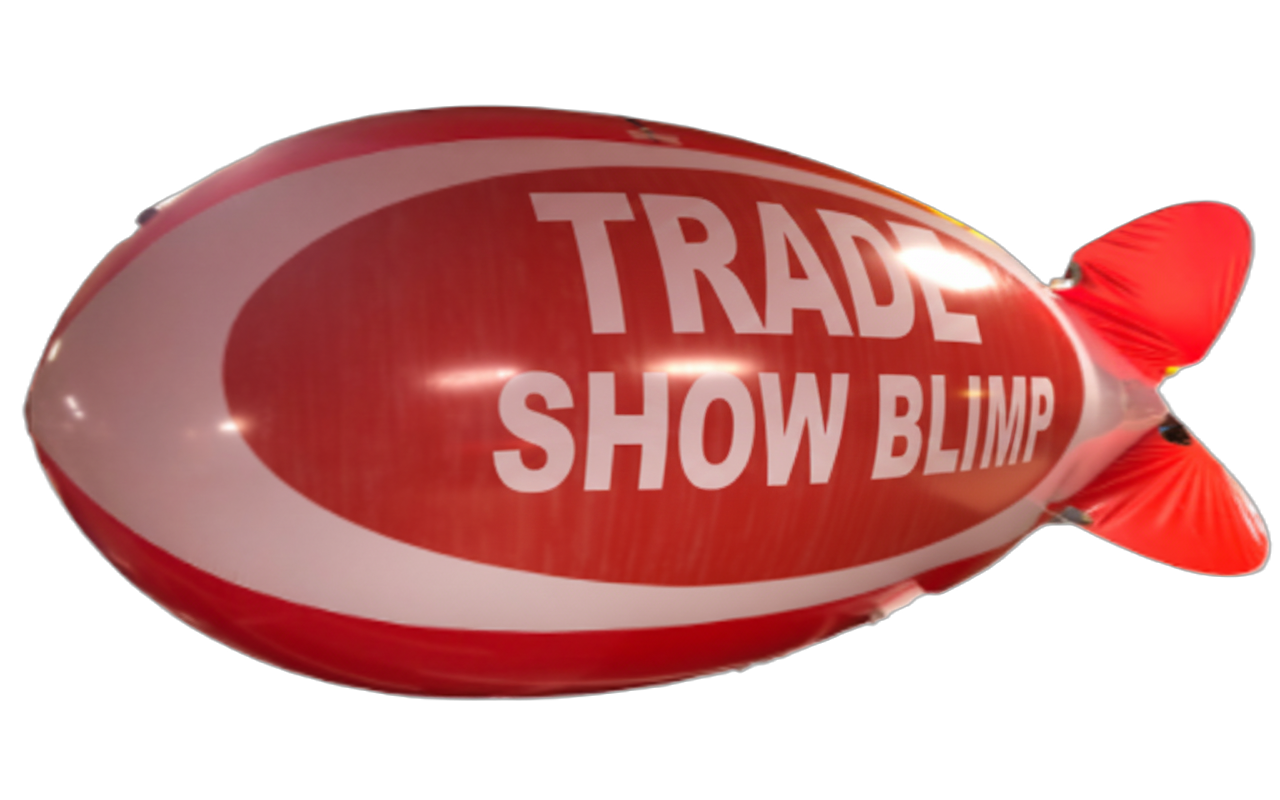
For outdoor trade shows, festival-adjacent events, open-lot expos, and convention center entrances, helium advertising balloons and tethered marketing blimps provide exactly this kind of above-the-crowd brand presence. A custom-printed balloon bearing a company’s logo can be seen from hundreds of feet away—drawing traffic toward the exhibit location before attendees even consult a venue map. Unlike digital installations that require proximity to deliver their message, aerial inflatables work continuously at maximum range from the moment they are inflated.
The practical advantages align well with the cost-consciousness that defines 2026 exhibit spending. Helium advertising balloons require no power source, no technical staff to operate, and no complex setup logistics. They are reusable across multiple shows, consistent with the sustainability and modularity trends reshaping the exhibit industry this year. For a regional business or mid-size exhibitor competing against larger booths, aerial signage is one of the highest-visibility investments available at a comparatively modest price point.
Personalization and Experience Replace Passive Displays
The B2B buyer attending trade shows in 2026 has been shaped by consumer platforms that deliver hyper-personalized experiences on demand. Generic product demos no longer satisfy attendees who arrive with specific goals and limited time. Research consistently shows that when an attendee’s event experience aligns with their objectives, they are dramatically more likely to return and more likely to convert into a qualified lead after the show.
For exhibitors, this means the pre-show, on-site, and post-show phases need to function as a unified campaign rather than three separate activities. Artificial intelligence has moved from novelty to mainstream workflow in event marketing: AI adoption among event planners jumped to roughly 50 percent in 2025, and 2026 is the year these tools are becoming standard practice for lead scoring, attendee matching, and personalized follow-up. Exhibitors who map their full conference marketing funnel from six weeks before to six weeks after the event are consistently outperforming those who treat the show floor as the entire campaign.
Sustainability and Modularity as Competitive Differentiators
Sustainability has crossed from aspiration to expectation on the U.S. trade show floor. Modular and reusable booth structures are saving exhibitors an estimated 20 percent on carbon footprint and cost year over year, according to industry tracking. Leading operators are replacing disposable signage with bamboo frames, LED panels, and digital handouts. For many enterprise exhibitors, sustainable booth design is no longer a brand statement—it appears as a baseline requirement in event RFPs.
Modular systems also answer a practical operational need: exhibitors attending multiple shows per year need booth components that travel well, reconfigure to different footprints, and maintain brand consistency without being rebuilt from scratch each time. The shift away from single-use display materials mirrors a broader industry movement toward strategic, long-term exhibit investment rather than event-by-event spending. Reusable helium advertising inflatables fit directly into this framework—built to last across dozens of deployments, lightweight to ship, and immediately recognizable as a brand asset from show to show.
What This Means for Your Marketing
The defining challenge of trade show marketing in 2026 is not budget—industry planners report that budgets are actually growing, with nearly 60 percent of respondents preferring in-person-only events over virtual or hybrid formats. The challenge is differentiation. With attendance near pre-pandemic levels and exhibitor competition intensifying, the businesses that win on the floor are those that make themselves impossible to miss before an attendee is close enough to read a sign or watch a demo. Outdoor and location-based visibility tools are not supplementary to a trade show strategy—they are the top of the funnel.
For marketing decision-makers in industries like home building, automotive, and product manufacturing, trade shows remain one of the highest-ROI venues for face-to-face engagement with qualified buyers. Maximizing that ROI starts with driving traffic to the booth, and traffic follows attention. Helium advertising balloons and tethered aerial marketing blimps provide the kind of above-the-crowd visibility that no banner stand or digital display can replicate at range. A custom-branded inflatable floating 20 to 30 feet above a convention entrance or outdoor expo lot creates a visual landmark that attendees navigate toward—often before the show officially opens.
Whether you exhibit at regional consumer shows, national industry conventions, or outdoor seasonal expos, aerial signage solutions deserve a place in your pre-show and on-site marketing plan. The exhibitors pulling ahead in 2026 are combining immersive booth experiences with maximum approach visibility. Investing in both dimensions—what people see up close and what draws them from a distance—is the complete strategy that the current trade show landscape rewards.
Sources
- EMC Outdoor: 7 Trade Show Marketing Trends That Will Define Success in 2026
- Taylor Corporation: Trade Show Industry Trends for 2026 and Beyond
- Strategic Factory: 10 Trade Show Booth Trends to Watch in 2026
- Ace Displays: Trade Show Trends 2026
- Editorialge: Trade Show Exhibit Trends 2026 – Custom, Rental and Portable Designs
- Trade Show Labs: Trade Show Trends 2026 – AI, Hybrid Events and Exhibitor Strategies
- Exponents: Upcoming Trade Shows in the US in 2026 to Maximize ROI