
Auto Dealer Showroom Traffic Faces Friction as Spring Selling Season Normalizes
Auto Dealer Showroom Traffic Faces Friction as Spring Selling Season Normalizes in 2026
By Arizona Balloon Company (arizonaballoon.com) — May 8, 2026
Market Snapshot: April 2026 SAAR Forecast
Auto dealer showroom traffic is expected to remain steady but increasingly friction-filled as the U.S. new-vehicle market transitions out of its peak spring-selling window. According to a May 5, 2026 forecast released by automotive analytics firm Fountain Forward, U.S. light vehicle sales are projected to reach a seasonally adjusted annual rate of 16.1 million units for April 2026 — a modest dip from the notably strong 16.3 million SAAR recorded in March. The firm attributes the slight pullback to a winding down of tax-refund-driven demand and persistent affordability pressures that continue to weigh on deal-closing rates across franchised and independent dealerships alike.
The March performance itself was fueled by an unusually strong tax refund season and pent-up consumer demand, conditions that analysts say are unlikely to repeat in the months ahead. Fountain Forward CEO Stephen Jurgella noted that even with solid consumer liquidity earlier in the spring, affordability remains a key constraint, with more friction expected in deal structure and closing. For dealers, that translates directly to longer decision cycles and more negotiation at the finance desk — even when showroom doors are open and traffic counts look healthy on the surface.
The broader 2026 picture underscores the same theme. Cox Automotive has projected total new-vehicle sales of 15.8 million units for the full year, down approximately 2.4 percent from 2025. Front-end gross profit per vehicle (PVR) ticked upward through Q1 2026 for the first time in several years, but industry observers caution that meaningful margin expansion is unlikely for the balance of the year. Dealers who relied on thin-inventory, high-gross conditions through 2021 and 2022 are now operating in a fundamentally different environment where marketing efficiency and physical visibility matter more than ever.
Affordability and Negative Equity Create Deal Friction
Beyond the headline SAAR figures, the nuances inside each transaction tell a more telling story for dealership operators. Elevated monthly payments, negative equity on trade-ins, and stretched loan terms are collectively slowing the pace at which interested shoppers convert into signed buyers. Industry analysts at the JM&A Group noted in their Q1 2026 Automotive Trends Report that lenders offering longer financing terms alongside manufacturer-incentivized rates have helped sustain finance penetration, but those same long terms are creating equity gaps that complicate future trade cycles.
The used-vehicle market is absorbing some of the affordability pressure. With new-car average transaction prices hovering above $50,000, a growing number of budget-conscious buyers are pivoting toward certified pre-owned and off-lease inventory. Automotive News reported that several top dealership groups have responded by increasing their used-vehicle focus, with some groups selling more than two used vehicles for every new one. For dealerships that can balance both sides of the lot, the opportunity is real — but so is the need to attract attention to each segment separately, especially as buyers move fluidly between online research and in-person lot visits before committing.

Digital-First Buyers Still End the Journey on the Lot
Despite the rapid expansion of online retailing tools, the physical dealership lot remains the final decision point for the overwhelming majority of vehicle purchases. A recurring theme across multiple 2026 dealership marketing studies is that digital engagement — whether through search ads, social video, or AI-powered chat — is most effective when it drives in-person visits rather than attempting to replace them. According to research cited by Porch Group Media and referenced in automotive marketing industry analyses, three out of four car buyers watch video content before visiting a dealership, yet the dealership visit itself remains where deals are closed, trade-ins are appraised, and F&I products are presented.
What has changed is the sophistication of the buyer who walks onto the lot. Today’s shopper has frequently already compared trim levels, checked payment calculators, and verified inventory before arrival. Automotive digital marketing experts at Fullpath noted in March 2026 that traffic to dealership websites driven by AI platforms such as ChatGPT and Google Gemini increased dramatically year over year, signaling that prospective buyers are now using conversational AI tools to narrow their shortlist before ever picking up a phone. Dealers who fail to maintain accurate, well-structured online inventory data risk being filtered out before the physical visit even becomes a possibility.
Omnichannel Is Now the Baseline, Not a Differentiator
Industry analysts are converging on a consistent message for 2026: omnichannel execution is no longer a competitive advantage for auto dealers — it is the minimum standard for staying in contention. According to ACV Auctions’ 2026 dealership marketing outlook, buyers move across search engines, social platforms, dealership websites, email, SMS, and in-store visits without distinguishing between channels. Dealerships that unify their messaging, pricing, and promotions across all of those touchpoints are seeing higher appointment show rates and improved customer retention compared to those operating with siloed marketing stacks.
The practical implication for marketing managers is that no single channel — paid search, social media, direct mail, or outdoor signage — can carry the load alone. The most effective strategy layers multiple touchpoints so that a prospective buyer encounters consistent branding and inventory information regardless of where they happen to engage first. Digital Dealer’s 2026 outlook reinforced this point, noting that success this year hinges on adaptability and digital innovation while also emphasizing the importance of physical presence and in-store execution. Campaigns that create urgency around seasonal events, special financing windows, or model-year clearance inventory continue to perform well when they are supported by both digital and visible, on-lot marketing assets.
Why Outdoor Visibility Still Wins Auto Dealer Foot Traffic
In an environment where every marketing dollar is being scrutinized against measurable ROI metrics, it is easy to overlook the role that physical, on-location visibility plays in generating impulse and drive-by traffic for auto dealerships. Yet this category of marketing — making the dealership lot itself impossible to miss from the road — remains one of the most cost-effective tools available to dealers operating in competitive local markets.
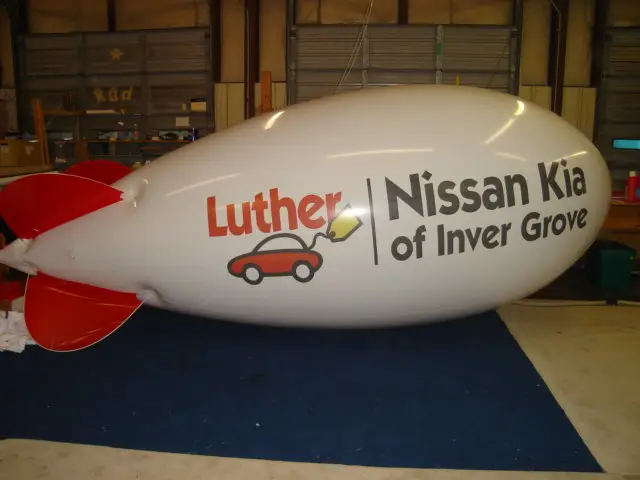
Helium advertising balloons and marketing blimps serve a function that no digital channel can replicate: they stop traffic. A 17-foot helium blimp tethered above a dealership lot is visible from a half-mile away, creating brand awareness among drivers who were not actively searching for a vehicle at that moment. That passive, location-based impression — repeated daily for thousands of commuters passing a dealership corridor — builds the kind of subconscious familiarity that influences which lot a buyer visits first when they are finally in-market. For dealerships competing with multiple franchises on the same road, aerial visibility is not a gimmick; it is a territory marker.
The category works especially well during high-stakes selling periods: model-year clearance events, holiday weekends, Memorial Day and Labor Day sales, and new inventory delivery windows. Cold-air advertising balloons in custom shapes — including oversized car replicas, giant gorillas, or branded tube men — draw attention on the lot itself and signal to passing drivers that something worth stopping for is happening right now. In a market where showroom traffic is under pressure from affordability headwinds and longer decision cycles, every incremental drive-in matters.
What This Means for Your Marketing
The May 2026 sales data reinforces a reality that dealership marketing managers have been navigating all year: generating steady showroom traffic requires more effort and more layers than it did even two years ago. As tax-refund urgency fades and the market normalizes around a 16-million-unit pace, dealerships need to shift messaging from urgency-only triggers to value, affordability, and payment flexibility — a recommendation echoed by Fountain Forward in their April forecast release. At the same time, marketing budgets need to be allocated across channels that work together, not in isolation.
Outdoor and location-based marketing deserves a prominent line in the 2026 dealership budget precisely because it performs a function that digital cannot: it intercepts buyers who are not yet in active search mode. Helium advertising balloons and aerial marketing blimps from Arizona Balloon Company have helped auto dealers across the country increase lot visibility, drive walk-in traffic during promotional events, and build daily brand impressions for commuters in their trade area. Unlike a paid search impression that disappears the moment a budget runs out, a tethered blimp or rooftop balloon continues to work as long as it is flying — making it one of the highest-impression-per-dollar assets available to a local dealership.
For dealers entering the second half of spring selling season, now is the time to audit the full marketing mix. Ensure that your digital strategy is backed by physical on-lot visibility that captures drive-by traffic, reinforces promotional events, and gives your location a competitive edge it can hold without an ongoing cost-per-click. A well-executed outdoor balloon or blimp campaign does not replace digital — it amplifies it by ensuring that the buyers your ads brought to your neighborhood actually turn into your lot instead of a competitor’s.
Sources
- Fountain Forward — April 2026 U.S. Auto Sales Forecast and Automotive Industry Outlook (EIN Presswire, May 5, 2026)
- JM&A Group — Automotive Trends Report Q1 2026
- Cox Automotive — 2026 Automotive Industry Outlook
- Automotive News — 2026 Top 150 Dealership Groups
- ACV Auctions — Automotive Digital Marketing Trends for 2026
- Fullpath — The Dealership Marketing Playbook for 2026 (March 2026)
- Digital Dealer — What’s Ahead for Automotive Dealers in 2026