Tag: outdoor signage

  • Small Business Advertising Trends 2026: 68% of Owners Are Raising Budgets—Here’s Where the Money Is Going

    <mark class=”rank-math-highlight” style=”background-color: #fee894″><mark class=”rank-math-highlight” style=”background-color: #fee894″>Small Business Advertising Trends 2026:</mark></mark> 68% of Owners Are Raising Budgets—Here’s Where the Money Is Going

    Small Business Advertising Trends 2026: 68% of Owners Are Raising Budgets—Here’s Where the Money Is Going

    By Arizona Balloon Company (arizonaballoon.com) — April 8, 2026

    small business advertising trends 2026 showing increased marketing investment and outdoor signage

    Small Business Advertising Trends Show Marketing Budgets Are Rising Despite Economic Headwinds

    The latest data on small business advertising trends delivers a clear message: most American business owners are betting on marketing, not retreating from it. A survey of 1,500 small business owners across the United States and other English-speaking markets, conducted by Constant Contact and reported by American Marketer on April 7, 2026, found that 68 percent of small business owners expect their marketing budgets to increase this year. Additionally, 74 percent expect to spend more time on marketing in 2026 than they did in 2025. That momentum is remarkable given the economic backdrop. Inflation and rising costs remain the top concern cited by small business owners heading into the year. Rather than pulling back, the majority of owners are choosing to invest through the uncertainty.

    A separate survey of more than 300 small businesses conducted by LocaliQ reinforces the trend. According to that report, nearly 40 percent of small businesses plan to increase their marketing budgets in 2026. Conversely, only 8 percent plan to decrease them. The majority—54 percent—plan to keep budgets flat. This means that those who are spending more represent a decisive, proactive segment of the market. For businesses aiming to capture local market share, this shift signals a more competitive environment. Visibility and brand consistency will separate the winners from those who stay on the sidelines.

    Clutch’s budget planning research, which surveyed 337 marketing professionals, adds further context: 60 percent of small businesses plan to increase their 2026 marketing and advertising budgets compared to 2025. Furthermore, 78 percent of marketing professionals say they are optimistic about the marketing landscape this year. The confidence is measurable and broad-based. The question for any individual business owner is not whether to invest, but where.

    Where the Money Is Going: Channels, AI, and Efficiency in Small Business Advertising Trends

    The LocaliQ report found that more than half of small businesses plan to invest more in video marketing and advertising (53 percent). Meanwhile, 47 percent plan to put more into search advertising and social media advertising. Social media is widely expected to be the channel delivering the most value in 2026. One in three U.S. small business owners plan to launch entirely new social campaigns rather than simply continuing existing ones, according to the Advertising Week analysis of Constant Contact data.

    As we delve deeper into small business advertising trends, it’s essential to consider how this year’s changes will impact local markets.

    Understanding small business advertising trends allows owners to prioritize their marketing efforts effectively.

    Tracking these small business advertising trends will help in forecasting future market shifts.

    The latest insights into small business advertising trends reveal the importance of adapting to evolving consumer behaviors.

    By analyzing small business advertising trends, companies can identify opportunities that will enhance their outreach.

    These small business advertising trends indicate a shift towards more integrated marketing strategies.

    Awareness of small business advertising trends can significantly influence budget allocation decisions.

    As small business advertising trends evolve, staying informed is crucial for competitive advantage.

    Small business advertising trends are crucial for understanding consumer engagement in 2026.

    AI adoption is accelerating alongside those budget increases. Constant Contact’s research found that 54 percent of small business owners are already using AI marketing tools. Additionally, another 27 percent plan to adopt them this year. Business owners are using AI primarily to analyze trend data (45 percent), create campaigns and content (44 percent), and develop visual assets (40 percent). NP Digital’s 2026 budget research found that 61 percent of B2B marketers are increasing overall marketing spend this year. Furthermore, SEO budgets are rebounding sharply after a softer 2025.

    Yet, the data also reveals a persistent gap. Despite enthusiasm for digital channels, research from DIY Marketers and the LocaliQ report both caution that direct marketing, referrals, and relationship-based channels consistently outperform social media for businesses with fewer than 50 employees—often at a fraction of the cost. Many small businesses are increasing their digital budgets while underinvesting in high-ROI channels that have proven track records closer to home.

    The Offline Opportunity Most Small Businesses Are Missing

    While digital spending dominates the conversation, Clutch’s research contains a telling data point: about a third of marketers anticipate decreasing spending in traditional media such as TV, print, and radio. However, the same report draws a clear distinction: this pullback does not extend to all offline channels. Sponsorships and strategic partnerships are actually gaining investment from 35 percent of marketers surveyed. This reflects a growing appetite for physical-world visibility that connects brands to local communities and real foot traffic.

    This is where location-based, outdoor advertising tools earn their place in any well-rounded marketing plan. While national TV buys and print runs are declining because they are expensive and difficult to attribute, hyper-local outdoor advertising is a different story. A business that can place a high-visibility marker precisely at the point where potential customers are making location decisions—at a grand opening, a new community development, a trade show floor, or a heavily trafficked intersection—captures attention that no email campaign or social post can replicate. That principle has driven the demand for advertising blimps and marketing inflatables for decades, and it is as relevant in 2026 as it has ever been.

    small business advertising trends 2026 showing increased marketing investment and outdoor signage

    Why Outdoor Visibility Still Drives Foot Traffic and Walk-In Revenue

    The 2026 small business marketing data, taken as a whole, points to a fundamental challenge: digital channels are becoming more crowded, more expensive, and harder to attribute as AI-driven search changes how consumers find local businesses. NP Digital’s research notes that AI systems increasingly provide direct answers without sending users to websites at all. This means website traffic is expected to continue declining even as search engine use remains high. For any business that depends on foot traffic, walk-in customers, or local visibility—home builders, auto dealers, trade show exhibitors, and neighborhood retailers among them—this trend underscores the value of marketing that works in physical space.

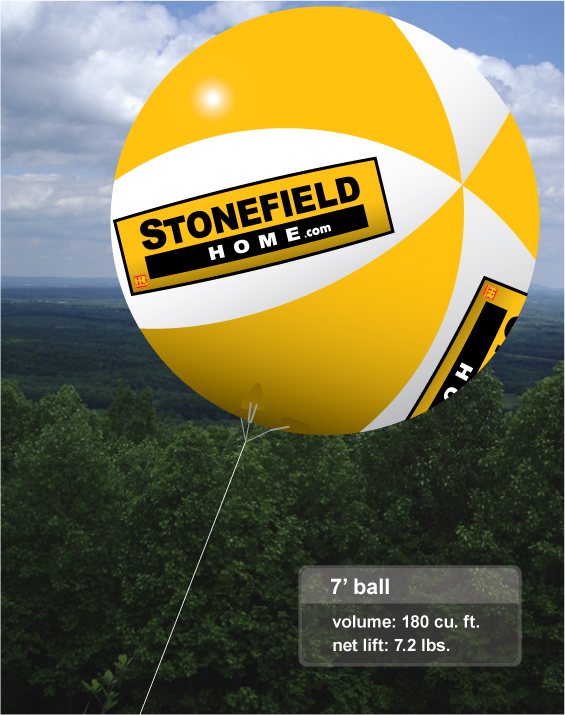
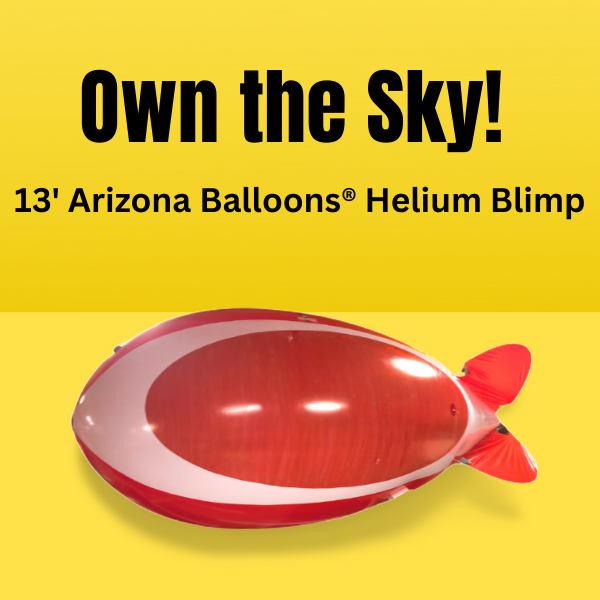
    Helium advertising balloons and giant inflatable marketing products function precisely in the environment where digital struggles most: the physical world at the moment of decision. When a family drives through a new subdivision and spots a towering blimp above a model home, or when a trade show attendee sees an inflatable display rising above the booth floor, the impression is immediate, three-dimensional, and impossible to scroll past. That is the kind of attention that complements a well-funded digital strategy rather than competing with it. Helium advertising balloons from Arizona Balloon Company are used by home builders, auto dealerships, and event marketers across the Southwest for exactly this reason. They create a visible landmark that drives traffic from the street level into the sales environment.

    Balancing Digital and Physical: A Smarter Channel Mix for 2026

    The Rhode Island Small Business Development Center’s 2026 marketing guidance emphasizes that growth-oriented businesses are focusing on mapping and connecting the entire customer journey rather than executing isolated tactics. That principle applies directly to the question of channel mix. When 66 percent of small businesses report that economic uncertainty is somewhat or very challenging heading into 2026, according to LocaliQ, every marketing dollar must justify its place in the budget. Outdoor advertising tools that are visible, repeatable, and budget-scalable—such as helium blimps rented for a grand opening weekend or a weekend auto sale event—offer a measurable cost-per-impression that many digital alternatives struggle to match at the local level.

    Neil Patel’s 2026 marketing budget analysis, published by NP Digital, recommends a 70-20-10 framework. Seventy percent of the budget should be allocated to proven high-ROI channels, 20 percent to promising growth channels, and 10 percent to experimental tactics. For businesses with strong walk-in or event-driven sales cycles, physical visibility tools belong in the proven 70 percent tier. They are not a novelty. They are a tested, location-specific demand-generation tool with a long and documented track record across retail, real estate, and event marketing.

    The Boomer Productions analysis of the top ten marketing trends for small businesses in 2026 highlights that community trust and human connection are emerging as differentiators. Digital channels are becoming commoditized. An inflatable advertising display at a local event, a grand opening, or a community trade show is a tangible, human-scale statement of presence. This reinforces exactly the kind of trust and local identity that drives long-term customer relationships.

    What This Means for Your Marketing

    The clearest takeaway from the 2026 small business advertising data is that increasing your marketing investment is not enough on its own. The businesses that will outperform are those that combine digital precision with physical presence. They reach customers both in their feeds and in the real world. If your competitors are raising their digital budgets while ignoring the street level, that gap is an opportunity. A visible, well-placed outdoor marketing asset during a grand opening, a seasonal sale, or a community event can deliver the kind of immediate foot traffic and brand impression that online campaigns build toward over weeks and months.

    For home builders, auto dealers, trade show exhibitors, and local retailers navigating a more competitive 2026 marketing environment, outdoor location-based advertising tools deserve a line in the budget. Helium advertising balloons and aerial marketing blimps are among the most cost-effective and attention-commanding options available. They are particularly beneficial for businesses with a physical location or event-driven sales model. They are visible from distance, require no ongoing ad spend after deployment, and create a landmark that guides customers directly to your door.

    Whether you are evaluating your 2026 marketing mix for the first time or looking to fill gaps that digital channels cannot reach, the data makes the case for a channel that operates where algorithms cannot: in the open air, above the roofline, and in direct view of your next customer. Arizona Balloon Company manufactures, rents, sells, and services helium advertising inflatables for businesses across the United States. Explore product and rental options to see what fits your next campaign.

    Sources

    Ultimately, recognizing small business advertising trends is key to thriving in a dynamic market.

    These observations on small business advertising trends provide a roadmap for future marketing endeavors.

    Business owners should monitor small business advertising trends closely to adjust their strategies.

    Aligning strategies with small business advertising trends can yield significant returns on investment.

    Leveraging insights from small business advertising trends will enhance customer outreach efforts.

    Adapting to small business advertising trends can help local businesses thrive amid challenges.

    The ongoing analysis of small business advertising trends will yield actionable insights for marketers.

    It’s imperative for small businesses to adapt to the latest small business advertising trends to remain relevant.

    Grasping small business advertising trends empowers businesses to reach their target audiences more effectively.

    Innovative ideas stemming from small business advertising trends will shape local market strategies.

    Tracking these small business advertising trends will help in forecasting future market shifts.

    Small business advertising trends are crucial for understanding consumer engagement in 2026.

    Researching small business advertising trends can lead to innovative approaches in marketing campaigns.

    As small business advertising trends evolve, staying informed is crucial for competitive advantage.

    Marketers are leveraging small business advertising trends to craft compelling narratives that engage consumers.

    Awareness of small business advertising trends can significantly influence budget allocation decisions.

    These small business advertising trends indicate a shift towards more integrated marketing strategies.

    By analyzing small business advertising trends, companies can identify opportunities that will enhance their outreach.

    The latest insights into small business advertising trends reveal the importance of adapting to evolving consumer behaviors.

    Understanding small business advertising trends allows owners to prioritize their marketing efforts effectively.

    As we delve deeper into small business advertising trends, it’s essential to consider how this year’s changes will impact local markets.

  • Out of Home Ad Spend


    US Out-of-Home Ad Spend Hits $4 Billion in 2026 — And Traditional Formats Are Still in the Game

    By Arizona Balloon Company (arizonaballoon.com) — April 2, 2026

    out of home ad spend-Outdoor advertising displays along a busy urban street, showing billboards and signage targeting consumers in public spaces

    US OOH Reaches a $4 Billion Milestone

    US out-of-home advertising spending is projected to reach $4 billion in 2026, a 4.1% increase year-over-year, according to new data published in March 2026 by Guideline, a media intelligence platform that tracks more than $110 billion in annual ad spend sourced directly from holding companies and independent agencies. The figure marks a steady continuation of growth that has averaged roughly 4% annually since 2022, when the category stood at $3.4 billion.

    The report confirms that OOH is the only non-pure-digital advertising format expected to grow at all in 2026. Radio, print, and linear television are collectively forecast to contract by 3.5%, while performance digital channels — search, social, streaming audio, connected television, and programmatic — are projected to expand 6.7%. OOH occupies a distinct middle position: consistently growing in absolute dollars while competing in an ad market expanding faster around it.

    The Digital vs. Traditional Split

    The headline growth number conceals a sharp divide within the OOH category. Digital out-of-home formats are projected to expand 14.5% in 2026, while traditional formats — static billboards, banners, posters, and non-screen physical displays — are forecast to grow just 1.5%. That nearly ten-to-one ratio reflects a structural shift that has been accelerating since at least 2017, when digital formats accounted for only 7% of total US OOH ad spend. By 2025, that figure had climbed to 20%, with digital capturing 55% of all OOH revenue growth between 2024 and 2025, per the Guideline data.

    However, the DOOH deceleration is also real. Guideline’s report describes digital’s growth trajectory as “healthy but decelerating,” citing limited inventory as a structural constraint on how quickly the market can absorb advertiser demand. Despite extensive programmatic infrastructure expansion in 2025 and early 2026 — including major platform acquisitions and new screen partnerships — supply-side bottlenecks continue to slow adoption.

    Growing Dollars, Shrinking Market Share

    One of the most striking findings in the Guideline report is what analysts describe as a market-share paradox. Although OOH has posted year-over-year revenue gains every year since 2022, its share of total US media expenditure has declined. OOH represented 3.1% of all US media spend in 2022 and had slipped to 2.7% by 2025 — a loss of 40 basis points over three years even as the category posted consistent absolute growth.

    Guideline calculates that OOH lost roughly $500 million in market share since 2022 and $1.3 billion since 2017. The cause is straightforward: the broader advertising market has grown faster than outdoor. For marketing decision-makers, this framing matters. Outdoor advertising is not shrinking — but it is competing for a share of budgets in an environment where digital performance channels are absorbing an outsized portion of new spending.

    Where the Budgets Are Coming From

    Guideline’s source-of-volume analysis tracks specific budget flows feeding OOH growth. Between 2024 and 2025, television contributed $248 million in net dollars shifting into OOH, while digital performance channels represented a net outflow of $104 million. Industries identified as high-growth OOH spenders include banking, non-health insurance, and discount retail — categories that rely on geographic reach and high-frequency visibility to drive consumer behavior.

    Separately, independent research from Keen Decision Systems found that OOH advertising achieves a marginal ROI of $7.58 per incremental dollar invested, compared with a cross-channel average of $5.52. That ROI credential is increasingly cited by media planners as a justification for maintaining or growing outdoor allocations even as digital spending pressure intensifies.

    Why Physical Formats Still Win on the Ground

    For businesses that operate in local or regional markets — home builders promoting new communities, auto dealers drawing traffic to a lot, trade show exhibitors competing for booth visitors — the relevance of macro OOH data comes down to a practical question: what gets noticed by people who are physically present in a specific place, at a specific moment?

    The Guideline report’s own budget-loss analysis offers a revealing data point. Of traditional OOH budgets that migrated away from the format in 2025, only 1% were reinvested into digital out-of-home. The remaining 99% shifted to social, programmatic search, and other digital channels — environments with no guaranteed physical presence. This gap represents an ongoing opportunity for location-anchored physical advertising formats that screen-based digital cannot replicate. High-visibility physical assets — large-format inflatables, aerial signage, and advertising balloons positioned at a sales center, event venue, or high-traffic corridor — operate in the same “unblockable” physical space that makes static billboards valuable, but with the added advantage of vertical visibility and the novelty that draws eyes. Unlike a screen, a large helium balloon or marketing blimp visible from a highway or across a subdivision cannot be scrolled past, filtered out, or served to the wrong audience.

    What This Means for Your Marketing

    The Guideline data confirms that out-of-home advertising is a durable channel in a volatile media landscape. For businesses making location-based marketing decisions in 2026 — whether promoting a grand opening, a model home, a dealership event, or a trade show appearance — the strategic implication is clear: physical presence in the right place still drives measurable outcomes that digital alone cannot replicate. OOH’s $7.58 marginal ROI figure is a headline number worth putting in front of any budget committee skeptical of spending outside digital channels.

    The growing split between digital and traditional OOH also signals opportunity rather than threat for businesses that rely on physical foot-traffic conversion. As larger advertisers chase programmatic DOOH inventory, competition for attention in the physical, non-screen space becomes less crowded — not more. Local businesses, home builders, auto dealers, and event marketers who deploy distinctive, high-visibility physical advertising assets hold an advantage in precisely the environments where their customers are making purchase-influencing decisions in real time.

    For businesses exploring what large-format physical outdoor advertising can look like in practice, helium advertising balloons and aerial marketing blimps offer a proven, attention-commanding format that complements any broader OOH or experiential strategy. As the overall OOH market grows toward and beyond $4 billion, the fundamentals that make physical outdoor advertising effective — visibility, geographic precision, and an inability to be ignored — remain unchanged.

    Sources