Outdoor Advertising’s “Human Medium” Moment: What the $4B OOH Surge Means for Your Business
By Arizona Balloon Company | May 1, 2026
OAAA Declares OOH the “Human Medium” Ahead of Dallas Conference
The outdoor advertising human medium industry is rallying around a powerful new identity just as US out-of-home spend crosses a major milestone. The Out of Home Advertising Association of America (OAAA) has unveiled the full agenda for its 2026 OOH Media Conference — taking place May 11 through 13 in Dallas — and with it, a refreshed industry positioning that brands out-of-home as the “human medium,” the one advertising channel that is shared, physical, unskippable, and woven into everyday life. For marketing managers and business owners investing in outdoor advertising human medium strategies, the timing of this declaration could not be more relevant.
The OAAA’s April 24, 2026 announcement brought together a marquee lineup of speakers, including serial entrepreneur Emma Grede, co-founder of SKIMS and Good American; John Morgan, founder of Morgan & Morgan and a prominent investor in OOH; Rishad Tobaccowala, Senior Advisor at Publicis Groupe; and leaders from Google, Zillow, National Geographic, and UTA. The Dallas Cowboys Cheerleaders are set to close out the first night of programming — a fitting symbol of the live spectacle that defines out-of-home at its best.
OAAA President and CEO Anna Bager framed the conference’s purpose plainly: brand marketers, agency executives, media decision-makers, and technology leaders are converging in Dallas to align on what comes next for a medium that is growing in both scale and strategic importance. The conference also introduces an inaugural OAAA Honors Circle to recognize exceptional achievement across the disciplines that shape out-of-home advertising.
US Out-of-Home Ad Spend Reaches $4 Billion in 2026
The conference backdrop is a market in genuine expansion. US out-of-home advertising spend is projected to reach $4 billion in 2026, a 4.1% year-over-year increase, according to new data released by Guideline, the media intelligence platform that captures more than $110 billion in annual ad spend directly from holding companies and independent agencies. This figure continues a steady climb from $3.4 billion in 2022, through $3.7 billion in 2024, and $3.9 billion in 2025.
What makes this moment particularly meaningful is the context. According to Guideline’s analysis, OOH is now the only non-pure-digital advertising format forecast to grow at all in 2026. Traditional media categories — radio, print, and linear television — are collectively projected to contract by 3.5%. Performance digital formats such as search, social, connected TV, and retail media are forecast to grow 6.7%. OOH sits between them, growing steadily and holding a distinct position: it is the only mass-reach, real-world medium that is expanding its total revenue base year over year.
For businesses evaluating where to place their advertising dollars, this trajectory carries a clear signal. Outdoor media is not retreating. It is consolidating its role as a core, measurable part of the modern media mix — and the industry is investing heavily in the measurement infrastructure and creative frameworks to prove it.

Traditional Formats Versus Digital OOH: A Widening Split
Within the overall OOH growth story, a significant divergence is underway. Guideline’s data shows traditional out-of-home formats — static billboards, printed displays, physical signage — are forecast to grow just 1.5% in 2026. Digital out-of-home, meanwhile, is projected to expand by 14.5%. That nearly ten-to-one differential reflects a structural shift that has been reshaping outdoor media for nearly a decade.
In 2017, traditional OOH held a 93% share of total US outdoor advertising expenditure. By 2025, that figure had fallen to 80%, with digital formats climbing from 7% to 20% over the same period. According to Guideline, 55% of all US OOH revenue growth between 2024 and 2025 came directly from digital out-of-home formats. The programmatic infrastructure supporting this growth has expanded rapidly, with major platform acquisitions and partnerships announced throughout late 2025 and early 2026 extending programmatic access to millions of screens globally.
However, Guideline’s data also reveals a structural tension that marketing planners should not overlook. Despite consistent absolute growth, OOH’s share of total US media spend has slipped from 3.1% in 2022 to 2.7% in 2025. The category is growing in dollars but losing share in a market growing faster around it. This makes format selection, creative impact, and location strategy more important than ever for OOH advertisers — not less.
Why Helium Advertising Balloons Thrive in the Human Medium Era
The OAAA’s “human medium” positioning centers on a straightforward principle: out-of-home advertising is inherently shared. Unlike digital media consumed privately on screens, outdoor advertising human medium is experienced simultaneously by large groups of people in the physical spaces where they live, work, commute, and make purchasing decisions. This is precisely the environment where helium advertising balloons and cold-air inflatables generate outsized results for local and regional businesses.
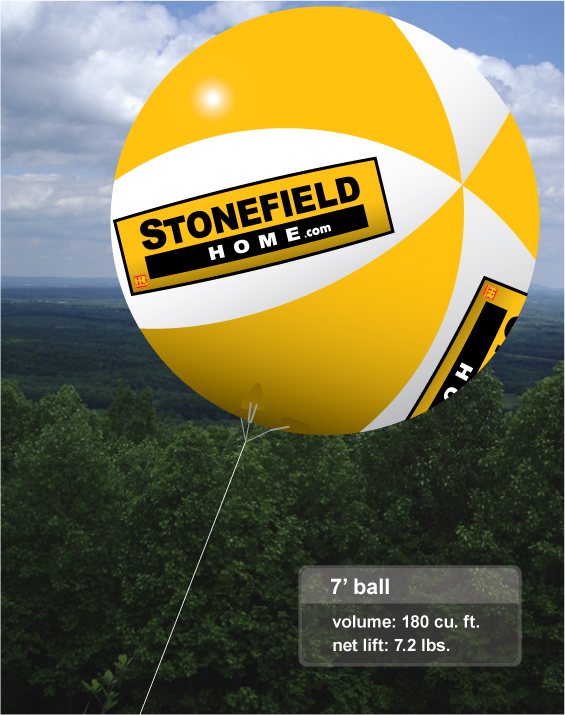
Consider the primary clients served by outdoor and experiential advertising: home builders opening new communities, auto dealers running weekend sales events, trade show exhibitors competing for floor traffic, and general businesses launching new locations or seasonal promotions. In every one of these scenarios, the advertiser needs to capture attention in a shared physical space where the audience is already present and already moving. A giant helium blimp or a towering cold-air advertising balloon does not ask a consumer to stop scrolling. It simply exists in the sky or above a roofline, visible for a half-mile radius, unskippable in exactly the way the OAAA describes the best OOH formats.
Research from Keen Decision Systems, released in late 2025, found that out-of-home advertising achieves a marginal return on investment of $7.58 per incremental dollar invested — well above the cross-media average of $5.52. While that figure reflects the OOH category broadly, the dynamics apply with particular force to location-specific, high-visibility formats like advertising blimps and inflatables, which concentrate their impression delivery in a defined geographic area where purchase intent already exists.
The advertising blimps and marketing inflatables offered by Arizona Balloon Company operate squarely within the spirit of the human medium framework. They are bold, unmissable, and community-scale — exactly the qualities that OOH industry leaders are citing as differentiators in an increasingly automated, algorithm-driven media landscape.
ROI Data and Budget Flows Reshaping Outdoor Media Planning
Guideline’s source-of-volume analysis identifies which advertising budgets are flowing into OOH. Between 2024 and 2025, television contributed the largest net increase to OOH’s budget pool — $248 million — as brands reallocated from linear TV toward media with stronger measurable reach. Industry verticals including banking, airlines, and software were among the specific sectors shifting budgets into outdoor formats during this period.
Separate research published by OAAA and Winterberry Group adds a compelling data point for any business owner evaluating outdoor media. The study found that 98% of marketers now incorporate out-of-home into purchase-driven initiatives, with investment in the channel expected to rise further over the next two years. The study frames OOH as a driver of discovery, engagement, and conversion across the full customer journey — not simply a brand-awareness vehicle.
For small and mid-sized businesses that cannot compete with national brands on programmatic digital spend, this is meaningful news. The human medium frame is not just a positioning exercise for large media owners. It is a reminder that showing up physically, visibly, and boldly at the point where a consumer is making a decision — driving past a new subdivision, pulling into an auto mall, walking a trade show floor — is one of the highest-leverage advertising actions a local business can take. Budget flows at the national level are validating what experienced local advertisers have always known.
What This Means for Your Marketing
The OAAA’s “human medium” positioning and the $4 billion OOH spend milestone are not abstract industry statistics. They reflect a measurable shift in how marketing decision-makers are thinking about reach, attention, and human connection in a media landscape saturated by digital automation. For home builders, auto dealers, trade show exhibitors, and local businesses competing for customers in physical spaces, the core lesson is straightforward: presence in the real world is becoming more valuable, not less, as digital channels become noisier and harder to cut through.
Outdoor and experiential advertising works because it is woven into the environments where people make decisions. A potential homebuyer driving a new community on a Saturday morning, a car shopper walking a dealer lot, a trade show attendee navigating a busy exhibition hall — these are consumers with high purchase intent in a defined location. Reaching them requires physical visibility, not another screen. That is exactly the strategic gap that helium advertising balloons and aerial marketing blimps are built to fill: they create unmissable, location-specific impressions that stop people, generate conversations, and drive traffic at the moment and place it matters most.
As you plan your outdoor advertising strategy for the remainder of 2026, consider how the “human medium” framework applies to your specific business context. What shared physical spaces do your best customers pass through? Where are the decision-making moments that happen in the real world rather than on a screen? Outdoor and experiential formats — from towering cold-air inflatables to tethered helium blimps — are purpose-built for those moments. The national OOH industry is investing billions to prove their value. The insight for local advertisers is that the case was already made every time a giant balloon above a grand opening turned heads and drove foot traffic that no digital ad could replicate.
Sources
- GlobeNewswire — OAAA 2026 OOH Media Conference Unveils New Speakers from Google, UTA, and Zillow (April 24, 2026)
- OAAA — Full Agenda Announcement for the 2026 OOH Media Conference (April 24, 2026)
- PPC Land — US Out-of-Home Ad Spend Hits $4B in 2026, Guideline Report (March 9, 2026)
- OAAA Blog — OOH Is the Human Medium: Why That Matters in 2026
- The Drum — OOH Is the Human Medium: Why That Matters in 2026 (January 14, 2026)
- OAAA — Out of Home Advertising Association of America Official Website