Spring 2026 Real Estate Market Shifts: What Home Builders and Marketers Need to Know Now
By Arizona Balloon Company (arizonaballoon.com) — April 6, 2026
The Spring 2026 Real Estate Market Is Rebalancing
The real estate market spring 2026 has arrived at a genuine inflection point. After years of historically constrained inventory, frenzied pandemic-era bidding wars, and stubbornly high mortgage rates, the U.S. housing market is finally shifting toward something closer to balance. For home builders, real estate professionals, and marketing decision-makers, the dynamics of this spring selling season carry significant implications for how, where, and how loudly you compete for buyer attention.
According to research from Realtor.com, the week of April 12–18, 2026 is projected to be the single best week of the year to list a home for sale, delivering sellers a combination of stronger buyer demand, faster sale times, and reduced competition from other listings than at any other point in the calendar. Homes listed during that window are expected to sell for an average of 6.6% more than those listed at the start of the year — roughly $26,000 more in dollar terms — and attract approximately 16.7% more buyer views than a typical week.
That concentration of buyer activity creates a compressed, competitive window that rewards builders and sellers who show up visibly, credibly, and early. Whether you are moving spec homes, opening a new community, or competing in a crowded local market, the spring 2026 selling season will not wait for slow marketing plans to catch up.
Inventory Is Climbing — But Not Evenly Across the Country
One of the defining features of the real estate market spring 2026 is rising inventory — and the geographic divergence that comes with it. According to ResiClub Analytics, national active home listings rose 8.1% year over year between March 31, 2025 and March 31, 2026, representing a meaningful shift in buyer leverage across many markets. However, that figure masks significant regional variation.
As of late March 2026, eleven states had active inventory levels that surpassed pre-pandemic 2019 norms: Arizona, Colorado, Florida, Idaho, Nebraska, Oklahoma, Oregon, Tennessee, Texas, Utah, and Washington. In these Sun Belt and Mountain West markets, increased supply has introduced pricing softness and in some cases outright year-over-year price declines. Meanwhile, much of the Northeast and Midwest remains supply-constrained, with sellers still holding leverage and prices continuing to edge upward.
Nationally, the median list price held at approximately $419,000, while the median price of newly listed homes came in at $399,900, signaling that sellers are pricing more competitively as competition for buyers increases. Price reductions affected about 34.2% of active listings — nearly identical to the same week in 2025 — and the median days on market remained around 91 days. That is a balanced pacing environment where negotiation has replaced urgency, and where differentiated marketing makes the difference between a listing that moves and one that sits. Learn more about giant advertising balloons for new home communities that help builders draw traffic before a sign goes in the ground.

What This Means for Home Builders Right Now
Home builders face a nuanced operating environment in spring 2026. On one hand, the National Association of Home Builders projects approximately 1.05 million new homes will be completed this year — a 4% increase over 2025 — suggesting continued construction momentum. On the other hand, resale inventory is rising in many of the same Sun Belt markets where builders have been most active, creating direct competition for the same buyers that new communities are courting.
J.P. Morgan’s head of Securitized Products Research, John Sim, noted that builder incentives such as rate buydowns — where builders pay upfront to lower a buyer’s mortgage rate — are becoming standard tools to move inventory in this environment. Roughly 60% of builders are now offering some form of concession to close deals, according to RCLCO Real Estate Consulting. That shift puts a premium on driving qualified foot traffic to model homes, sales offices, and community events, because incentive programs only work when buyers are actually in the room.
The window for capturing that traffic is narrowing. With buyer confidence improving — real estate agent surveys tracked by NAR show buyer confidence jumping from 27% to 37% year over year — the buyers who show up this spring are increasingly ready to act, provided they feel confident in their choice. That makes the first impression of a community entrance, a model home, and a sales event more consequential than it has been in years.
Buyer Behavior Is Cautious but Active — And Increasingly Selective
Redfin’s early 2026 market tracking describes a housing market where buyers are engaged but deliberate. The typical home sold in January 2026 spent 64 days on the market — the longest span in six years — and more than 42,000 homebuying contracts fell through in February alone, equal to nearly 14% of all homes under contract that month. That is the highest cancellation rate for February since Redfin began collecting data in 2017.
Buyers are requesting inspections, negotiating on price, and walking away from deals that don’t feel right. Redfin’s chief economist, Daryl Fairweather, noted that overall conditions are more favorable for buyers in 2026 than in recent years, with home prices rising more slowly than wages and overall inflation. The 30-year fixed mortgage rate stands at approximately 6.38% as of late March 2026 — elevated by geopolitical uncertainty, including disruptions tied to conflict in the Middle East — but still lower than the 6.6%-plus rates seen at the same point in 2025.
For sellers and builders, this translates into a clear directive: buyers need more convincing, more transparency, and more compelling reasons to choose your community over the one down the road. Marketing that is passive, inconsistent, or invisible will not convert this audience. Marketing that stops traffic, communicates lifestyle, and signals activity at a development site is far more likely to turn a curious drive-by into a sales appointment.
Why Outdoor Visibility Marketing Is a Spring Must for Real Estate
In a spring market defined by rising competition and a more deliberate buyer, location-based visibility becomes a primary differentiator. New home communities, grand openings, and weekend sales events all depend on one fundamental question: can potential buyers find you, and does your site communicate energy and activity from the road?
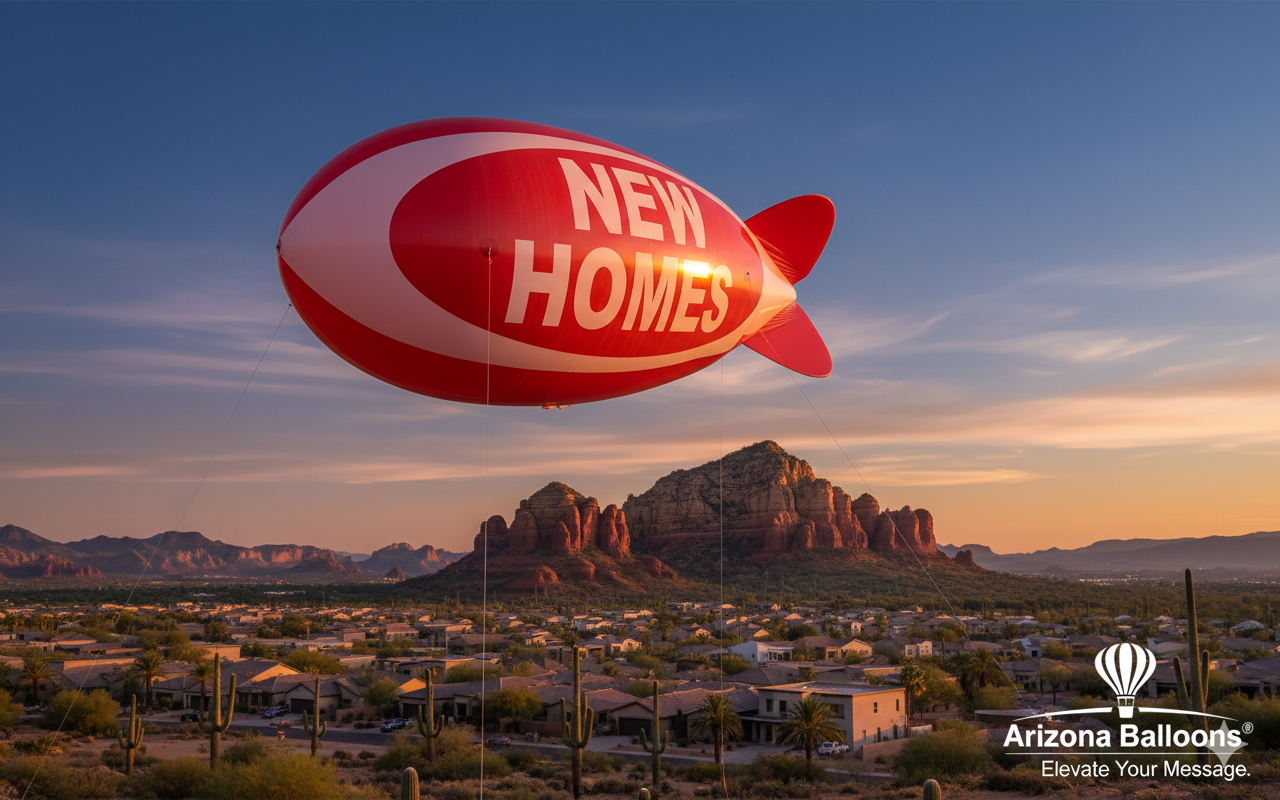
This is where giant advertising blimps and helium marketing inflatables have served home builders as one of the most cost-effective attention tools in the industry. A large helium blimp flying above a model home or subdivision entrance is visible from a mile or more in any direction — providing wayfinding for buyers who are already searching the area and spontaneous exposure for those who are not. Unlike digital advertising, which requires intent and a device, aerial inflatables intercept passive traffic and create immediate curiosity.
For home builders operating in markets where resale inventory has jumped above pre-pandemic norms — states like Arizona, Texas, Colorado, and Florida — the stakes are particularly high this spring. When buyers have more choices, the communities that generate the most foot traffic on a given weekend are the ones most likely to close deals. Outdoor inflatables, including giant shape balloons, rooftop blimps, and custom-branded marketing balloons, have been a mainstay for new home sales teams precisely because they work across demographics, require no digital connection, and can be deployed on the day of an event without complex logistics.
Auto dealers, trade show exhibitors, and general businesses have long relied on the same principle: visible presence at the right location, at the right moment, draws more of the right people. Real estate is no different — and with buyer attention at its most concentrated during the April 12–18 window and throughout the spring season, there has rarely been a more targeted opportunity to maximize physical visibility at a sales site.
What This Means for Your Marketing
The spring 2026 real estate market rewards marketers who act with speed, visibility, and precision. With buyer activity concentrated in specific high-demand weeks — and with more resale competition in Sun Belt markets than builders have faced in years — the communities, brokerages, and dealers that generate consistent foot traffic will have a measurable advantage over those relying on digital-only strategies. Location-based marketing that intercepts buyers in the physical world is not supplementary in this environment; it is essential.
For home builders and real estate marketers, the practical implication is straightforward: invest in outdoor, high-visibility marketing tools that work at the community level. Helium advertising balloons placed at community entrances, model home sites, and grand opening events have a proven track record of driving walk-in and drive-by traffic without requiring a buyer to be online, targeted, or opted-in. In a market where buyers are selective but actively touring properties, getting them to your site in the first place is the critical first step.
The compressed nature of the spring selling season also makes event-based marketing more valuable. A weekend grand opening, a VIP preview event, or a broker open house supported by large-scale aerial marketing inflatables creates urgency, communicates community activity, and signals to passing traffic that something worth seeing is happening right now. As mortgage rates remain volatile and buyer confidence fluctuates with macroeconomic headlines, the communities that project confidence and energy — visibly, from the road — are the ones most likely to capture the buyers who are ready to commit this spring.
Sources
- Churchill Mortgage — Best Week to Sell a Home in 2026 (April 12–18), citing Realtor.com research
- ResiClub Analytics — National Active Housing Inventory by State, April 2026
- Redfin — 2026 Housing Market Mood: Buyers Are Cautious, Sellers Are Showing Up
- CNN Business — US Housing Market: Mortgage Rates Rise for Fourth-Straight Week, March 2026
- J.P. Morgan — The Outlook for the US Housing Market in 2026
- RCLCO Real Estate Consulting — The 2025–2026 Outlook for U.S. New Residential Real Estate
- National Association of REALTORS® — 2026 Real Estate Outlook: What Leading Housing Economists Are Watching
- HousingWire — Rising Inventory Brings Balance to the 2026 U.S. Housing Market