
American-made in Glendale, Arizona · Since 1979
Polyurethane helium advertising blimps for model homes, car lots, events and trade shows—available to buy or rent, with custom logo printing.
- Sizes from 10 to 30 feet
- Factory-direct guidance from the manufacturer
- Nationwide shipping and practical setup support
Send the site, date and artwork. Johnny will help match the size and setup to the job.

Arizona Balloon Company manufactures polyurethane helium advertising blimps from 10 to 30 feet in Glendale, Arizona. You can buy, rent or order custom printing. Send your location, artwork and deadline and we’ll recommend a practical size and setup, then confirm current price and delivery.



A note from Johnny Mulder, owner of Arizona Balloon Company—the manufacturer behind the polyurethane helium blimps you’ve seen flying over model homes, car lots, trade shows and a few places you’d never guess.
I’ve been building advertising blimps in the same Glendale, Arizona shop since 1979. In that time I’ve shipped polyurethane helium blimps to NASA, the Jet Propulsion Laboratory, the U.S. Navy, Arizona State University and the National Institutes of Health—alongside the home builders, auto dealers and trade-show exhibitors who make up the bulk of our work.
This page is what I tell those customers when they call. It’s longer than a sales sheet because the cheap answer (“yes, we have blimps”) is what gets people stuck with the wrong size, the wrong material and a helium bill that doesn’t quit.
The chart that shows the operating-cost difference
Here is the only spec that matters in your first phone call with a blimp company — how much helium the thing eats. Helium prices move, but the ratios don’t. This is the volume each of our polyurethane blimps requires for a single fill, by length:
| Blimp length | Helium per fill (cubic feet) | Best fit |
|---|---|---|
| 10 ft | 105 | Trade-show booth, small storefront |
| 13 ft | 170 | Model home weekends, dealership lots — the size I sell most |
| 15 ft | 255 | Step up when 13 ft gets lost in tall surroundings |
| 18 ft | 329 | Highway-frontage builders |
| 21 ft | 430 | Multi-acre auto dealer, festival lift |
| 25 ft | 787 | Major event sponsorship |
| 30 ft | 1,510 | You-can-see-it-from-the-freeway showpiece |
Read that table sideways and you’ll see why the 13-foot is our most-ordered size. A 13-foot polyurethane blimp delivers visibility comparable to a 20-foot PVC blimp while requiring about 170 cubic feet of helium per fill. That gap is the entire ballgame for builders running blimps every weekend — the helium math, not the sticker price, is what kills budgets.
Why I build in polyurethane and won’t sell PVC

Polyurethane and PVC are not the same balloon in different colors. See the full polyurethane vs PVC comparison, with the helium math. They are different physics. PVC is a porous plastic — helium molecules are small enough to escape through the wall on their own, no leak required. Polyurethane has a tighter molecular structure. In our shop the same fill lasts noticeably longer in a polyurethane envelope than in PVC, which is why I built the company around it 45+ years ago and why I haven’t moved.
I’ll be direct: if a competitor quotes you a cheaper PVC blimp, the upfront savings will be eaten by helium refills inside the first season of weekend use. I won’t sell you a PVC blimp because I’d rather lose the sale than sell you a tool that costs more to operate than it does to buy.
What every “advertising blimp” page on the internet won’t tell you
Most pages selling advertising blimps were written by someone who has never inflated one. Three things they leave out:
Demonstrated wind performance is not a universal safe operating limit. Larger Arizona Balloon Company blimps have demonstrated performance up to 30 mph under appropriate test and operating conditions. That statement is not a blanket instruction to fly every model at 30 mph. The model, inflation, tethering, site, obstacles, steady wind, gusts and supplied operating guidance all matter. Visibility and presentation can deteriorate well before the equipment limit, so bring the blimp down whenever conditions are unsuitable or uncertain.
Lead time matters more than price. Because we manufacture in Glendale, custom orders typically ship in 2–4 weeks. Imported blimps can take eight or more weeks and arrive with artwork misaligned because the proof was approved by someone four time zones away. If you’ve got a grand opening on the calendar, lead time is the spec to ask about, not just price.
FAA and local rules depend on the balloon and site. Operating an unshielded moored balloon at 150 feet or less generally avoids the FAA’s 24-hour advance-notice requirement, but it does not remove other Part 101 operating restrictions. Many models on this page exceed 115 cubic feet, and airport distance, cloud clearance, visibility, tethering, local sign ordinances, HOA rules and property-owner permission can all matter. Call me with the exact address and planned height so we can identify the questions to check before setup.
Advertising blimp sizes and prices
Factory-direct prices below are current as of August 2026 and are subject to change. Call 1-800-791-1445 for today’s exact quote, artwork options and lead time. For a fuller buying comparison, see the USABlimps model and pricing guide.
| Size | Base price | Both-side lettering | Helium capacity |
|---|---|---|---|
| 10 ft | $684 | $421 | 105 cu ft |
| 13 ft (most popular) | $975 | $537 | 170 cu ft |
| 15 ft | $1,258 | $615 | 255 cu ft |
| 18 ft | $1,813 | $657 | 329 cu ft |
| 21 ft | $2,561 | $664 | 430 cu ft |
| 25 ft | $4,208 | $1,074 | 787 cu ft |
| 30 ft | $6,772 | $1,449 | 1,510 cu ft |
13-foot example: The listed $975 base price plus $537 for both-side lettering totals $1,512. Your quote will confirm artwork, tethering equipment, shipping, tax, helium, installation and any other applicable charges before you commit.

One purchase, used for years. Most of my home-builder customers run a single 13-footer through three to five model-home weekends a month for multiple seasons. The math works out to a per-deployment cost lower than a single weekend of digital geo-fenced display advertising — and the blimp is visible from up to four miles away on flat terrain, depending on surrounding buildings.
Who I’ve built these for

I keep saying “home builders” because that’s the largest single segment of my orders. Builders use a 13-foot blimp lettered with their company colors over a model-home subdivision on Saturdays and Sundays — the blimp pulls drive-by traffic off the arterial road and into the model. Winchester Homes and Stonefield Homes are two of the builders I’ve made blimps for, and the same template — 13-foot polyurethane, custom lettered, run on weekends — is what most builders end up on after a season of testing.
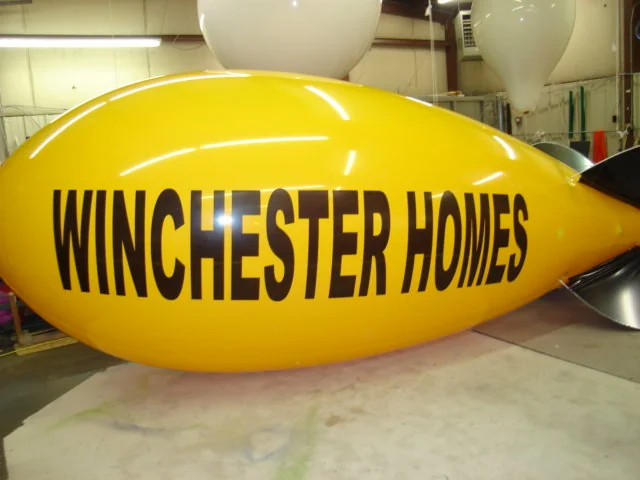
Beyond builders: car dealerships use them as lot markers in highway-visible parking lots, trade-show exhibitors use them indoors when ceiling height permits or outdoors above their booth, and a handful of clients I’m proud to mention — NASA, JPL, the U.S. Navy, ASU, and the NIH — have used our blimps for projects where a tethered aerostat was the right tool for measurement, demonstration, or visibility.

What I won’t sell you
If you have a 14-foot residential garage and you’re calling about a 25-foot blimp, I’m going to talk you out of it. The 25-footer needs space, more helium, more hands at setup, and a transport plan. For 90% of customers, the 13-foot is the right answer. The 25- and 30-foot models exist because some campaigns genuinely need the size — but I’d rather lose the bigger sale and keep you as a customer for the next ten years.
If you’re calling for a one-weekend grand opening and you’re in the Phoenix metro, ask about rental before purchase. Because polyurethane retains helium so well, short-term rentals are profitable for us where competitors using PVC can’t make the math work. That means we can quote a real weekend rental price instead of pushing a purchase you may not need.
How they get to you
Standard production for a custom blimp runs 2–4 weeks from artwork approval. Rush orders are sometimes available — call before you assume they aren’t. We accept artwork as vector files (AI, EPS, PDF) for best reproduction, or high-resolution raster (PNG, JPEG, TIFF at 300+ DPI). Setup at your location takes one person about 5–10 minutes for the 10- and 13-foot sizes; larger blimps go faster with two. The 13-foot fits in a standard residential garage between deployments.
Frequently asked questions
How long do these last?
With reasonable care — stored clean, dry, out of direct sun, away from sharp edges — a polyurethane blimp will go years through repeat deployments. As one data point: I have an Auto Sale blimp out in the field that’s been deployed for five years and is still flying. The variables are usage frequency, storage, and weather exposure, but five-year service is a reasonable expectation, not a stretch.
Can it fly indoors?
If the ceiling height is sufficient, yes. But indoor venues rarely have the height to use the visibility advantage that’s the whole point of a blimp. For trade-show booths under a typical exhibit-hall ceiling, ask me about cold-air inflatables instead — different product, better fit.
Do I need a permit?
Many models on this page exceed 115 cubic feet. Staying at or below 150 feet generally avoids the FAA’s 24-hour advance-notice requirement for unshielded moored balloons, but other Part 101 restrictions may still apply. Airport distance, cloud clearance, visibility, tethering, local sign ordinances, HOA rules and property-owner permission can also matter. Call with the exact address and planned height so the right questions can be checked before setup.
Can I rent instead of buying?
Yes — for one-time events, short campaigns, or if you want to test before committing. Our polyurethane construction is the reason rental pricing works on our end; helium retention is what makes a one-weekend rental profitable.
What’s the warranty?
Every balloon and blimp we ship is warrantied for one year against workmanship defects and two years against material defects. If something fails inside those windows because of how we built it or what we built it from, that’s on us — not on you.
What to do next
Call me at 1-800-791-1445 or email sales@arizonaballoon.com with three things: the size of the space you want the blimp to be visible from, the lettering or artwork you want on it, and the date of your first deployment. I’ll quote a real price, a real lead time, and tell you straight whether the 13-foot is the right call or whether your campaign warrants going bigger. Use the quote form if you’d rather start in writing.
— Johnny Mulder, Arizona Balloon Company, Glendale, Arizona. Manufacturing polyurethane helium advertising blimps in the U.S.A. since 1979.
Compare advertising blimp rentals, giant helium advertising balloons, and custom advertising balloon options to choose the shape and setup for your campaign.