Promotional Products Marketing Reaches $27.7 Billion
By Arizona Balloon Company (arizonaballoon.com) | November 23, 2026
Why Promotional Products Marketing Is in the Spotlight
Promotional products marketing drew fresh attention this week when the Advertising Specialty Institute (ASI) announced its 2026 Counselor Power 50 ranking on November 17. The list names the most influential executives in what ASI describes as a $27.7 billion U.S. promotional products industry. For the second year in a row, Jeremy Lott, president and CEO of SanMar, took the top spot.
The announcement is a leadership ranking, not a market study. Still, it gives business owners a useful snapshot of an advertising category that includes custom apparel, drinkware, bags and pens, and that sits alongside outdoor displays such as helium advertising balloons in many local marketing budgets. For marketing managers, the question is what a healthy, growing branded-merchandise sector says about the demand for physical, in-person brand exposure.
SanMar’s Growth Despite Tariffs and Supply Chain Disruption
According to the ASI release, SanMar is the industry’s largest supplier of branded apparel. Under Lott, the company grew its 2025 sales by 8 percent to an estimated $4.1 billion. ASI also reports that SanMar has posted double-digit growth in 2026 despite tariffs and global supply chain disruptions.
That detail matters for advertisers. Tariffs and logistics problems have pressured many businesses that rely on imported goods, yet demand for branded products has held up at the top of the supplier market. Companies are still buying physical items that carry a logo, which suggests that tangible, visible advertising continues to earn budget even as digital channels become more crowded and costly.
How Big Is the Market? Two Estimates
Readers comparing figures will notice that estimates differ. ASI puts the U.S. promotional products industry at $27.7 billion. IBISWorld, in a May 2026 industry report, estimates the U.S. promotional products industry at $22.4 billion for 2026 and counts 6,727 businesses. IBISWorld’s definition also covers related activities such as custom sign fabrication and product demonstrations, so the two numbers are not measuring identical things.
Both sources point in the same direction on growth and trade exposure. IBISWorld reports that the industry has grown over the past five years and says import tariffs are unlikely to have a material effect because imports represent a small share of industry revenue. For a buyer, the practical lesson is to treat any single market-size figure as a range rather than an exact count, and to check how each publisher defines the category.
Inside the 2026 Counselor Power 50
The 21st annual Counselor Power 50 recognizes 68 executives, including seven newcomers. ASI says it includes leaders from 15 family-owned businesses and nine executives who have appeared on every list since the ranking debuted in 2006. Rankings combine votes from industry peers and previous honorees with editorial evaluation of business performance, innovation and leadership.
Behind Lott, the top ten includes leaders from Hit Promotional Products, Geiger, S&S, HALO, Proforma, HPG, Gemline, 4imprint and ASB. In the release, ASI chief executive Ashish Mittal said that artificial intelligence can process large amounts of data but cannot replace human judgment, and that people, not technology, will decide the industry’s direction. For small and mid-sized advertisers, the family-owned presence on the list is a reminder that scale is not the only route to influence in this market.
Where Inflatables and Blimps Fit the Promotional Mix
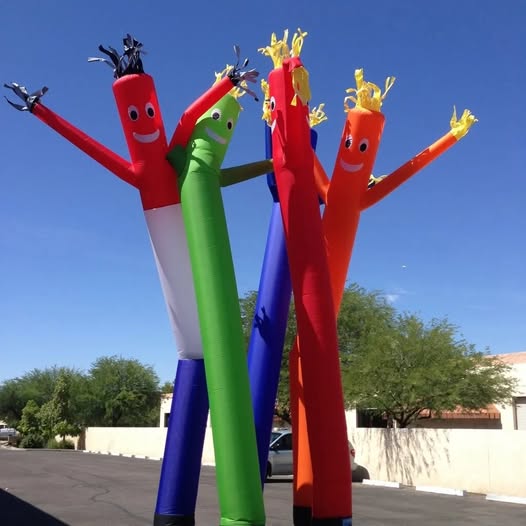
Large inflatables are part of the same conversation about attention-grabbing physical advertising. A Trendhunter overview of giant inflatables describes custom inflatables as a growing promotional category for grand openings, corporate events and festivals. It points to interactive designs, easier storage and transport, and rising U.S. demand for custom manufacturing as trends shaping the segment.
Those trends line up with how advertising balloons and advertising blimps are used by home builders, auto dealers and trade show exhibitors. A branded pen reaches a person who already visited the booth. A helium balloon or blimp works earlier in the funnel, drawing in traffic from a distance, and the two formats often support one another within a single event or sales promotion.
What to Watch Next
Readers should keep the source in mind. The Power 50 announcement comes from ASI, a company that serves the promotional products industry, so it reflects that sector’s perspective and focuses on apparel-heavy suppliers rather than inflatable advertising specifically. It is evidence of strong demand for branded marketing, not proof that any single tactic delivers a given return.
Over the coming months, watch whether SanMar’s reported 2026 growth is matched by other suppliers, how tariff pressures develop, and whether more businesses combine branded merchandise with large-format outdoor displays. Those signals will indicate whether physical advertising keeps gaining share of local marketing budgets.
What This Means for Your Marketing
The main takeaway is that physical brand exposure remains a serious investment for American businesses. If suppliers of branded goods are growing through tariffs and supply chain strain, buyers clearly still value items and displays that people can see and touch. For location-based businesses, the goal is to put that visibility where customers actually make decisions: at the lot, the community entrance, the show floor or the storefront.
For home builders, auto dealers and trade show exhibitors, this usually means pairing a giveaway item with an eye-level or overhead display that draws people in first. Large, tethered displays can mark a model home weekend, a sales event or a booth location from far away, while smaller branded items keep the message with visitors afterward. Measure each element separately, for example through visit counts, lead forms or event-day traffic, so you know which piece is doing the work.
If you are planning outdoor or event-based campaigns for 2027, consider how helium advertising balloons or aerial marketing blimps could anchor the visual side of your plan. Start with a clear goal, a defined location and a budget, then choose the format that fits the audience and the site.