Home Builder Marketing Balloons Gain Ground as Confidence Slides
By Arizona Balloon Company (arizonaballoon.com) — June 16, 2026
Builder Sentiment Falls Again in June
Home builder marketing balloons are getting fresh attention this week after the National Association of Home Builders released data showing builder confidence has dropped for the fourteenth straight month. According to the NAHB/Wells Fargo Housing Market Index, builder confidence in the market for newly built single-family homes fell two points to 35 in June, a level not seen on a sustained basis since the 2011-2012 foreclosure crisis. Current sales conditions slipped two points to 38, while traffic of prospective buyers held flat at a weak 25, signaling that fewer shoppers are walking into model homes and sales offices in the first place.
NAHB leadership tied the slump to high mortgage rates, persistent affordability pressure, and a national shortage of roughly 1.2 million homes. For builders, the index is more than an abstract number — it is a direct read on whether buyer traffic, the lifeblood of every new home community, is showing up at the gate. Many sales and marketing teams are now reassessing how they generate that traffic without further squeezing already-thin margins. Builders looking for proven, affordable ways to draw eyes to a community entrance can review options like advertising balloons for new home communities as part of that reassessment, alongside a broader look at outdoor marketing tools built for site visibility.
Incentives Are Everywhere, But Margins Are Shrinking
The same HMI survey found that 35% of builders cut prices in June, up from 32% in May, with the average price reduction holding at 6%. Sales incentives — rate buydowns, closing cost credits, design upgrades — were used by 62% of builders, marking the fifteenth consecutive month that share has stayed at 60% or higher. That is an unusually long stretch of heavy incentive use, and it tells a clear story: builders are fighting for every buyer, and discounting has become the default lever.
The trouble with discounting as a primary strategy is that it compresses profit on every sale a builder does close. Price cuts and incentives only work if a prospect actually visits the community to take advantage of them. If traffic stays soft, builders end up giving away margin without moving more units. That dynamic is pushing some marketing teams to look upstream of the negotiating table, toward the tools that get a buyer to the site at all.
The Real Problem Isn’t Just Price — It’s Visibility
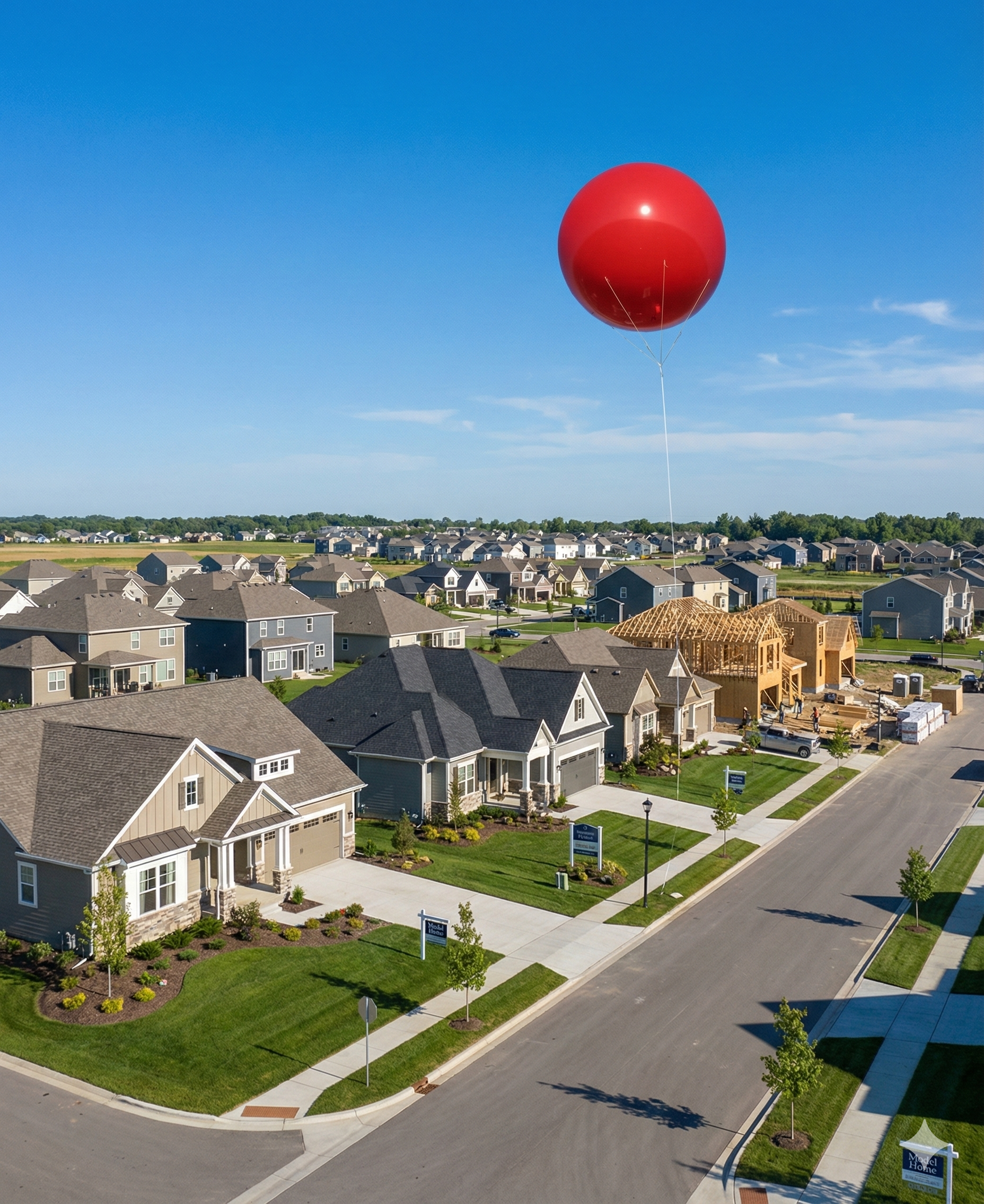
NAHB’s data shows that buyer traffic, not just affordability, is the bottleneck. A community can offer the best incentive package in the market and still underperform if drivers and online shoppers simply do not notice it exists. New subdivisions are often tucked behind arterial roads, surrounded by competing signage, or located in areas where buyers are passing by without a clear visual cue to stop.
This is precisely the gap that large-format outdoor displays are built to close. A community entrance competing against five other builders along the same corridor needs something that breaks through clutter at a glance, from a moving vehicle, at a distance. Static yard signs and banners rarely do that job once a market gets this competitive.
How Balloons and Blimps Solve a Traffic Problem
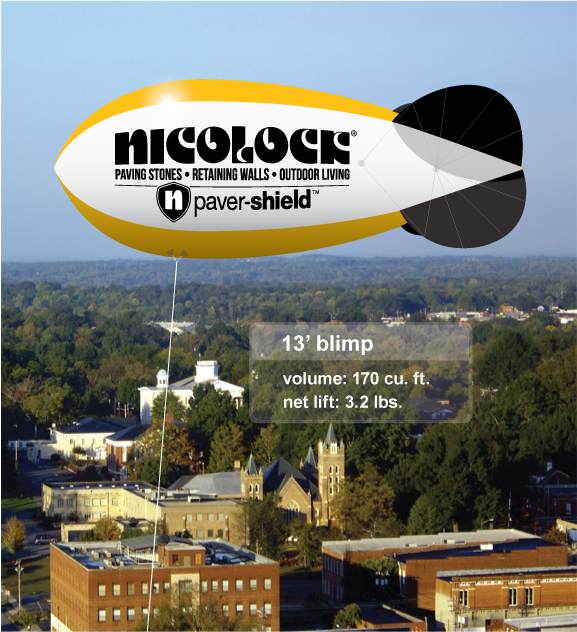
This is where helium advertising balloons and tethered marketing blimps earn their place in a builder’s marketing mix. A 12-foot or 20-foot inflatable positioned at a community entrance is visible from a quarter mile or more, day or night with lighting options, and does not require a recurring media buy the way digital or broadcast advertising does. For builders managing tight margins after a round of price cuts, that one-time or seasonal rental cost is small compared to the cost of an empty model home on a Saturday.
Blimps and tethered balloons also solve a problem specific to subdivisions: they work as wayfinding. A buyer who has seen a listing online but is unsure which turn leads to the sales office can spot a balloon from the main road and self-navigate. That reduces the chance a curious driver gives up and moves on to a competing community instead.
A Cost Comparison Builders Should Run
Before adding another paid digital campaign or a billboard lease, builders comparing marketing line items should weigh cost-per-week-of-visibility rather than cost-per-click. A billboard typically requires a monthly contract and is fixed to one location regardless of which community is actively selling. An advertising balloon or blimp can be moved between active sales sites as inventory shifts, redeployed for grand openings, and reused across multiple seasons, which spreads the cost over years rather than a single campaign.
That flexibility matters most right now, when 62% of builders are already trimming margin through incentives. Marketing spend that can flex with inventory, rather than locking a builder into a long-term placement, is the kind of efficient spend a soft market rewards.
Beyond Home Builders: A Pattern Across Industries
The same visibility problem NAHB’s data highlights for home builders shows up across other businesses that rely on physical foot or vehicle traffic. Auto dealers competing along the same retail strip, trade show exhibitors trying to stand out on a crowded show floor, and general businesses launching a sale all face a version of the same question: how do you get noticed before a price incentive even matters? Large-format inflatables have become a recurring answer because they scale to fit a parking lot, a booth, or a subdivision entrance with the same basic principle — be the largest, most visible object in the field of view.
What This Means for Your Marketing
For home builders navigating a fourteenth straight month of soft sentiment, the lesson from this week’s HMI release is that price cuts alone are not generating the buyer traffic builders need. Outdoor, location-based marketing puts a community physically in front of more prospects without adding another recurring incentive cost to the closing table. A well-placed inflatable at a community entrance functions as a 24/7 advertisement that does not compete for space in someone’s inbox or social feed — it simply has to be seen from the road.
The same principle applies whether the goal is drawing weekend traffic to a model home, marking a grand opening, or making a dealership lot or trade show booth impossible to miss. Businesses across the home building, auto, and exhibition industries are increasingly treating helium advertising balloons as a standing part of their site marketing rather than a one-off novelty, precisely because the cost stays fixed while the visibility keeps working, month after month, regardless of where mortgage rates or builder sentiment land next.
Marketing teams reassessing budgets after this week’s report should treat outdoor visibility as a complement to incentive spending, not a replacement for it. The combination of a strong offer and a community that is easy to find and impossible to miss is what converts soft traffic numbers into signed contracts.