Tag: local advertising

  • Small Business Advertising Costs Are Rising — Here’s What Owners Are Doing About It


    Small Business Advertising Costs Are Rising — Here’s What Owners Are Doing About It

    Small Business Advertising Costs Are Climbing in 2026 — Here’s How Owners Are Responding

    Arizona Balloon Company (arizonaballoon.com) — July 20, 2026

    Small business advertising costs rising in 2026, marketing budget concept

    Digital Advertising Costs Keep Climbing

    Small business advertising costs are once again a top concern for owners heading into the second half of 2026. New pricing breakdowns published this month show that management fees for search, social, and paid media campaigns continue to inch upward, even before ad spend itself is factored in. Agency management fees now typically run 10 to 20 percent of a business’s total ad budget, with standard monthly retainers ranging from $1,500 to $5,000, and that’s before accounting for the complexity of managing campaigns across multiple platforms. For many small business owners, that math is prompting a hard look at where marketing dollars are actually going, and whether there’s a more cost-effective way to get noticed. Companies exploring those alternatives can learn more at Arizona Balloon Company, which has spent decades helping local businesses stand out without competing in an increasingly expensive digital auction.

    Why This Matters for Small Business Owners

    Rising fees aren’t the only pressure point. Industry data shows that the cost of reaching a shared audience climbs whenever many businesses compete for the same attention, and industries like insurance, loans, and legal services already face steep costs because of that fierce competition. Home builders, auto dealers, and trade show exhibitors are feeling a similar squeeze; the more competitors bid on the same keywords or the same social feeds, the more expensive it becomes to be seen at all. That dynamic is pushing owners to diversify their marketing mix rather than pour every dollar into digital channels alone. For businesses that rely on physical foot traffic, a well-placed helium advertising balloon can capture attention from a highway or parking lot without ever entering a bidding war.

    Small business advertising costs rising in 2026, marketing budget concept

    The Shift Toward Local, High-Visibility Marketing

    As digital costs rise, local and location-based marketing is gaining renewed attention. Recent guidance for small businesses points out that optimizing a Google Business Profile and investing in local SEO is the most cost-effective starting point, since it requires no ongoing ad spend and targets buyers who already have high purchase intent. But local SEO alone doesn’t solve the problem of physical visibility; a business can rank well online and still be invisible to someone driving past on the street. That’s where large-format, location-based advertising has re-entered the conversation. A giant balloon or blimp positioned above a storefront, grand opening, or trade show booth functions much like local search: it targets people who are already nearby and already in decision mode, just through the sky instead of a search bar.

    The Growing Pressure to Prove ROI

    Budget scrutiny has intensified alongside rising prices. Broader pricing research shows digital advertising costs falling between roughly $301 and $5,000 per month for most businesses, with actual costs varying widely by platform, industry, and audience targeting. Owners are increasingly asking marketing partners to justify every dollar with measurable results, not just impressions or clicks. This is part of why simple, high-impact tactics are regaining favor: a balloon towering over a dealership lot or a blimp circling a stadium parking lot during a trade show doesn’t require a bidding algorithm to prove its value; the visibility is immediate and self-evident to anyone driving, walking, or parked nearby.

    Where Helium Balloons and Blimps Fit In

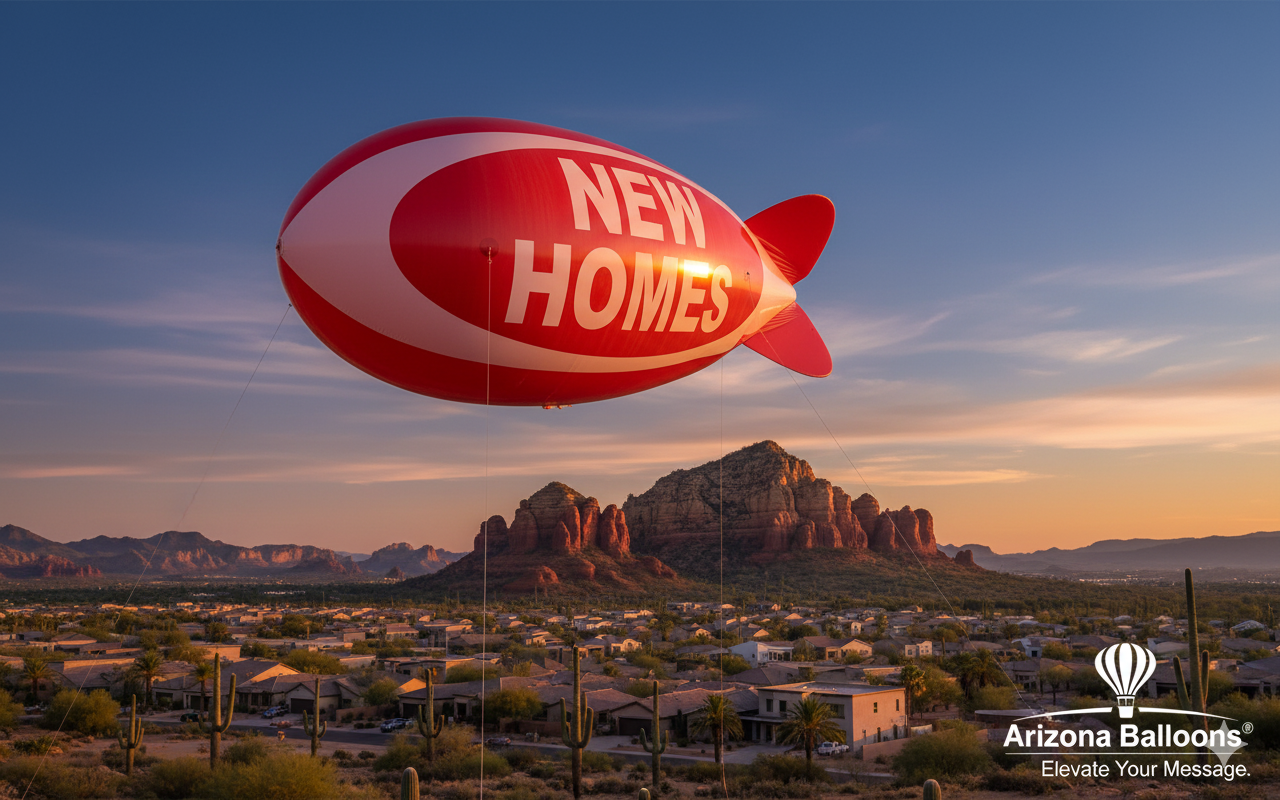
    For home builders marketing a new subdivision, auto dealers running a weekend sales event, or trade show exhibitors trying to be seen across a crowded convention floor, helium advertising balloons and marketing blimps offer something digital campaigns can’t: physical, unmissable presence in the exact location where customers already are. Unlike a paid search campaign that competes for the same eyeballs as every other advertiser, a large inflatable draws attention purely through scale and novelty. Businesses looking to diversify away from expensive digital-only strategies can explore marketing blimps as a way to extend visibility across an entire trade show hall, stadium, or business district for a single event or an entire season.

    Getting Started With Outdoor Advertising

    Businesses new to outdoor and inflatable advertising typically start small, with a single balloon at a grand opening or a seasonal blimp rental during a busy sales period, before expanding into recurring installations tied to specific campaigns. Because these assets are reusable across events, they often deliver a lower cost-per-impression over time than a comparable digital campaign, particularly for businesses in competitive local markets where digital ad auctions are already expensive.

    What This Means for Your Marketing

    The current environment rewards businesses that can be seen without constantly outbidding competitors for attention. As digital ad costs continue climbing and platforms grow more pay-to-play, outdoor and location-based marketing offers a way to reach the same nearby customers that local SEO and paid social are chasing, just through physical visibility instead of a screen. For home builders showcasing a new community, auto dealers hosting a weekend event, or trade show exhibitors competing for foot traffic on a crowded floor, that kind of visibility can be the difference between being noticed and being scrolled past.

    The strongest strategies right now combine both approaches: a strong local digital presence to be found online, paired with a physical presence that can’t be ignored in person. A large balloon on a busy corner or a blimp circling an event doesn’t need to win an ad auction to work; it simply needs to be seen, and that visibility compounds every time it’s reused for a future event.

    Businesses reassessing their marketing budgets this year may find that helium advertising balloons deliver a level of sustained, repeatable visibility that’s harder to achieve as digital costs keep rising.

    Sources


  • Advertising Trust Signals: Why AI Ad Sameness Is Pushing Businesses Toward Physical Marketing


    Advertising Trust Signals: Why AI Ad Sameness Is Pushing Businesses Toward Physical Marketing

    Advertising Trust Signals: Why AI Ad Sameness Is Pushing Businesses Toward Physical Marketing

    By Arizona Balloon Company (arizonaballoon.com) — July 3, 2026

    Advertising trust signals shown through a large outdoor helium balloon display at a business location

    The AI Creative Sameness Problem

    New industry data published this week is putting a number on something marketers have felt for months: advertising trust signals are becoming harder to find in a feed full of AI-generated content that all looks and sounds the same. A July 2026 advertising trends report cited by startup marketing analysts found that 46% of marketers now use AI to scale creative production, while 86% have seen AI-generated outputs that resemble competitor content. In plain terms, the tools that were supposed to make brands stand out are quietly making them blend in.

    The report goes further, noting that three in four marketers are actively worried that AI-generated creative is making their brand indistinguishable from rivals. For small businesses competing against larger, better-funded competitors on the same social platforms, that is a warning sign. When every digital ad is drafted by a similar model with a similar prompt, differentiation has to come from somewhere else.

    Why Trust Is Now a Measurable Conversion Asset

    The same analysis argues that trust markers such as reviews, proof, precise claims, and visible humans now carry more weight in conversion paths than ever before, largely because audiences are learning to filter out anything that feels synthetic or interchangeable. It also points out that nostalgic, founder-led, and proof-based creative is outperforming polished but forgettable ads, and that campaigns built around genuine memory and identity can lift brand likability by a notable margin.

    That shift matters beyond the digital feed. Businesses looking to build authentic visibility — whether through a local marketing partner or a physical presence at a storefront or event — are finding that tactics rooted in real-world proof, not just algorithmic reach, are what cut through. This is exactly where outdoor and location-based advertising re-enters the conversation for home builders, dealerships, and trade show exhibitors.

    Advertising trust signals shown through a large outdoor helium balloon display at a business location

    The Physical Marketing Response

    As digital creative becomes commoditized, businesses are re-examining channels that cannot be templated or mass-produced by a language model. A giant helium balloon towering over a parking lot, or a marketing blimp circling a stadium before a game, is inherently a one-of-one asset. It cannot be A/B tested into sameness because there is only one of it, and it exists in physical space where a competitor’s identical ad literally cannot occupy the same spot at the same time.

    This is not a rejection of digital strategy. The report is clear that AI, first-party data, and structured websites still matter for reach and measurement. But it also confirms what outdoor advertisers have argued for years: attention earned in the real world carries a credibility that a synthetic feed struggles to replicate.

    How Helium Balloons and Blimps Fit the Trust Gap

    For home builders trying to draw weekend traffic to a new community, or auto dealers competing on the same three-mile strip, a large-format inflatable balloon or an advertising blimp functions as a trust signal in its own right. It says, plainly and visibly, “we are here, we are real, and we are worth stopping for.” That kind of unmistakable, physically present branding is difficult for an algorithm to replicate and impossible to scroll past.

    Trade show exhibitors face a similar version of this problem indoors. Booths that rely purely on printed banners and screens increasingly look like every other booth on the floor. A branded advertising balloon rising above the exhibit hall solves the same sameness problem the July report describes, just in three dimensions instead of a social feed.

    Who Benefits Most Right Now

    Businesses with a physical location or a live event are best positioned to act on this shift immediately. Home builders opening new phases, dealerships pushing seasonal inventory, and trade show exhibitors preparing for fall convention season all have a natural moment to pair digital campaigns with a visible, unmistakable presence on the ground.

    Getting Started With Outdoor Trust Marketing

    The practical first step is simple: identify one high-traffic location or event already on the calendar and pair it with a large-format inflatable or blimp presence rather than another round of near-identical digital creative. Businesses do not need to abandon paid social or search; they need one asset that customers can point to and remember, which is exactly the gap the current data describes.

    What This Means for Your Marketing

    Outdoor and location-based marketing is regaining relevance precisely because digital advertising is becoming harder to differentiate. When every brand’s social ads are drafted by similar AI tools, the businesses that win attention are often the ones willing to occupy physical space in a way competitors cannot copy overnight. A branded balloon over a sales lot or a blimp above a stadium is not a nostalgia play; it is a direct answer to the sameness problem marketers are now measuring and naming.

    For home builders and auto dealers, this means treating outdoor presence as a scheduled, recurring part of the marketing calendar rather than a one-time stunt — tied to grand openings, model home weekends, or seasonal sales events when foot traffic and buyer intent are highest. For trade show exhibitors, it means budgeting for booth visibility the same way competitors budget for premium floor space, since a memorable physical presence extends the life of the interaction well past the show itself.

    Businesses considering this approach can review options for helium advertising balloons to plan a presence that fits their location, budget, and event calendar. As digital ad creative continues to converge, the value of a visible, physical brand statement is likely to keep growing rather than fade.

    Sources


  • Small Business Advertising Trends for 2026


    Small Business Advertising Trends for 2026

    Small Business Advertising Trends Show Owners Spending More Despite Inflation Worries

    Byline: Arizona Balloon Company (arizonaballoon.com) — June 17, 2026

    Small business advertising trends 2026 storefront with outdoor marketing display

    1. The Latest Small Business Advertising Trends Data

    New survey data is reshaping how analysts talk about small business advertising trends heading into the second half of 2026. According to a widely cited MarketingProfs summary of Constant Contact research, 68% of small business owners expect their marketing budgets to increase this year, and 74% expect to spend more time on marketing than they did last year. The underlying report surveyed 1,500 small business owners across the United States, United Kingdom, Canada, Australia, and New Zealand, and it found that inflation and rising costs remain the single biggest concern business owners cite for the year ahead.

    What stands out is the response to that pressure. Rather than retreating, owners are choosing to invest. A separate Constant Contact report on small business sentiment found that 41% of owners named inflation as their top worry, yet 50% are prioritizing operational efficiency and 36% are actively refining their marketing strategy rather than cutting it. For home builders, dealership groups, and trade show exhibitors who plan promotional calendars months in advance, this is a meaningful signal: competitors are not pulling back on visibility, they are getting more deliberate about where every dollar goes.

    2. Why Marketing Budgets Are Rising Despite Inflation

    The logic behind rising marketing spend, even in a tight economy, comes down to a simple competitive reality: businesses that go quiet during uncertain times tend to lose ground to the ones that stay visible. Industry research from LocaliQ’s small business marketing trends report backs this up, noting that 66% of small businesses expect economic uncertainty to be a meaningful challenge this year, up sharply from 48% the previous year, yet only a small minority plan to decrease their marketing budgets. Owners appear to understand that cutting promotional spend during a downturn often costs more in lost market share than it saves in budget.

    That shift in mindset is also changing what counts as a “smart” marketing dollar. A recent industry analysis from Digital Advertising Trends for June 2026 argues that the businesses winning right now are not the ones spending the most, but the ones connecting their media choices to measurable, real-world outcomes like foot traffic, calls, and walk-in visits rather than chasing impressions alone. For companies that operate physical locations, that means rethinking how visibility translates into people actually walking through the door, which is precisely where Arizona Balloon Company helps clients turn marketing spend into something a passing driver or neighborhood resident can actually see. Businesses exploring new ways to extend their visibility budget can review advertising balloon options built specifically for grand openings, model home tours, and seasonal promotions.

    Small business advertising trends 2026 storefront with outdoor marketing display

    3. Digital Channel Saturation Is Pushing Owners to Diversify

    Part of what is driving renewed interest in non-digital visibility is simple cost pressure inside the channels businesses already use. Pay-per-click costs have climbed steadily, and several 2026 market analyses now place average digital advertising spend for small businesses between roughly $300 and $5,000 per month, with cost-per-click rates varying widely depending on industry and competition. Social media and email remain the channels small business owners expect to deliver the most value this year, but rising costs and shrinking organic reach on paid platforms mean every dollar has to work harder.

    This saturation is prompting more owners to look at marketing mixes that combine digital reach with something tangible in the physical world. Local visibility, in particular, has become a recurring theme across 2026 marketing commentary, with multiple industry sources noting that businesses without a clear, distinctive local presence risk being passed over even when their digital marketing is technically sound.

    4. Visibility and Trust Are Becoming the New Differentiators

    Trust and authenticity now sit alongside visibility as core themes in small business marketing conversations this year. Industry commentary has repeatedly pointed to community presence and consistent, recognizable branding as ways smaller companies can compete with national chains that have far larger ad budgets. That favors businesses with a strong, memorable physical identity, whether that comes from a recognizable storefront, a branded vehicle, or a large-format display that catches attention from the road.

    For home builders and auto dealers especially, this matters because buying decisions in those categories are rarely made from a single ad impression. Prospective buyers often drive past a community or dealership multiple times before stopping in, which means sustained, unmistakable curb appeal does real work that a banner ad cannot replicate.

    5. Where Outdoor and Physical Marketing Fit Into the Picture

    Outdoor advertising has been quietly gaining attention in small business marketing discussions throughout 2026, largely because it offers something digital channels increasingly struggle to deliver cheaply: guaranteed, undeniable visibility to anyone within view. Trade publications covering outdoor advertising for small businesses have highlighted that storefront visibility can, in many cases, outperform costly online campaigns for driving local walk-in traffic, particularly for retail locations, dealerships, and new home communities competing for attention along busy corridors.

    This is not a rejection of digital marketing. Most small businesses surveyed this year still plan to maintain or grow their digital spend. It is, instead, a recognition that physical visibility and digital visibility serve different jobs, and that a balanced strategy tends to outperform a single-channel approach, especially when digital costs keep climbing.

    6. How Helium Balloons and Marketing Blimps Support This Shift

    This is where the small business advertising trends of 2026 connect directly to large-format outdoor marketing. As digital ad costs rise and audiences grow more selective about which brands they trust, businesses are looking for visibility tools that work continuously, without a daily budget, and without competing against thousands of other ads for the same few seconds of attention. Giant helium balloons, cold-air inflatables, and aerial marketing blimps fill exactly that gap. A 20-foot inflatable balloon positioned above a new home community or dealership lot is visible to every driver who passes, day after day, for a fraction of what a comparable digital campaign might cost over the same period.

    Trade show exhibitors are seeing similar value. In crowded convention halls where every booth competes for the same foot traffic, a branded balloon or inflatable product replica rising above the show floor solves the same problem search and social ads are struggling with: getting noticed before a prospect’s attention moves elsewhere. Companies looking to learn more about how the broader industry operates can also explore Arizona Balloon Company’s full range of services, which include manufacturing, rental, sales, and service support for both balloon and blimp marketing programs.

    What This Means for Your Marketing

    The data from this year’s small business marketing surveys points to a clear opportunity rather than a warning. Owners are not cutting back, they are getting more selective, and that selectivity rewards marketing investments that are visible, memorable, and cost-predictable over time. For home builders showcasing a new model home, auto dealers managing seasonal inventory promotions, or trade show exhibitors trying to stand out on a crowded floor, location-based outdoor marketing offers exactly the kind of durable, repeatable visibility that rising digital ad costs are making harder to sustain through paid channels alone.

    A practical approach for the rest of 2026 is to treat outdoor and digital marketing as complementary rather than competing line items. Digital channels are well suited to targeting specific buyers actively searching online, while large-format outdoor displays are better suited to building broad, repeated local awareness among everyone who drives past a location, regardless of whether they searched for the business that day. Businesses that combine both tend to show up more consistently across a buyer’s decision-making process, which several 2026 industry reports identify as one of the strongest predictors of which small businesses pull ahead of competitors this year.

    For business owners weighing where to add visibility without significantly increasing recurring ad spend, helium advertising balloons and aerial marketing blimps offer a way to extend a location’s footprint in a manner that digital advertising simply cannot replicate. They work around the clock, require no daily bidding against competitors, and give a business a physical landmark that becomes part of how customers recognize and remember the location itself.

    Sources

  • Small Business Advertising Trends 2026: Why Outdoor Visibility Still Wins


    Small Business Advertising Trends 2026: More Spend, More Competition — and Why Outdoor Visibility Still Wins

    Small Business Advertising Trends 2026: Why Outdoor Visibility Still Wins

    By Arizona Balloon Company (arizonaballoon.com) | April 22, 2026

    small business advertising trends outdoor marketing balloon signage

    Small Business Advertising Trends Show Budgets Are Rising in 2026

    The latest research on small business advertising trends confirms what many marketing managers already feel: competition for customer attention is intensifying, and businesses are responding by opening their wallets wider. According to a major survey of 1,500 small business owners across the United States and other English-speaking markets, conducted by Constant Contact and reported by Marketing Profs in February 2026, a substantial majority of small business advertising trends owners’ expect both their marketing budgets and the time they devote to marketing to increase this year. Specifically, 68 percent of respondents anticipated higher marketing spending, and 74 percent expected to invest more hours into their marketing programs.

    The same survey found that inflation and rising costs are the top concern heading into the year, yet business owners are pressing forward with investment rather than pulling back. The intent signals a fundamental shift in how small and mid-size businesses view marketing: not as a discretionary line item to be trimmed when budgets tighten, but as a core operational expense tied directly to survival and growth.

    A separate analysis from LocaliQ, drawing on responses from more than 300 small business owners in the United States, reinforced this trend. More than half of those surveyed — 53 percent — plan to put more money into video marketing and advertising, while 47 percent plan to increase investment in both search advertising and social media advertising in 2026. At the same time, 24 percent said they planned to reduce investment in traditional media, up from 16 percent the prior year, signaling a continued pivot toward measurable digital channels.

    Digital Channels Dominate — But Come With Rising Costs

    The surge in digital spending is not without friction. According to the local advertising cost analysis published by Adwave in February 2026, Google Ads costs have continued rising approximately five to ten percent annually as more businesses compete for the same high-intent search queries. The result is a tightening cost-per-lead environment, particularly for local service businesses. Home services and trades providers, for example, routinely encounter cost-per-click figures between five and fifteen dollars, making paid search one of the most expensive digital channels for small businesses in competitive markets.

    Social media advertising costs have stabilized somewhat compared to previous years, but the platforms themselves are becoming increasingly pay-to-play. The LocaliQ report noted that 66 percent of small businesses expect economic uncertainty to be a significant challenge in 2026, up sharply from 48 percent the year before. That anxiety is pushing many owners toward lower-cost marketing strategies even as their overall budgets grow — a tension that makes high-visibility, low-cost-per-impression formats more attractive than ever.

    Entrepreneur contributor and marketing firm co-founder Neil Patel, writing in March 2026, observed that the marketing funnel itself is being restructured. Discovery now happens across AI assistants, social feeds, marketplaces, and video platforms simultaneously. That fragmentation raises the stakes for formats that create undeniable physical presence — the kind that does not depend on an algorithm to deliver it.

    small business advertising trends outdoor marketing balloon signage

    Why Local Visibility Has Never Mattered More

    One of the clearest findings across multiple 2026 marketing reports is the renewed emphasis on local, community-rooted visibility. VitalStorm’s analysis of top small business marketing trends, published in February 2026, noted that local marketing in 2026 is no longer just about listing a city name on a website. Search engines and social platforms are increasingly favoring businesses that demonstrate genuine community connection, and consumers are making purchasing decisions based on which businesses feel like they belong to their neighborhood.

    The Rhode Island Small Business Development Center’s marketing trends guide for 2026, published in March of this year, reinforced this point from a strategic perspective. Growth-oriented small businesses are shifting focus to mapping the entire customer journey and identifying precisely where prospective customers disengage before converting. For businesses with a physical location — a model home community, a car dealership lot, a trade show booth, a retail storefront — this means that driving foot traffic and first impressions at the location level is as important as any digital funnel optimization.

    Physical, location-based visibility creates what community-focused marketing analysts describe as referral ecosystems. When people see a business making a bold, visible statement in their community, they talk about it, photograph it, and share it. That word-of-mouth amplification cannot be purchased through a Google Ads campaign. It has to be earned through presence.

    The Outdoor Advertising Advantage for Small Business

    Amid all the discussion of digital strategy, outdoor advertising continues to deliver some of the most competitive cost-per-impression figures available to small businesses. The Adwave local advertising cost guide places outdoor formats at roughly three to ten dollars per thousand impressions — significantly lower than the fifteen to eighty dollar CPM range associated with streaming television or paid search. For businesses that need sustained visibility in a specific geographic area, outdoor formats offer an efficiency that digital channels struggle to match.

    Outdoor advertising also operates without the fragmentation problem that plagues digital channels. A billboard, banner, or aerial display does not compete with an algorithm for placement. It does not require a user to be logged in, on the right platform, or using the right device. It simply occupies space in the physical environment where customers already are, delivering impressions whether or not a prospective buyer is actively searching.

    According to the Shopify small business marketing budget guide, in-person awareness campaigns — including event booths, pop-up shops, and roadshows — are recognized as a legitimate category of core marketing investment alongside digital advertising. This recognition reflects a broader understanding that physical presence and digital presence work best as complements, not substitutes.

    Where Helium Advertising Balloons and Marketing Blimps Fit In

    For the industries most directly affected by the 2026 small business advertising trend toward local visibility — home builders opening new communities, auto dealerships competing for weekend foot traffic, trade show exhibitors vying for booth attention, and general retailers marking grand openings — helium advertising balloons and giant marketing blimps address a specific marketing problem that no digital channel can solve: making a location impossible to overlook.

    A giant helium advertising balloon anchored above a model home sales office or a new construction community creates an aerial landmark visible from a mile or more away. In markets where dozens of competing communities may share the same highway corridor, that kind of differentiation is not cosmetic — it is commercial. Shoppers looking for a sales office they have never visited before will reliably navigate to a visible aerial marker before they will scroll through a website for directions.

    Marketing blimps carry the same principle to an even larger scale. A giant advertising blimp tethered above a trade show, a dealership event, or a grand opening ceremony creates a visual anchor that serves as both a wayfinding tool and a branding statement. The cost-per-impression arithmetic for aerial inflatables compares favorably to digital alternatives, particularly for events where concentrated local reach matters more than broad demographic targeting. And unlike a Google ad, a helium blimp floating above your event does not disappear when the budget runs out — it stays in the air as long as you need it.

    The 2026 advertising environment, characterized by rising digital costs, algorithmic fragmentation, and consumer preference for businesses that feel genuinely local, creates favorable conditions for physical, location-based marketing formats. Small businesses that layer aerial visibility into their marketing mix benefit from the combination of digital reach and physical presence — a pairing that the research consistently shows outperforms either channel used in isolation.

    What This Means for Your Marketing

    The core message of the 2026 small business advertising trend data is straightforward: spending more is not enough. The businesses that are gaining ground are those investing in the right combination of channels — ones that work together to reach prospective customers at different stages of their journey. For businesses that depend on location-based traffic, that combination must include a strategy for physical, on-site visibility. Digital campaigns drive awareness and interest; location-based tactics convert that interest into a visit.

    Outdoor advertising formats, including helium advertising balloons and aerial marketing blimps from Arizona Balloon Company, are particularly well suited to the industries where local foot traffic is the primary revenue driver. Home builders, auto dealers, event exhibitors, and retail businesses all operate in environments where the ability to be seen from a distance — before a customer has made a final decision about where to go — directly influences sales outcomes. In a competitive market, the business that can be spotted from a busy road or a trade show floor entrance has a structural advantage that no amount of social media spend can fully replicate.

    As digital advertising costs continue to rise and consumer attention becomes more fragmented across platforms, the relative value of high-visibility outdoor formats increases. Marketing managers evaluating their 2026 channel mix should assess not just where their budget is going, but where it is physically showing up. Aerial inflatables, event balloons, and custom marketing blimps offer a proven, cost-effective mechanism for making your location the most visible one in any competitive environment — a principle that has only become more valuable as the digital landscape grows more crowded and expensive.

    Sources


  • Small Business Advertising Trends 2026: 68% of Owners Are Raising Budgets—Here’s Where the Money Is Going

    <mark class=”rank-math-highlight” style=”background-color: #fee894″><mark class=”rank-math-highlight” style=”background-color: #fee894″>Small Business Advertising Trends 2026:</mark></mark> 68% of Owners Are Raising Budgets—Here’s Where the Money Is Going

    Small Business Advertising Trends 2026: 68% of Owners Are Raising Budgets—Here’s Where the Money Is Going

    By Arizona Balloon Company (arizonaballoon.com) — April 8, 2026

    small business advertising trends 2026 showing increased marketing investment and outdoor signage

    Small Business Advertising Trends Show Marketing Budgets Are Rising Despite Economic Headwinds

    The latest data on small business advertising trends delivers a clear message: most American business owners are betting on marketing, not retreating from it. A survey of 1,500 small business owners across the United States and other English-speaking markets, conducted by Constant Contact and reported by American Marketer on April 7, 2026, found that 68 percent of small business owners expect their marketing budgets to increase this year. Additionally, 74 percent expect to spend more time on marketing in 2026 than they did in 2025. That momentum is remarkable given the economic backdrop. Inflation and rising costs remain the top concern cited by small business owners heading into the year. Rather than pulling back, the majority of owners are choosing to invest through the uncertainty.

    A separate survey of more than 300 small businesses conducted by LocaliQ reinforces the trend. According to that report, nearly 40 percent of small businesses plan to increase their marketing budgets in 2026. Conversely, only 8 percent plan to decrease them. The majority—54 percent—plan to keep budgets flat. This means that those who are spending more represent a decisive, proactive segment of the market. For businesses aiming to capture local market share, this shift signals a more competitive environment. Visibility and brand consistency will separate the winners from those who stay on the sidelines.

    Clutch’s budget planning research, which surveyed 337 marketing professionals, adds further context: 60 percent of small businesses plan to increase their 2026 marketing and advertising budgets compared to 2025. Furthermore, 78 percent of marketing professionals say they are optimistic about the marketing landscape this year. The confidence is measurable and broad-based. The question for any individual business owner is not whether to invest, but where.

    Where the Money Is Going: Channels, AI, and Efficiency in Small Business Advertising Trends

    The LocaliQ report found that more than half of small businesses plan to invest more in video marketing and advertising (53 percent). Meanwhile, 47 percent plan to put more into search advertising and social media advertising. Social media is widely expected to be the channel delivering the most value in 2026. One in three U.S. small business owners plan to launch entirely new social campaigns rather than simply continuing existing ones, according to the Advertising Week analysis of Constant Contact data.

    As we delve deeper into small business advertising trends, it’s essential to consider how this year’s changes will impact local markets.

    Understanding small business advertising trends allows owners to prioritize their marketing efforts effectively.

    Tracking these small business advertising trends will help in forecasting future market shifts.

    The latest insights into small business advertising trends reveal the importance of adapting to evolving consumer behaviors.

    By analyzing small business advertising trends, companies can identify opportunities that will enhance their outreach.

    These small business advertising trends indicate a shift towards more integrated marketing strategies.

    Awareness of small business advertising trends can significantly influence budget allocation decisions.

    As small business advertising trends evolve, staying informed is crucial for competitive advantage.

    Small business advertising trends are crucial for understanding consumer engagement in 2026.

    AI adoption is accelerating alongside those budget increases. Constant Contact’s research found that 54 percent of small business owners are already using AI marketing tools. Additionally, another 27 percent plan to adopt them this year. Business owners are using AI primarily to analyze trend data (45 percent), create campaigns and content (44 percent), and develop visual assets (40 percent). NP Digital’s 2026 budget research found that 61 percent of B2B marketers are increasing overall marketing spend this year. Furthermore, SEO budgets are rebounding sharply after a softer 2025.

    Yet, the data also reveals a persistent gap. Despite enthusiasm for digital channels, research from DIY Marketers and the LocaliQ report both caution that direct marketing, referrals, and relationship-based channels consistently outperform social media for businesses with fewer than 50 employees—often at a fraction of the cost. Many small businesses are increasing their digital budgets while underinvesting in high-ROI channels that have proven track records closer to home.

    The Offline Opportunity Most Small Businesses Are Missing

    While digital spending dominates the conversation, Clutch’s research contains a telling data point: about a third of marketers anticipate decreasing spending in traditional media such as TV, print, and radio. However, the same report draws a clear distinction: this pullback does not extend to all offline channels. Sponsorships and strategic partnerships are actually gaining investment from 35 percent of marketers surveyed. This reflects a growing appetite for physical-world visibility that connects brands to local communities and real foot traffic.

    This is where location-based, outdoor advertising tools earn their place in any well-rounded marketing plan. While national TV buys and print runs are declining because they are expensive and difficult to attribute, hyper-local outdoor advertising is a different story. A business that can place a high-visibility marker precisely at the point where potential customers are making location decisions—at a grand opening, a new community development, a trade show floor, or a heavily trafficked intersection—captures attention that no email campaign or social post can replicate. That principle has driven the demand for advertising blimps and marketing inflatables for decades, and it is as relevant in 2026 as it has ever been.

    small business advertising trends 2026 showing increased marketing investment and outdoor signage

    Why Outdoor Visibility Still Drives Foot Traffic and Walk-In Revenue

    The 2026 small business marketing data, taken as a whole, points to a fundamental challenge: digital channels are becoming more crowded, more expensive, and harder to attribute as AI-driven search changes how consumers find local businesses. NP Digital’s research notes that AI systems increasingly provide direct answers without sending users to websites at all. This means website traffic is expected to continue declining even as search engine use remains high. For any business that depends on foot traffic, walk-in customers, or local visibility—home builders, auto dealers, trade show exhibitors, and neighborhood retailers among them—this trend underscores the value of marketing that works in physical space.

    Helium advertising balloons and giant inflatable marketing products function precisely in the environment where digital struggles most: the physical world at the moment of decision. When a family drives through a new subdivision and spots a towering blimp above a model home, or when a trade show attendee sees an inflatable display rising above the booth floor, the impression is immediate, three-dimensional, and impossible to scroll past. That is the kind of attention that complements a well-funded digital strategy rather than competing with it. Helium advertising balloons from Arizona Balloon Company are used by home builders, auto dealerships, and event marketers across the Southwest for exactly this reason. They create a visible landmark that drives traffic from the street level into the sales environment.

    Balancing Digital and Physical: A Smarter Channel Mix for 2026

    The Rhode Island Small Business Development Center’s 2026 marketing guidance emphasizes that growth-oriented businesses are focusing on mapping and connecting the entire customer journey rather than executing isolated tactics. That principle applies directly to the question of channel mix. When 66 percent of small businesses report that economic uncertainty is somewhat or very challenging heading into 2026, according to LocaliQ, every marketing dollar must justify its place in the budget. Outdoor advertising tools that are visible, repeatable, and budget-scalable—such as helium blimps rented for a grand opening weekend or a weekend auto sale event—offer a measurable cost-per-impression that many digital alternatives struggle to match at the local level.

    Neil Patel’s 2026 marketing budget analysis, published by NP Digital, recommends a 70-20-10 framework. Seventy percent of the budget should be allocated to proven high-ROI channels, 20 percent to promising growth channels, and 10 percent to experimental tactics. For businesses with strong walk-in or event-driven sales cycles, physical visibility tools belong in the proven 70 percent tier. They are not a novelty. They are a tested, location-specific demand-generation tool with a long and documented track record across retail, real estate, and event marketing.

    The Boomer Productions analysis of the top ten marketing trends for small businesses in 2026 highlights that community trust and human connection are emerging as differentiators. Digital channels are becoming commoditized. An inflatable advertising display at a local event, a grand opening, or a community trade show is a tangible, human-scale statement of presence. This reinforces exactly the kind of trust and local identity that drives long-term customer relationships.

    What This Means for Your Marketing

    The clearest takeaway from the 2026 small business advertising data is that increasing your marketing investment is not enough on its own. The businesses that will outperform are those that combine digital precision with physical presence. They reach customers both in their feeds and in the real world. If your competitors are raising their digital budgets while ignoring the street level, that gap is an opportunity. A visible, well-placed outdoor marketing asset during a grand opening, a seasonal sale, or a community event can deliver the kind of immediate foot traffic and brand impression that online campaigns build toward over weeks and months.

    For home builders, auto dealers, trade show exhibitors, and local retailers navigating a more competitive 2026 marketing environment, outdoor location-based advertising tools deserve a line in the budget. Helium advertising balloons and aerial marketing blimps are among the most cost-effective and attention-commanding options available. They are particularly beneficial for businesses with a physical location or event-driven sales model. They are visible from distance, require no ongoing ad spend after deployment, and create a landmark that guides customers directly to your door.

    Whether you are evaluating your 2026 marketing mix for the first time or looking to fill gaps that digital channels cannot reach, the data makes the case for a channel that operates where algorithms cannot: in the open air, above the roofline, and in direct view of your next customer. Arizona Balloon Company manufactures, rents, sells, and services helium advertising inflatables for businesses across the United States. Explore product and rental options to see what fits your next campaign.

    Sources

    Ultimately, recognizing small business advertising trends is key to thriving in a dynamic market.

    These observations on small business advertising trends provide a roadmap for future marketing endeavors.

    Business owners should monitor small business advertising trends closely to adjust their strategies.

    Aligning strategies with small business advertising trends can yield significant returns on investment.

    Leveraging insights from small business advertising trends will enhance customer outreach efforts.

    Adapting to small business advertising trends can help local businesses thrive amid challenges.

    The ongoing analysis of small business advertising trends will yield actionable insights for marketers.

    It’s imperative for small businesses to adapt to the latest small business advertising trends to remain relevant.

    Grasping small business advertising trends empowers businesses to reach their target audiences more effectively.

    Innovative ideas stemming from small business advertising trends will shape local market strategies.

    Tracking these small business advertising trends will help in forecasting future market shifts.

    Small business advertising trends are crucial for understanding consumer engagement in 2026.

    Researching small business advertising trends can lead to innovative approaches in marketing campaigns.

    As small business advertising trends evolve, staying informed is crucial for competitive advantage.

    Marketers are leveraging small business advertising trends to craft compelling narratives that engage consumers.

    Awareness of small business advertising trends can significantly influence budget allocation decisions.

    These small business advertising trends indicate a shift towards more integrated marketing strategies.

    By analyzing small business advertising trends, companies can identify opportunities that will enhance their outreach.

    The latest insights into small business advertising trends reveal the importance of adapting to evolving consumer behaviors.

    Understanding small business advertising trends allows owners to prioritize their marketing efforts effectively.

    As we delve deeper into small business advertising trends, it’s essential to consider how this year’s changes will impact local markets.