Helium Balloon Prices Stay High as Qatar Supply Remains Constrained
By Arizona Balloon Company (arizonaballoon.com) | October 1, 2026

Helium Balloon Prices and the Qatar Supply Shock
Anyone budgeting for helium balloon prices this fall is facing a market that has not recovered from its spring disruption. A supply outlook from Fusion Worldwide said the world was in an active helium shortage as of August 31, 2026, and called it the most severe on record. The trigger was a series of Iranian strikes on Qatar’s Ras Laffan Industrial City starting in March, which hit the largest single helium source on the planet.
Before the attacks, Qatar supplied roughly 30 to 35 percent of global helium. Reporting from the Associated Press at the time said the damage would take years to repair and would cut Qatar’s annual helium exports by about 14 percent. Fusion Worldwide reports that QatarEnergy has since restarted its Helium2 plant at about 25 percent of normal capacity, using one of four fill bays. It also noted that the Strait of Hormuz, the only sea route out, was still effectively closed to commercial traffic. For businesses that rent or buy lighter-than-air media from Arizona Balloon Company, this is a supply-chain story first and a pricing story second.
What the Pricing Data Shows
Market trackers describe a wide gap between contract and spot prices. A report from Epignosis Insights put long-term contract pricing at $500 to $600 per thousand cubic feet (Mcf) in early 2026. Spot prices in shortage-hit regions were reported at $1,000 to $1,200 per Mcf. Fusion Worldwide describes similar levels and says buyers in Northeast Asia are paying more than twice the North American rate.
Helium is mostly sold through confidential long-term contracts, so a spot figure does not translate directly into what a local business pays. Retail effects have still been visible. In March, a North Carolina news report said helium prices had roughly doubled. One balloon retailer raised her prices and began offering air-filled options. Buyers of custom helium advertising balloons should expect pricing to depend on supplier allocation as much as on the headline market rate.

Why Balloon Buyers Are Not First in Line
When helium is scarce, the industry rations it by importance. Phil Kornbluth, a helium market consultant quoted by the AP, said critical users such as chipmaking and medical imaging go to the front of the line. Party and promotional balloons are a small share of total demand and sit near the back.
In practice, balloon users tend to see the shortage as surcharges, delivery limits, or reduced volumes from their gas distributor rather than an outright cutoff. Chip manufacturers and hospitals are served first, so smaller commercial buyers should confirm allocation terms before committing to a campaign date.
What This Means for Advertising Balloons and Blimps
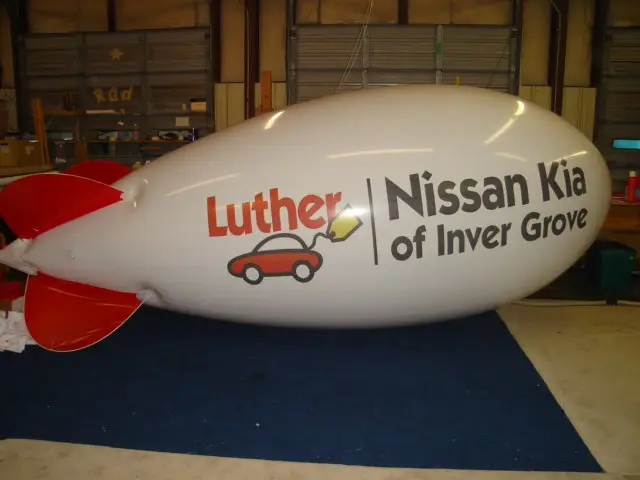
Helium is a recurring cost for any business that uses aerial advertising, so supply conditions affect planning for home builders, auto dealers, and trade show exhibitors. Most of the volatility falls on fill costs, not on the balloon itself. A well-built advertising blimp or large balloon envelope is a durable asset. Seams, valves, and material quality decide how often it needs topping off.
Industry practice is to treat helium as a managed input rather than an afterthought. That means scheduling fills in advance, keeping envelopes in good repair to limit leakage, and leaving a placement up for a longer run instead of deflating and reinflating it repeatedly. Compared with short-lived party balloons, a long-duration promotional balloon or blimp spreads each fill over weeks of exposure. That makes the cost per day of visibility easier to defend when gas is expensive.
Planning Around Supply Risk
Several practical steps follow from the current market. Ask your provider how helium is sourced and whether allocation limits apply to your event dates. Book inflation and rental windows earlier than usual. For short promotions, consider mixing helium-filled pieces with air-filled signage so the budget is not tied entirely to one gas.
Longer-term, analysts cited by Fusion Worldwide and Epignosis point to new sources, including Russian supply sold at a discount, as possible relief. None of those sources offer a firm date for normalization. Marketing managers are better off planning for elevated helium costs through the end of 2026 than waiting for a price drop.
What This Means for Your Marketing
Outdoor and location-based marketing still works because it is physical and hard to ignore. A tethered balloon over a model home, a dealership lot, or a booth entrance gives a location a landmark that digital ads cannot match. A tighter helium market does not change that. It does make it worth planning promotional calendars further ahead.
Treat helium like any other volatile input. Set a budget range, not a single number, and prioritize placements where a balloon will be seen for days or weeks. Home builders running grand openings and auto dealers staging sales events can often schedule around supply windows. Exhibitors with fixed show dates should lock in inflation arrangements early.
If you are weighing options, the team at Arizona Balloon Company can walk through helium advertising balloons and sizing, fill volumes, and run lengths that fit your campaign and budget.
Sources
- Fusion Worldwide: Helium Shortage 2026: Supply Outlook, Pricing, and What Buyers Should Do Now
- Epignosis Insights via OpenPR: Helium Prices 2026 Tracker Report
- Fortune (Associated Press): Iran war halts Qatar helium output, threatening global tech supply chains
- Spectrum News: Helium price increases tied to Middle East conflict