Buying an advertising blimp? Arizona Balloon Company builds custom polyurethane blimps in the USA and ships nationwide — sizes from about 11 to 30 feet, priced roughly $684 to $6,772 depending on size and artwork. Polyurethane holds helium about three times longer than PVC, so your ongoing cost stays low. Call 1-800-791-1445 to buy.
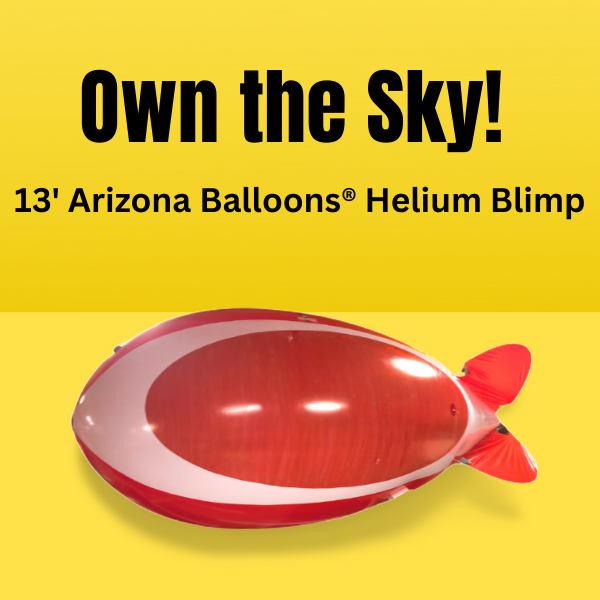
You’ve searched “advertising blimps for sale” and found dozens of options — prices ranging from $664 to over $5,000, sizes from 10 feet to 40 feet, and materials you’ve never heard of. Most sellers won’t tell you what separates a blimp that lasts 10 years from one you’ll be replacing in two. This guide covers everything a first-time or replacement buyer needs to know: sizes and use cases, material differences, total cost of ownership, vendor vetting questions, and real pricing. By the end, you’ll know exactly what to buy — and why.
Advertising Blimp Sizes and What They’re Best For
Blimp size determines visibility range, helium volume required, and the impression count you’ll generate each day. Bigger is not always better — an oversized blimp in a small indoor showroom wastes money and creates handling problems. Use this size guide to match the right blimp to your actual deployment situation.
Size and Daily Impressions: A Quick Reference
A 10 ft blimp is visible from roughly 200–300 feet and works well in contained spaces. A 20 ft blimp is readable from a quarter mile or more on a clear day. At 30 ft and above, roadside visibility can exceed half a mile in open terrain. For car dealerships on a major road or home builder model homes on a busy corridor, a 17–21 ft blimp typically delivers the best combination of cost, helium usage, and daily impression volume.
Find the Right Blimp Size for Your Use Case
Use this tool to get a size recommendation, estimated daily impressions, and a price range from Arizona Balloon Company based on your situation.
Interactive Size Selector
The Material Question: Polyurethane vs. PVC vs. Nylon
Most buyers focus entirely on size and price — and end up buying the wrong product. The single most important variable in a blimp purchase is the envelope material. It determines how often you’ll be filling with helium, how long the blimp lasts, and whether it will hold up through the summer heat or winter cold at your location.
- Typical price: $700–$1,400
- Loses 3–5% helium per day
- Lifespan: 2–3 years
- Stiff and brittle in cold weather
- Cracks and fades under UV exposure and heat
- Mostly imported; limited repair options
- Typical price: $700–$1,200
- Porous — high helium loss rate
- Not suitable for long-term or repeated deployments
- Lightweight but structurally weaker
- Can work for short-term indoor use only
- Not field-repairable
- Price range: $664–$3,130 (10–21 ft)
- 3–5x better helium retention than PVC
- Lifespan: 6–10 years with proper care
- Flexible in both cold and extreme heat (tested at 120°F)
- UV-resistant — won’t crack or fade
- Field-repairable with included repair kit
- Manufactured in the USA by Arizona Balloon Company
5-Year Total Cost of Ownership by Blimp Material
The chart below accounts for purchase price, annual helium costs (adjusted for each material’s retention rate), and replacement costs for PVC (which typically needs replacing by year 3). Polyurethane’s higher upfront cost is offset by dramatically lower helium costs and no replacement needed within 5 years.
Assumptions: PVC — $1,200 purchase, $600/yr helium, $400 replacement at Year 3. | Polyurethane — $2,200 purchase, $300/yr helium. | Nylon — $900 purchase, $900/yr helium.
What to Look for in a Vendor: 7 Questions to Ask Before You Buy
Not all advertising blimp vendors are equal. Some sell blimps manufactured overseas with no quality control and no support after the sale. Use these seven questions to evaluate any vendor before you send money — and see how Arizona Balloon Company answers each one.
-
1. Where is the blimp manufactured?
Many blimps sold in the US are manufactured in China or Southeast Asia. Overseas manufacturing means variable quality, no factory support, and slow replacement parts.
Arizona Balloon Co.: Made in the USA — manufactured in-house in Arizona. -
2. What material is used — polyurethane, PVC, or nylon?
Ask directly. Many vendors will say “heavy-duty vinyl” or “commercial grade” without specifying the actual material. Demand specifics.
Arizona Balloon Co.: 100% polyurethane — the most durable material available for advertising blimps. -
3. What is the stated helium retention rate per day?
PVC typically loses 3–5% of volume per day. Polyurethane loses far less. A lower daily loss rate means fewer helium fills and significantly lower operating costs over time.
Arizona Balloon Co.: Polyurethane retains helium 3–5x longer than PVC; exact retention varies by blimp size and temperature. -
4. Is the blimp field-repairable if punctured?
A punctured blimp that can’t be repaired on-site means lost advertising time and shipping costs for repairs. Polyurethane can be patched quickly in the field.
Arizona Balloon Co.: Yes — every blimp ships with a field repair kit and instructions. -
5. What is the rated wind speed tolerance?
A blimp that tears loose in moderate wind is a liability hazard. Ask for the rated operating wind speed and the maximum safe wind speed before takedown is required.
Arizona Balloon Co.: Blimps are engineered for outdoor deployment; consult the team for specific wind ratings by size. -
6. What is the warranty and what does it cover?
Generic imported blimps often come with 30–90 day warranties that cover almost nothing. A US manufacturer can stand behind its product with real warranty support.
Arizona Balloon Co.: Manufacturer warranty included; contact the team for full terms on your specific blimp size. -
7. What customization options are available (colors, logos, shapes)?
A plain white blimp is a missed opportunity. Custom printing — logos, phone numbers, colors, taglines — multiplies your advertising value. Ask if the vendor can print directly on the envelope.
Arizona Balloon Co.: Full custom printing included — logos, colors, text, all printed directly on the polyurethane envelope. Free artwork mockup with every order.
Total Cost of Ownership Calculator
Use this calculator to estimate your real cost of ownership based on purchase price, helium expenses, and how long you plan to use the blimp. The cost-per-day and cost-per-thousand-impressions figures help you compare advertising blimps to other media buys.
Your TCO Calculator
What’s Included When You Buy from Arizona Balloon Company
Arizona Balloon Company has been manufacturing advertising blimps in the USA for over 40 years. Every blimp order is built to your specifications and ships complete — nothing extra to source or figure out on your own.
Full-color logos, text, phone numbers, and graphics printed directly on the polyurethane envelope. No stickers or vinyl wraps — printed as part of the manufacturing process. Free artwork mockup included before production.
Rated tether lines included and sized for your blimp. Multiple tether points provide stability in wind conditions.
Ground stake or anchor hardware ships with your blimp so you can deploy immediately on arrival.
Step-by-step setup guide. Most customers have their blimp inflated and flying within an hour of their first setup.
Polyurethane patch material and adhesive included. Minor punctures or abrasions can be repaired on-site without sending the blimp in for service.
Manufacturer warranty backed by a US-based team. Phone and email support from the same people who built your blimp.
Advertising Blimp Comparison by Material Type
This table summarizes the key differences between the three main blimp materials sold in the US market. Use it as a reference when evaluating any vendor’s product.
| Feature | Polyurethane (Arizona Balloon Co.) |
PVC (Generic Import) |
Nylon (Generic Import) |
|---|---|---|---|
| Typical Price Range | $664–$3,130 (10–21 ft sizes) |
$700–$1,400 | $700–$1,200 |
| Helium Retention (loss per day) |
Very low — 3–5x better than PVC |
3–5% per day | High loss — not rated for long deployment |
| Expected Lifespan | 6–10 years | 2–3 years | 1–2 years (heavy use) |
| UV & Heat Resistance | Excellent — tested at 120°F+, UV-resistant coating |
Poor — cracks and fades in direct sun/heat |
Fair — fades under extended UV exposure |
| Cold Weather Flexibility | Excellent — remains flexible at low temps |
Poor — becomes brittle and stiff |
Moderate |
| Field Repairable? | Yes — patch kit included | No — typically not repairable on-site |
No — seams and fabric tear unpredictably |
| Country of Manufacture | USA (Arizona) | Primarily imported (China, SE Asia) |
Primarily imported (China, SE Asia) |
| Typical Warranty | Manufacturer warranty; USA-based support |
30–90 days (limited coverage) |
30–60 days (if any) |
Frequently Asked Questions
How much does an advertising blimp cost?
Advertising blimps range from about $664 to $5,000 or more depending on size and material. PVC and nylon blimps from overseas manufacturers typically start around $700–$900 for smaller sizes and climb to $1,400–$2,900 for 20–30 ft sizes. Arizona Balloon Company’s polyurethane blimps — made in the USA — range from $664 for a 10 ft blimp to $3,130 for a 21 ft blimp, with prices available for sizes across the 10–21 ft range. Polyurethane costs more upfront but is significantly cheaper over a 5-year ownership window due to lower helium consumption and no need for early replacement. Custom printing and hardware are included in the price.
How long does an advertising blimp last?
Lifespan depends almost entirely on the envelope material. PVC blimps typically last 2–3 years under regular outdoor use — UV exposure and heat accelerate cracking and seam failure. Nylon blimps may last 1–2 years with heavy use before helium retention becomes unacceptably poor. Polyurethane blimps from Arizona Balloon Company are built to last 6–10 years with normal care. The material is UV-resistant, stays flexible in both extreme heat and cold, and is field-repairable if punctured. The difference in lifespan alone justifies much of the price premium over lower-cost alternatives.
How much helium does an advertising blimp need?
Helium requirements scale with blimp volume. A 10 ft advertising blimp requires approximately 150–200 cubic feet of helium for initial inflation. A 20 ft blimp requires roughly 600–800 cubic feet, and a 30 ft blimp can require 1,500–1,800 cubic feet or more. After initial inflation, ongoing top-offs are needed to maintain proper flight pressure. With PVC, you may be topping off every 3–5 days. With polyurethane, helium retention is 3–5x better, meaning significantly fewer fills and lower ongoing helium costs — often $25–$50 per month less depending on local helium pricing and blimp size. Over a 5-year period, this difference adds up to hundreds or thousands of dollars in savings.
Can I fly an advertising blimp anywhere?
Tethered advertising blimps are regulated under FAA Part 101. The key rules to know: you must keep the blimp below 500 feet AGL (above ground level); if you fly above 150 feet AGL, you must notify Air Traffic Control in advance; and you may not operate in Class B, C, or D controlled airspace without explicit ATC authorization. For the vast majority of advertising deployments — parking lots, construction sites, car dealerships, strip malls, model home communities — you will be flying well under 150 feet and no prior notification is required. Always verify with your local FAA Flight Standards District Office (FSDO) if your location is near an airport or in question. State and local permits may also apply for certain events.
What’s the difference between an advertising blimp and an advertising balloon?
The key difference is shape. An advertising blimp has a streamlined, elongated aerodynamic body — similar in profile to a Goodyear blimp — that allows it to orient into the wind and fly level. This shape makes it more visible and readable from a distance, especially when printed with a logo or message. A spherical advertising balloon is round, like a giant ball. Both are helium-filled and tethered. Blimps are generally more effective for roadside advertising because the flat sides provide a larger, more stable printable surface that faces traffic. For maximum brand visibility at range, advertising blimps typically outperform spherical balloons of the same volume.
Ready to Buy? Here’s Your Decision Framework
If you’re shopping for an advertising blimp, the buying decision comes down to three questions. First, what size fits your deployment location and traffic volume — use the size selector above if you’re not sure. Second, what material envelope are you getting — if the vendor can’t confirm polyurethane or at minimum provide helium retention data and a material spec, keep looking. Third, who stands behind the product after the sale — a US manufacturer with 40+ years of experience is a very different proposition from an overseas importer with a 30-day warranty.
Arizona Balloon Company manufactures polyurethane advertising blimps in the USA, ships complete packages nationwide, and has been doing it for over four decades. Prices start at $664 for a 10 ft blimp and go up to $3,130 for a 21 ft blimp — all custom printed with your logo and colors, with tether hardware, a repair kit, and ongoing support included. Lead time on custom orders is typically 3–5 weeks. Every order includes a free artwork mockup so you can see your logo on the blimp before production begins.
Get a Free Quote & Artwork Mockup
Talk to the only US manufacturer of polyurethane advertising blimps. No pressure, no overseas call center — just a straightforward conversation about the right blimp for your business.
Free artwork mockup included with every order — see your logo on your blimp before we build it.
Advertising Blimps for Sale – Made in USA
You can see more at AdvertisingBlimps.com.
Call 1-800-791-1445 for advertising blimps for sale.