
Short answer: Polyurethane. A PVC advertising blimp loses 3 to 5 percent of its helium every day through the wall of the envelope, with no leak. A polyurethane blimp loses under 1 percent. At today’s helium price that gap costs you between $360 and $730 in top-offs over one 90-day campaign, and between $7,300 and $14,800 over five years of daily flying. PVC film is also twice as heavy per square foot, so a 13 ft PVC blimp with the same helium has no lift to spare and will not hold a tether in a breeze. I have built advertising blimps in Glendale, Arizona since 1979. I build in polyurethane and I do not sell PVC. Below I show the arithmetic, so you can check it, and I say when PVC is actually the right choice.
Why a blimp deflates with no hole in it
Helium atoms are small enough to pass straight through PVC film. The envelope does not need a hole. The material itself is porous to helium. Polyurethane film has a tighter molecular structure, so far less helium gets through.
This is why a PVC blimp that was firm on Friday sags by Tuesday. Nothing is wrong with it. It is doing what PVC does.
How much helium each material loses per day
PVC: 3 to 5 percent of the helium in the blimp, every day. Polyurethane: under 1 percent per day. These are the figures I use for planning, and they match what I see in the field.
Left alone for 30 days with no top-off, a polyurethane blimp still holds about 74 percent of its helium. A PVC blimp holds about 40 percent, or as little as 21 percent at the high end of its loss range.
How often you will top it off
A blimp needs a top-off when it drops to about 85 percent full. Below that it loses shape and lift. At 1 percent a day, a polyurethane blimp reaches 85 percent in about 16 days. At 3 percent a day, PVC gets there in 5 days. At 5 percent, in 3 days.
Over a 90-day campaign that is about 6 top-offs for polyurethane against 17 to 28 for PVC.
What that costs in helium
I pay $250 for 200 cubic feet of helium delivered, which is $1.25 per cubic foot. A 13 ft blimp holds 170 cubic feet, so the first fill is $212.50 for either material. Each top-off puts back 15 percent, which is 25.5 cubic feet, or about $32.
| 13 ft blimp, 170 cu ft | Polyurethane (1%/day) | PVC (3%/day) | PVC (5%/day) |
|---|---|---|---|
| Days between top-offs | 16 | 5 | 3 |
| Top-offs in 90 days | 6 | 17 | 28 |
| Top-off helium, 90 days | 142 cu ft | 430 cu ft | 724 cu ft |
| Top-off cost, 90 days | $177 | $538 | $905 |
| Top-off cost, one year of daily flying | $719 | $2,181 | $3,672 |
| Top-off cost, five years of daily flying | $3,597 | $10,903 | $18,360 |
So polyurethane uses about one third of the top-off helium that PVC needs at the low end of PVC’s loss range, and about one fifth at the high end. This table gives PVC the benefit of the doubt and assumes the same 170 cubic feet. A real 13 ft PVC blimp holds about 290 cubic feet, for the reason explained below, which makes its top-offs $911 to $1,534 per 90 days.
Is polyurethane worth the extra cost?
Yes, if you will fly the blimp more than one weekend. My 13 ft blimp with lettering on both sides is $1,512, and five years of service is a reasonable expectation with normal care. The helium saving alone against a PVC blimp is $360 to $730 per 90-day campaign. Fly it for two seasons and the helium saving has paid the difference in price.
A 13 ft PVC blimp sells for about $460. That is the whole case for PVC, so here is what it costs after you own it. Five years of one 90-day campaign each year looks like this for polyurethane: blimp $1,512, five first fills $1,063, top-offs $887. Total $3,462. PVC film loses most of its strength to sun inside a year, so you replace it every year or two. The same five years in PVC: blimps $1,380 to $2,300, first fills $1,063, top-offs $2,688 to $4,527. Total $5,131 to $7,890.
Fly it daily, like a car lot does, and the five-year totals are $5,322 for polyurethane against $13,416 to $20,873 for PVC. The $460 blimp is the most expensive one on the lot.
Why a PVC blimp will not fly in a breeze
PVC film is heavy. My 13 ft polyurethane blimp has 3.2 pounds of net lift after the envelope, fins, valve and rigging are all counted. Build the same blimp in PVC and the net lift is zero or less. It lifts itself and nothing else, so the first breeze pushes it down the tether.
The numbers. My polyurethane film is 3.5 mil thick, which is 0.089 mm. Typical PVC blimp film is 0.18 mm, twice as thick, and PVC is also a denser plastic, about 1.30 grams per cubic centimeter against 1.20 for polyurethane. So a square meter of PVC film weighs about 234 grams and a square meter of polyurethane weighs about 107 grams. PVC is 2.2 times heavier per square foot.
A 13 ft blimp has about 195 square feet of envelope, fins and seams included. In polyurethane that envelope weighs about 4.3 pounds. In PVC it weighs about 9.3 pounds. Helium lifts about 11 pounds per 170 cubic feet at sea level, and about 10.3 pounds in Glendale in summer, because thin hot air lifts less. Take away the envelope, then the valve, rigging and tether hardware, and my polyurethane blimp has 3.2 pounds left to fly straight in a breeze. The same hardware on a 170 cubic foot PVC envelope leaves nothing. It cannot fly at all in Glendale summer air.
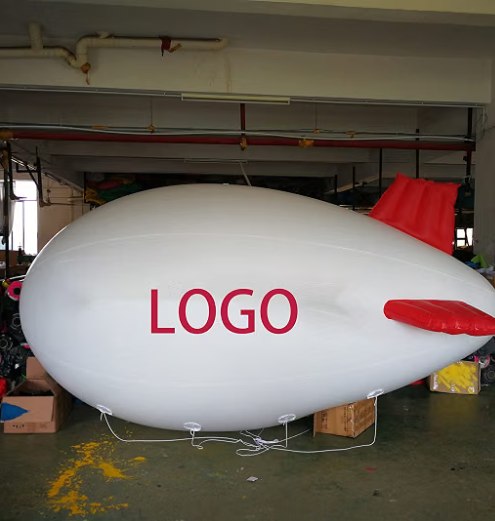
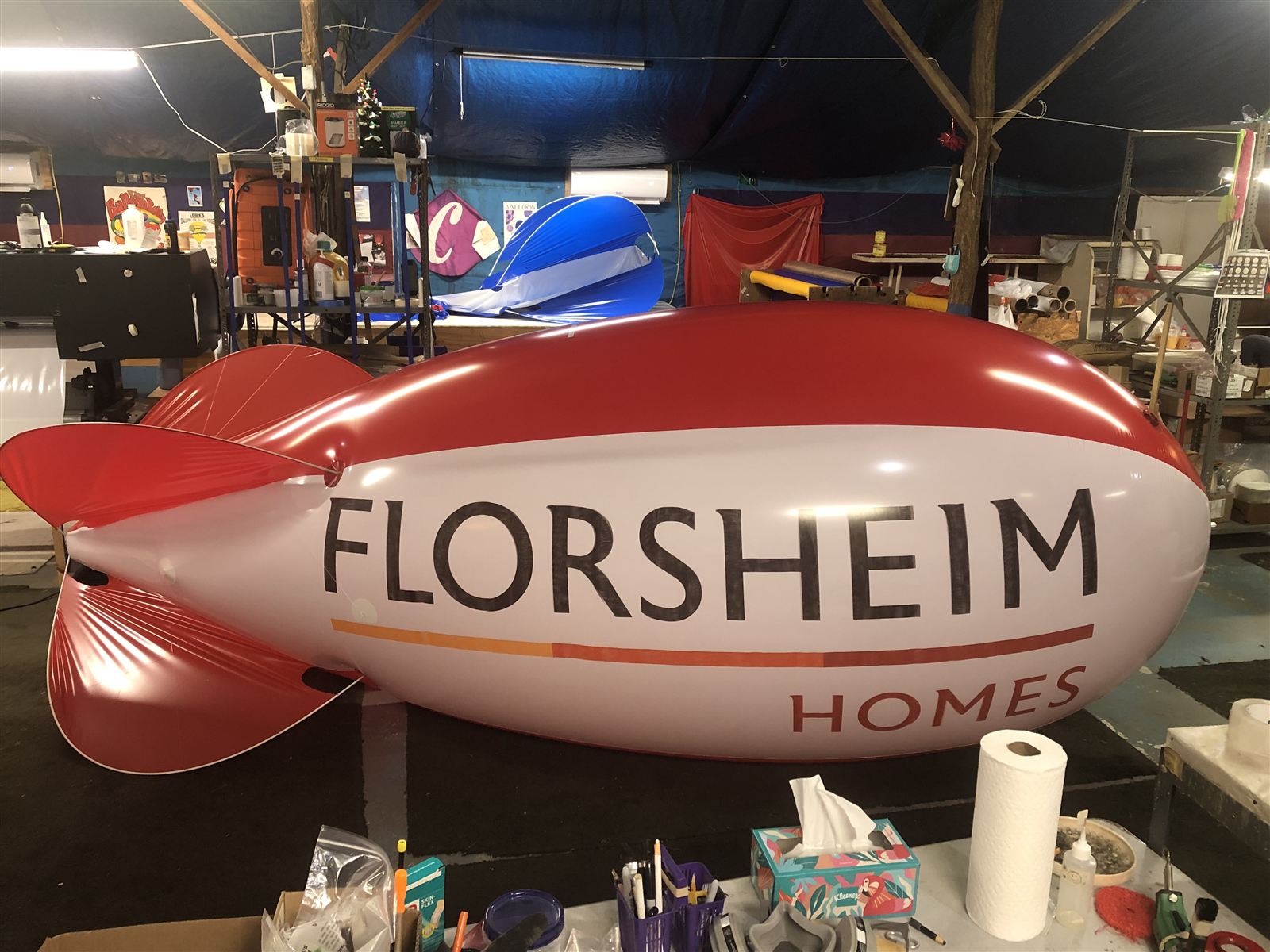
PVC makers know this, so they make the blimp fat. Look at a 13 ft PVC blimp next to one of mine. Mine is about 5 ft across. The PVC one is about 6.5 ft across, twice as long as it is wide. That fat body holds about 290 cubic feet of helium instead of 170. It has to, to lift its own skin.
Here is what the fat body costs. The first fill is $360 instead of $213. The top-offs over 90 days are $911 to $1,534 instead of $177, because there is 70 percent more helium leaking through twice as much wall. And after all that helium, the fat PVC blimp still has only about 2 pounds of net lift against 3.2 for mine, because the bigger skin and its inflatable fins weigh about 12.6 pounds before any hardware goes on.
The fat body also catches wind. Its frontal area is 33 square feet against 20 for a polyurethane 13 ft blimp. That is 70 percent more drag in the same breeze, on a blimp with less spare lift to fight it. This is why the PVC blimp lies down on its tether and mine points into the wind.
Fins: bags versus wings
PVC blimps use inflatable PVC fins. They are bags. They add about 1.2 pounds of skin, they need their own air or helium, and they flex in wind, so they steer nothing. A blimp with soft fins swings on its tether and turns its logo away from the road.
My fins are stretched polyurethane over a curved 14 inch fiberglass rod. The four fins together weigh under half a pound. They stay tight and flat, so they work as a tail. The blimp weathervanes into the wind and holds its heading, and the lettering stays broadside to traffic.
How long does a polyurethane blimp last?
Five years of repeat use is a reasonable expectation, not a stretch. Store it clean, dry, out of direct sun, and away from sharp edges. I have an Auto Sale blimp that has been in the field for five years and is still flying.
PVC film goes brittle and dull in sunlight. Expect a PVC blimp that flies outdoors to look tired inside one season and to fail inside two.
Which holds up better in cold and heat?
Polyurethane stays flexible from about -90°F to 185°F. PVC works from about -50°F to 175°F and goes stiff in the cold, which is when seams crack. In Arizona the heat matters more than the cold, and polyurethane handles a summer roof line without softening.
Can a PVC blimp be repaired or upgraded?
A puncture in PVC can be patched, but the helium loss through the wall cannot be fixed. That is the material, not the damage. There is no upgrade path. If you have a PVC blimp that will not stay up, the fix is a polyurethane blimp.
Is PVC safe?
PVC film uses plasticizers to stay flexible, and cheap PVC off-gasses when it is hot. It is not a health hazard flying on a tether outdoors. It does smell in a warm storage room. Polyurethane has no plasticizers to lose, which is also why it does not go brittle.
When PVC is the right choice
PVC is right when the blimp will fly once, for one or two days, and then be thrown away. A one-day grand opening. A single trade show weekend where you do not want to store anything afterward. In that case the extra helium is one or two top-offs, and the lower purchase price wins. I would still rent a polyurethane blimp for that job, but I understand buying PVC for it.
PVC is wrong for a car dealership, a model home, a seasonal lot, or anything that flies every day. The top-offs cost more than the blimp within one season.
Should I rent or buy?
Rent for a one-time event or to test a location. Buy if you will fly more than about three weekends a year. Polyurethane is what makes rental work at all. A PVC blimp loses too much helium in a weekend for a rental to pay.
Who makes polyurethane advertising blimps in the USA?
Arizona Balloon Company does. I am Johnny Mulder, and I have built helium advertising blimps in the same Glendale, Arizona shop since 1979. I have shipped polyurethane blimps to NASA, the Jet Propulsion Laboratory, the U.S. Navy, Arizona State University and the National Institutes of Health. Every blimp is warrantied one year on workmanship and two years on material.
Sizes run from 10 ft (105 cu ft) to 30 ft (1,510 cu ft). Prices and lift figures are on the advertising blimps page.
Tell me your location and I will tell you what size will fly there.