Every balloon we ship goes out with instructions, but the two questions we get on the phone are always the same: what exactly do I connect the helium to, and how do I tie this thing down without damaging my building?
So here are the actual photographs, from our own yard and our own installs. Not diagrams. The real fittings, the real screw eye, the real tank.
What you need before you start
- Helium. Bought locally from a welding-gas or party supplier. A 200 cubic foot cylinder runs around $300 and fills a 13 ft blimp (170 cu ft) with room to spare.
- A brass helium fitting, also called an inert fitting. This is the part that connects your hose to the tank. We sell the hose with the fitting already attached for $45.
- Tether line and an anchor point. More on that below.
You do not need a regulator to fill a balloon. You are not metering pressure, you are moving gas from a tank into a bag.
Step 1 — find the valve opening on the tank
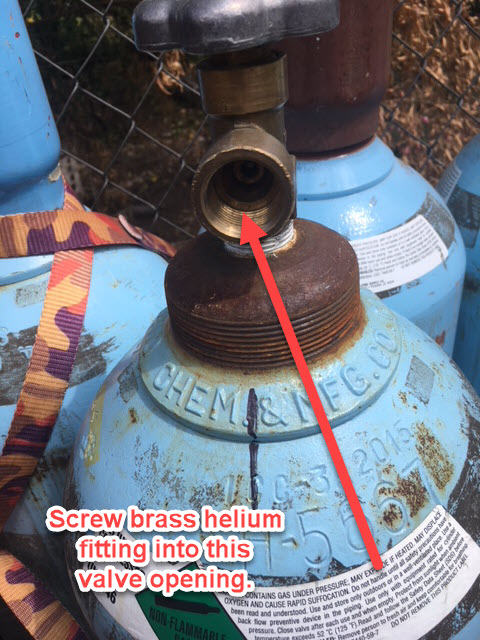
The cylinder will say HELIUM, COMPRESSED and carry a UN1046 label. If it does not say helium, do not connect anything to it. Oxygen and helium cylinders look similar and are not interchangeable.
Step 2 — connect the hose
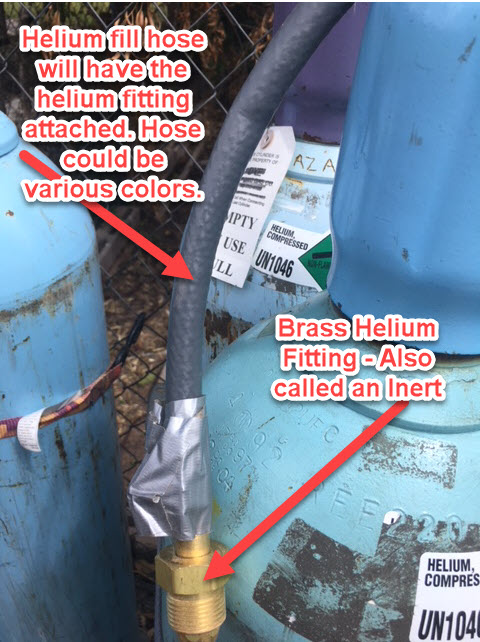
Screw the fitting in by hand, then snug it with a wrench. It does not need to be tight enough to strain. If it hisses, back it off and reseat it rather than forcing it.
Step 3 — fill slowly, and stop before it is hard
Open the tank valve gently. A balloon fills faster than people expect, and the mistake we see most often is overfilling.
A correctly filled balloon is firm, not hard. It should give slightly under your palm. Desert sun heats the gas and expands it through the afternoon, so a balloon filled hard at 7am is under real strain by 2pm. Leave it room.
Step 4 — tether it properly
This is the part that gets asked about most, because it involves putting a screw into a building.
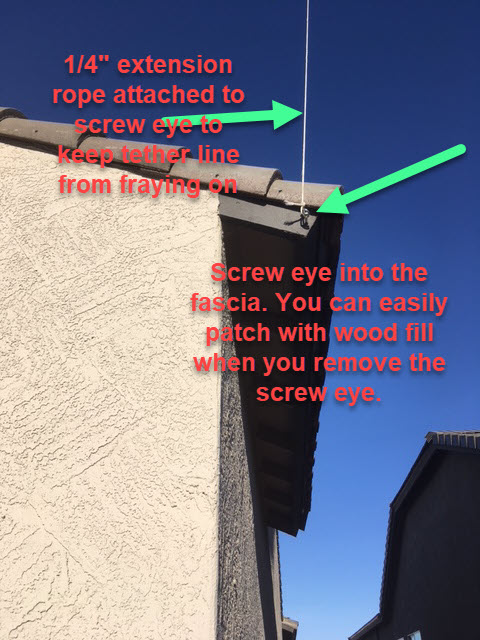
Two things worth knowing about that photo:
- The screw eye is repairable. When you take it out, the hole patches with wood filler. That is the whole repair.
- The rope extension is not optional. A tether line rubbing directly on a metal eye will fray through. The short rope wears instead, and rope is cheap.
How many tether points?
Two or three, spread apart, not one. A single line lets the balloon swing into whatever it is tied near. Spacing your anchor points fifteen to thirty feet apart holds it steadier and puts far less load on any one point.
Topping off
Polyurethane loses roughly 1% of its helium per day. In practice that means a top-off every three to seven days for a permanent display, and none at all for a weekend event or a three-day trade show — one fill covers it.
Keep the tank. You will use it again, and a cylinder holds enough for several fills of a mid-size balloon.
What not to do
- Do not fly near power lines. Not close, not “probably fine”. This is the one rule with no flexibility in it.
- Do not fill it hard. Heat expands the gas. Firm, not tight.
- Do not tether to a gutter. Gutters tear. Fascia, a post, or a ground anchor.
- Do not leave it up in a storm warning. Bring it down. Monsoon wind will take a balloon and whatever it is tied to.
Questions we get
Do I need a regulator?
No. You are filling a bag, not running a torch. The brass fitting and hose are all that connect the tank to the balloon.
Where do I buy helium?
Any welding-gas supplier, and most party suppliers. Ask for a 200 cubic foot cylinder and tell them it is for a balloon — they will know what you need.
How long does a fill last?
About 1% loss per day. A weekend event needs one fill. A permanent display wants topping off weekly.
Can I refill it myself, or do you have to come out?
You can do it yourself — that is what this page is for. We also service balloons in the Phoenix and Tucson areas if you would rather not.
What if it gets a hole?
Polyurethane is repairable. Send us a photo of the damage and we will tell you whether it is a patch or a rebuild.
Still stuck? Call 1-800-791-1445. We would rather talk you through it than have you guess.